
NEET Evolution PYQ practice sheet
20 previous-year NEET Zoology questions from Evolution, newest papers first. Evolution carries 25 of the Zoology questions in NEET 2020 to 2026, so this is a good place to test yourself after revising the chapter. Marking: +4 correct, −1 wrong.
- 1.
RE-NEET 2026
Natural selection can lead to _________. (a) stabilisation (b) genetic drift (c) directional change (d) disruption Choose the correct answer from the options given below :- (A)(a) and (c) only
- (B)(a) only
- (C)(a), (b), (c) and (d)
- (D)(a), (c) and (d) only
- (A)
- 2.
RE-NEET 2026
A population of diploid organisms is at Hardy-Weinberg equilibrium. If the frequency of allele A is 0.1, the frequency of AA is ________.- (A)0.02
- (B)0.99
- (C)0.01
- (D)0.10
- (A)
- 3.
RE-NEET 2026
Which of the following is not evidence for evolution?- (A)Convergent evolution of traits like wings of birds and butterflies
- (B)Embryological support for evolution as proposed by Ernst Heckel
- (C)Paleontological evidence from fossil records
- (D)Divergent evolution of anatomical structures such as forelimbs
- (A)
- 4.
RE-NEET 2026
Given below are two statements : Statement I : Modern Homo sapiens arose in Australia and moved across continents. Statement II : Homo sapiens arose around 75000 to 10000 years ago. In the light of the above statements, choose the most appropriate answer from the options given below :- (A)Both Statement I and Statement II are correct
- (B)Both Statement I and Statement II are incorrect
- (C)Statement I is correct but Statement II is incorrect
- (D)Statement I is incorrect but Statement II is correct
- (A)
- 5.
RE-NEET 2026
Adaptive radiation in placental mammals and Australian Marsupials leading to similarity between distant species is an example of ________.- (A)convergent evolution
- (B)genetic drift
- (C)founder effect
- (D)divergent evolution
- (A)
- 6.
RE-NEET 2026
Given below are two statements : one is labelled as Assertion A and the other is labelled as Reason R. Assertion A : Forelimbs of human and bats are homologous. Reason R : Forelimbs of humans and bats have similar anatomical structure. In the light of the above statements, choose the most appropriate answer from the options given below.- (A)Both A and R are correct and R is the correct explanation of A
- (B)Both A and R are true, but R is not the correct explanation of A
- (C)A is true but R is false
- (D)A is false but R is true
- (A)
- 7.
NEET 2026
Which of the following is not an example of convergent evolution?- (A)Fore limbs of whales and bats
- (B)Wings of butterflies and birds
- (C)Flippers of penguins and dolphins
- (D)Eyes of octopuses and mammals
- (A)
- 8.
NEET 2026
Match List I with List II with respect to chronology of evolution of life forms: List-I: A. About 65 mya, B. About 500 mya, C. About 350 mya, D. About 320 mya List-II: (I) Jawless fish probably evolved, (II) The dinosaurs suddenly disappeared from the earth, (III) Seaweeds and few plants probably existed, (IV) Invertebrates were formed and became active Choose the correct answer from the options given below:- (A)A(II), B(IV), C(I), D(III)
- (B)A(III), B(IV), C(I), D(II)
- (C)A(II), B(IV), C(III), D(I)
- (D)A(I), B(II), C(III), D(IV)
- (A)
- 9.
NEET 2026
Evolution of human appears parallel to the progressive development of brain and language skills. As such, the evolution of individual species in the sequence of their appearance is:- (A)Ramapithecus Homo habilis Homo erectus Neanderthal Homo sapiens
- (B)Homo sapiens Ramapithecus Homo habilis Neanderthal Homo erectus
- (C)Neanderthal Ramapithecus Homo habilis Homo erectus Homo sapiens
- (D)Homo habilis Homo erectus Ramapithecus Neanderthal Homo sapiens
- (A)
- 10.
NEET 2024
The flippers of the Penguins and Dolphins are the example of the- (A)Adaptive radiation
- (B)Natural selection
- (C)Divergent evolution
- (D)Convergent evolution
- (A)
- 11.
NEET 2024
Which one of the following factors will not affect the Hardy-Weinberg equilibrium?- (A)Genetic recombination
- (B)Constant gene pool
- (C)Gene migration
- (D)Genetic drift
- (A)
- 12.
NEET 2024
Given below are some stages of human evolution. Arrange them in correct sequence (Past to Recent). A. Homo habilis B. Homo sapiens C. Homo neanderthalensis D. Homo erectus Choose the correct sequence of human evolution from the options given below:- (A)D-A-C-B
- (B)A-D-C-B
- (C)B-A-D-C
- (D)C-B-D-A
- (A)
- 13.
NEET 2024
Match List I with List II: List-I: A. Mesozoic Era, B. Proterozoic Era, C. Cenozoic Era, D. Paleozoic Era List-II: I. Lower invertebrates, II. Fish & Amphibia, III. Birds & Reptiles, IV. Mammals Choose the correct answer from the options given below:- (A)A-I, B-II, C-IV, D-III
- (B)A-III, B-I, C-IV, D-II
- (C)A-III, B-I, C-II, D-IV
- (D)A-II, B-I, C-III, D-IV
- (A)
- 14.
NEET 2023
Select the correct group/set of Australian Marsupials exhibiting adaptive radiation.- (A)Lemur, Anteater, Wolf
- (B)Tasmanian wolf, Bobcat, Marsupial mole
- (C)Numbat, Spotted cuscus, Flying phalanger
- (D)Mole, Flying squirrel, Tasmanian tiger cat
- (A)
- 15.
NEET 2022
Natural selection, where more individuals acquire a specific character value other than the mean character value, leads to:- (A)Random change
- (B)Stabilising change
- (C)Directional change
- (D)Disruptive change
- (A)
- 16.
NEET 2022
Which of the following statements is not true?- (A)Flippers of penguins and dolphins are a pair of homologous organs.
- (B)Analogous structures are a result of convergent evolution.
- (C)Sweet potato and potato is an example of analogy.
- (D)Homology indicates common ancestry.
- (A)
- 17.
NEET 2021
The factor that leads to Founder effect in a population is :- (A)Natural selection
- (B)Mutation
- (C)Genetic drift
- (D)Genetic recombination
- (A)
- 18.
NEET 2021
Match List - I with List - II.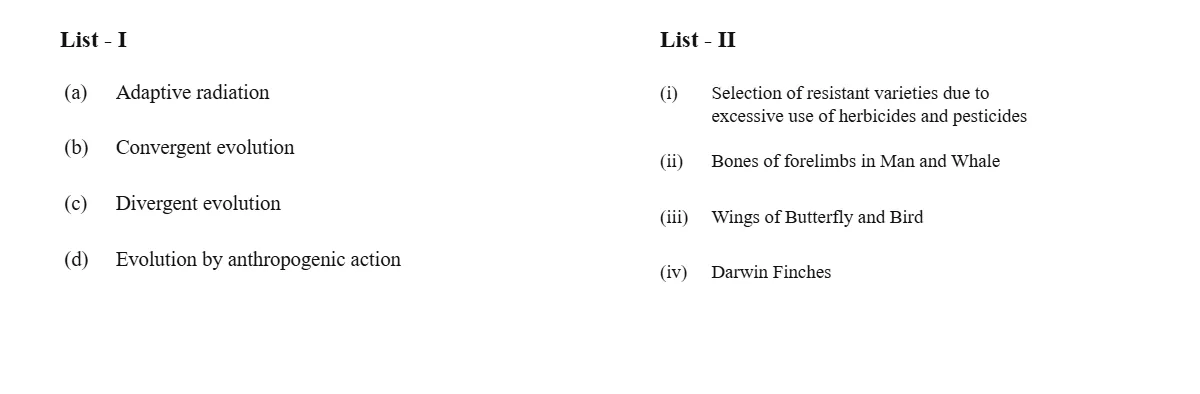 Choose the correct answer from the options given below.
- (A)(a)-(ii), (b)-(i), (c)-(iv), (d)-(iii)
- (B)(a)-(i), (b)-(iv), (c)-(iii), (d)-(ii)
- (C)(a)-(iii), (b)-(ii), (c)-(i), (d)-(iv)
- (D)(a)-(iv), (b)-(iii), (c)-(ii), (d)-(i)
- (A)
- 19.
NEET 2020
From his experiments, S.L. Miller produced amino acids by mixing the following in a closed flask :- (A), , and water vapor at C
- (B), , and water vapor at C
- (C), , and water vapor at C
- (D), , and water vapor at C
- (A)
- 20.
NEET 2020
Flippers of Penguins and Dolphins are examples of :- (A)Adaptive radiation
- (B)Convergent evolution
- (C)Industrial melanism
- (D)Natural selection
- (A)
Answer key
The answer key and step-by-step solutions are free with an Edurack account.
Log in to unlock