
NEET Ray Optics and Optical Instruments PYQ practice sheet
19 previous-year NEET Physics questions from Ray Optics and Optical Instruments, newest papers first. Ray Optics and Optical Instruments carries 21 of the Physics questions in NEET 2020 to 2026, so this is a good place to test yourself after revising the chapter. Marking: +4 correct, −1 wrong.
- 1.
RE-NEET 2026
Which of the following measurements require 'index correction'?- (A)Measurement of speed of sound using resonance tube
- (B)Measurement of resistance of a wire using meter bridge
- (C)Measurement of focal length of lenses using optical bench
- (D)Measurement of gravitational acceleration using simple pendulum
- (A)
- 2.
RE-NEET 2026
Consider three media , and with refractive indices , , and respectively. The medium having a thickness of cm is placed between extended media and as shown in the figure. An object is placed at the centre of medium . If viewed from medium near the normal direction, the apparent depth of is . For similar observation from medium , the apparent depth is . The value of , in cm, is: Figure: slab (, thickness cm) has medium () above it and medium () below it. The object is at the middle of , cm from each face.
- (A)
- (B)
- (C)
- (D)
- (A)
- 3.
RE-NEET 2026
The lens combination as shown in the figure, consists of two lenses, and , of the focal lengths cm and cm, respectively. The position of the image formed is: Figure: a convex lens ( cm) and a concave lens ( cm) placed cm apart on the same axis. The object is cm to the left of .
- (A)cm to the right of the concave lens
- (B)cm to the right of the concave lens
- (C)cm to the left of the concave lens
- (D)cm to the left of the concave lens
- (A)
- 4.
NEET 2026
A ray of monochromatic light is passing through an equilateral prism () as shown in the figure. The refracted ray () is parallel to its base () and the angle of incidence () is . Then the angle of deviation () is: The ray enters face , travels along parallel to the base , and leaves face along . The prism angle is .
- (A)
- (B)
- (C)
- (D)
- (A)
- 5.
NEET 2026
In a concave lens, a ray of light emanating from the object parallel to the principal axis of the lens after refraction: The figure shows a parallel ray striking a concave (diverging) lens, which bends the ray away from the axis so that it appears to come from a point on the object side of the lens.
- (A)passes through , which is the radius of curvature of the lens.
- (B)appears to diverge from the first principal focus.
- (C)passes through the second principal focus.
- (D)emerges parallel to the principal axis.
- (A)
- 6.
NEET 2024
A light ray enters through a right angled prism at point with the angle of incidence as shown in figure. It travels through the prism parallel to its base and emerges along the face . The refractive index of the prism is: The prism is right-angled at . The ray falls on face at , runs parallel to the base inside the prism, and leaves along the surface (grazing emergence).
- (A)
- (B)
- (C)
- (D)
- (A)
- 7.
NEET 2024
A small telescope has an objective of focal length 140 cm and an eye piece of focal length 5.0 cm. The magnifying power of telescope for viewing a distant object is:- (A)32
- (B)28
- (C)34
- (D)17
- (A)
- 8.
NEET 2023
Light travels a distance in time in air and in time in another denser medium. What is the critical angle for this medium?- (A)
- (B)
- (C)
- (D)
- (A)
- 9.
NEET 2023
In the figure shown here, what is the equivalent focal length of the combination of lenses (Assume that all layers are thin)?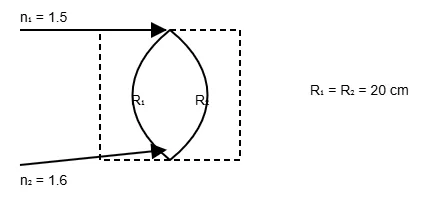 A biconvex lens of refractive index with both radii of curvature is surrounded (on both its sides) by a medium of refractive index .
- (A)
- (B)
- (C)
- (D)
- (A)
- 10.
NEET 2023
Two thin lenses are of same focal lengths (), but one is convex and the other one is concave. When they are placed in contact with each other, the equivalent focal length of the combination will be :- (A)Infinite
- (B)Zero
- (C)
- (D)
- (A)
- 11.
NEET 2022
A biconvex lens has radii of curvature, 20 cm each. If the refractive index of the material of the lens is 1.5, the power of the lens is:- (A)infinity
- (B)+2D
- (C)+20 D
- (D)+5D
- (A)
- 12.
NEET 2022
A light ray falls on a glass surface of refractive index , at an angle 60°. The angle between the refracted and reflected rays would be:- (A)
- (B)
- (C)
- (D)
- (A)
- 13.
NEET 2022
Two transparent media A and B are separated by a plane boundary. The speeds of light in those media are m/s and m/s, respectively. The critical angle for a ray of light for these two media is:- (A)
- (B)
- (C)
- (D)
- (A)
- 14.
NEET 2021
A lens of large focal length and large aperture is best suited as an objective of an astronomical telescope since :- (A)a large aperture provides a better resolution.
- (B)a large area of the objective ensures better light gathering power.
- (C)a large aperture contributes to the quality and visibility of the images.
- (D)all of the above.
- (A)
- 15.
NEET 2021
A convex lens 'A' of focal length and a concave lens 'B' of focal length are kept along the same axis with a distance 'd' between them. If a parallel beam of light falling on 'A' leaves 'B' as a parallel beam, then the distance 'd' in cm will be :- (A)30
- (B)15
- (C)25
- (D)50
- (A)
- 16.
NEET 2021
Find the value of the angle of emergence from the prism. Refractive index of the glass is . Figure: a right-angled prism ABC with the right angle at B (vertical face AB on the left, horizontal base BC) and an angle of at C, so the hypotenuse AC makes with the base. A ray of light falls on the hypotenuse AC normally (perpendicular to AC), and travels inside the prism towards the vertical face AB.
- (A)
- (B)
- (C)
- (D)
- (A)
- 17.
NEET 2021
A point object is placed at a distance of from a convex lens of focal length . If a plane mirror were put perpendicular to the principal axis of the lens and at a distance of from it, the final image would be formed at a distance of : Figure: the object O is on the principal axis, to the left of the convex lens. A plane mirror perpendicular to the axis is to the right of the lens.
- (A)20 cm from the lens, it would be a real image.
- (B)30 cm from the lens, it would be a real image.
- (C)20 cm from the plane mirror, it would be a virtual image.
- (D)30 cm from the plane mirror, it would be a virtual image.
- (A)
- 18.
NEET 2020
A ray is incident at an angle of incidence on one surface of a small angle prism (with angle of prism ) and emerges normally from the opposite surface. If the refractive index of the material of the prism is , then the angle of incidence is nearly equal to :- (A)
- (B)
- (C)
- (D)
- (A)
- 19.
NEET 2020
Assume that light of wavelength nm is coming from a star. The limit of resolution of telescope whose objective has a diameter of m is :- (A)rad
- (B)rad
- (C)rad
- (D)rad
- (A)
Answer key
The answer key and step-by-step solutions are free with an Edurack account.
Log in to unlock