
NEET Hydrogen PYQ practice sheet
5 previous-year NEET Chemistry questions from Hydrogen, newest papers first. Hydrogen carries 4 of the Chemistry questions in NEET 2020 to 2026, so this is a good place to test yourself after revising the chapter. Marking: +4 correct, −1 wrong.
- 1.
NEET 2026
Methane reacts with steam at 1273 K in the presence of nickel catalyst to form:- (A)and
- (B)CO and
- (C)and
- (D)CO and
- (A)
- 2.
NEET 2023
Which of the following statements are NOT correct? A. Hydrogen is used to reduce heavy metal oxides to metals. B. Heavy water is used to study reaction mechanism. C. Hydrogen is used to make saturated fats from oils. D. The H-H bond dissociation enthalpy is lowest as compared to a single bond between two atoms of any element. E. Hydrogen reduces oxides of metals that are more active than iron. Choose the most appropriate answer from the options given below :- (A)A, B, C only
- (B)B, C, D, E only
- (C)B, D only
- (D)D, E only
- (A)
- 3.
NEET 2022
Match List - I with List - II: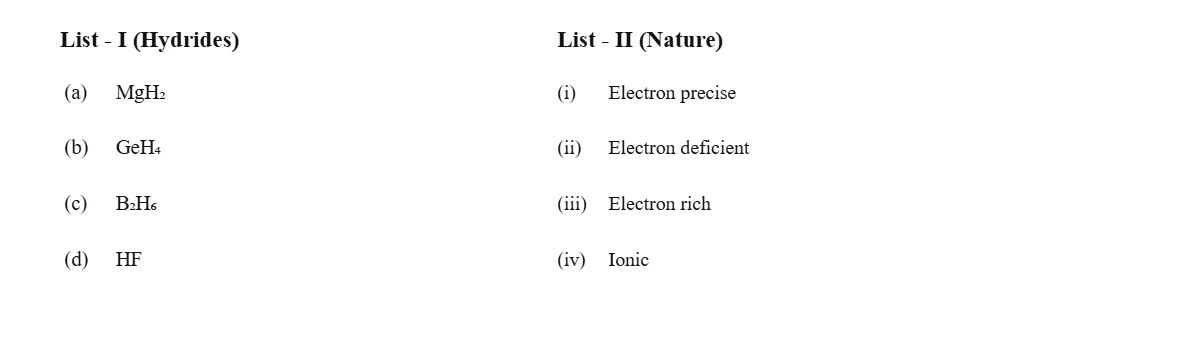 Choose the correct answer from the options given below:
- (A)(a)-(ii), (b)-(iii), (c)-(iv), (d)-(i)
- (B)(a)-(iv), (b)-(i), (c)-(ii), (d)-(iii)
- (C)(a)-(iii), (b)-(i), (c)-(ii), (d)-(iv)
- (D)(a)-(i), (b)-(ii), (c)-(iv), (d)-(iii)
- (A)
- 4.
NEET 2021
Tritium, a radioactive isotope of hydrogen, emits which of the following particles ?- (A)Neutron (n)
- (B)Gamma ()
- (C)Beta ()
- (D)Alpha ()
- (A)
- 5.
NEET 2020
Match the following and identify the correct option.
- (A)(a)-(iii), (b)-(i), (c)-(ii), (d)-(iv)
- (B)(a)-(iii), (b)-(ii), (c)-(i), (d)-(iv)
- (C)(a)-(iii), (b)-(iv), (c)-(ii), (d)-(i)
- (D)(a)-(i), (b)-(iii), (c)-(ii), (d)-(iv)
- (A)
Answer key
The answer key and step-by-step solutions are free with an Edurack account.
Log in to unlock