
NEET Coordination Compounds PYQ practice sheet
19 previous-year NEET Chemistry questions from Coordination Compounds, newest papers first. Coordination Compounds carries 26 of the Chemistry questions in NEET 2020 to 2026, so this is a good place to test yourself after revising the chapter. Marking: +4 correct, −1 wrong.
- 1.
RE-NEET 2026
Given below are two statements: Statement-I : is chiral. Statement-II : is chiral. (Given : ) In light of the above statements, choose the most appropriate answer from the options given below:- (A)Both Statement-I and Statement-II are correct
- (B)Both Statement-I and Statement-II are incorrect
- (C)Statement-I is correct but Statement-II is incorrect
- (D)Statement-I is incorrect but Statement-II is correct
- (A)
- 2.
RE-NEET 2026
According to crystal field theory, the correct order of ligands with respect to their decreasing order of field strength is- (A)
- (B)
- (C)
- (D)
- (A)
- 3.
RE-NEET 2026
Among the species given below, the spin-only magnetic moment is highest for (Given: Atomic number of Ti = 22, Mn = 25, Fe = 26 and Co = 27)- (A)
- (B)
- (C)
- (D)
- (A)
- 4.
RE-NEET 2026
The formula of tetraammineaquachloridocobalt(III) chloride is- (A)
- (B)
- (C)
- (D)
- (A)
- 5.
RE-NEET 2026
The complex which has facial and meridional isomers is (Given : py = pyridine and en = )- (A)
- (B)
- (C)
- (D)
- (A)
- 6.
RE-NEET 2026
A electrolyte in an aqueous solution is- (A)
- (B)
- (C)
- (D)
- (A)
- 7.
NEET 2026
Match List I with List II: List-I (Complex): A. , B. , C. , D. List-II (Type of isomerism): I. Optical, II. Solvate, III. Geometrical, IV. Linkage Choose the correct answer from the options given below:- (A)A-I, B-III, C-II, D-IV
- (B)A-III, B-I, C-IV, D-II
- (C)A-III, B-I, C-II, D-IV
- (D)A-II, B-IV, C-III, D-I
- (A)
- 8.
NEET 2026
Which one of the following is an ambidentate ligand?- (A)Oxalate
- (B)Thiocyanate
- (C)Ethylenediaminetetraacetate ion
- (D)Ethane-1,2-diamine
- (A)
- 9.
NEET 2026
Match List I with List II: List I (Complex/ion): A. , B. , C. , D. List II (Shape/geometry): I. Octahedral, II. Trigonal bipyramidal, III. Square planar, IV. Tetrahedral Choose the correct answer from the options given below:- (A)A-IV, B-I, C-III, D-II
- (B)A-I, B-III, C-IV, D-II
- (C)A-III, B-I, C-IV, D-II
- (D)A-III, B-IV, C-I, D-II
- (A)
- 10.
NEET 2024
Given below are two statements: Statement I: Both and complexes are octahedral but differ in their magnetic behaviour. Statement II: is diamagnetic whereas is paramagnetic. In the light of the above statements, choose the correct answer from the options given below:- (A)Statement I is true but Statement II is false.
- (B)Both Statement I and Statement II are true.
- (C)Statement I is false but Statement II is true.
- (D)Both Statement I and Statement II are false.
- (A)
- 11.
NEET 2024
Match List-I with List-II. List-I (Complex): A. , B. , C. , D. List-II (Type of isomerism): I. Solvate isomerism, II. Linkage isomerism, III. Ionization isomerism, IV. Coordination isomerism Choose the correct answer from the options given below:- (A)A-II, B-IV, C-III, D-I
- (B)A-I, B-III, C-IV, D-II
- (C)A-II, B-III, C-IV, D-I
- (D)A-I, B-IV, C-III, D-II
- (A)
- 12.
NEET 2024
Given below are two statements: Statement I: is a homoleptic complex whereas is a heteroleptic complex. Statement II: Complex has only one kind of ligands but has more than one kind of ligands. In the light of the above statements, choose the correct answer from the options given below:- (A)Both Statement I and Statement II are true.
- (B)Statement I is true but Statement II is false.
- (C)Both Statement I and Statement II are false.
- (D)Statement I is false but Statement II is true.
- (A)
- 13.
NEET 2023
Homoleptic complex from the following complexes is :- (A)Triamminetriaquachromium (III) chloride
- (B)Potassium trioxalatoaluminate (III)
- (C)Diamminechloridonitrito - N - platinum (II)
- (D)Pentaamminecarbonatocobalt (III) chloride
- (A)
- 14.
NEET 2022
The IUPAC name of the complex is:- (A)diaquasilver(I) dicyanidoargentate(I)
- (B)dicyanidosilver(II) diaquaargentate(II)
- (C)diaquasilver(II) dicyanidoargentate(II)
- (D)dicyanidosilver(I) diaquaargentate(I)
- (A)
- 15.
NEET 2022
The order of energy absorbed, which is responsible for the colour of complexes (A) (B) (C) is:- (A)(B) > (A) > (C)
- (B)(A) > (B) > (C)
- (C)(C) > (B) > (A)
- (D)(C) > (A) > (B)
- (A)
- 16.
NEET 2021
Ethylene diaminetetraacetate (EDTA) ion is :- (A)Tridentate ligand with three 'N' donor atoms
- (B)Unidentate ligand
- (C)Bidentate ligand with two 'N' donor atoms
- (D)Hexadentate ligand with four 'O' and two 'N' donor atoms
- (A)
- 17.
NEET 2021
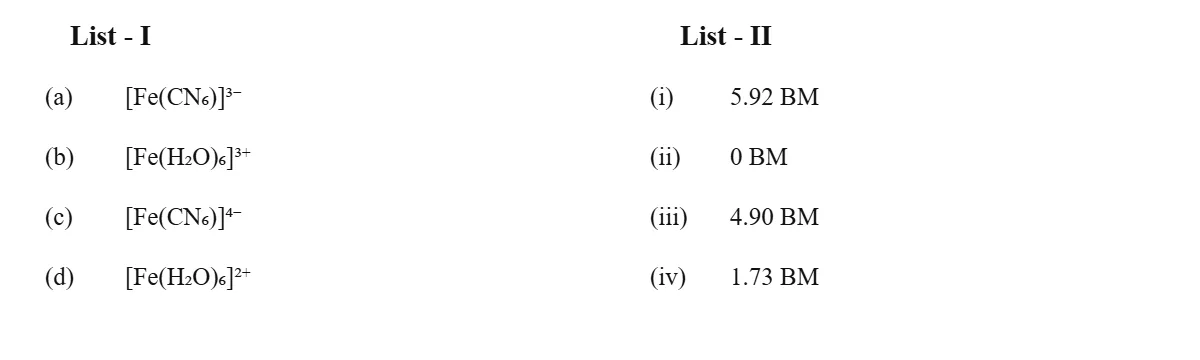 Choose the correct answer from the options given below.
- (A)(a)-(iv), (b)-(i), (c)-(ii), (d)-(iii)
- (B)(a)-(ii), (b)-(iv), (c)-(iii), (d)-(i)
- (C)(a)-(iv), (b)-(ii), (c)-(i), (d)-(iii)
- (D)(a)-(i), (b)-(iii), (c)-(iv), (d)-(ii)
- (A)
- 18.
NEET 2020
Which of the following is the correct order of increasing field strength of ligands to form coordination compounds?- (A)
- (B)
- (C)
- (D)
- (A)
- 19.
NEET 2020
Urea reacts with water to form A which will decompose to form B. B when passed through (aq), deep blue colour solution C is formed. What is the formula of C from the following?- (A)
- (B)
- (C)
- (D)
- (A)
Answer key
The answer key and step-by-step solutions are free with an Edurack account.
Log in to unlock