
NEET Aldehydes, Ketones and Carboxylic Acids PYQ practice sheet
20 previous-year NEET Chemistry questions from Aldehydes, Ketones and Carboxylic Acids, newest papers first. Aldehydes, Ketones and Carboxylic Acids carries 26 of the Chemistry questions in NEET 2020 to 2026, so this is a good place to test yourself after revising the chapter. Marking: +4 correct, −1 wrong.
- 1.
RE-NEET 2026
For the following reaction sequence, choose the correct option. Reaction: benzene reacts with (i) , and then (ii) to give .
- (A)If P gives a carboxylic acid on acidification, Q gives a poisonous gas on exposure to air and light
- (B)If P is the sodium salt of a carboxylic acid, Q is a primary alcohol
- (C)Both P and Q are carbonyl compounds
- (D)P and Q are aromatic compounds
- (A)
- 2.
RE-NEET 2026
The compound that CANNOT be obtained from the aldol condensation reaction shown below, is Reaction: -dimethylcyclopentanone Each option shows a structure.
- (A)

- (B)

- (C)

- (D)

- (A)
- 3.
RE-NEET 2026
Consider the following reaction, and choose the correct option. Reaction: toluene is treated with (i) , and then (ii) to give P.
- (A)On treatment with bromine water, compound P gives a white precipitate
- (B)Compound P is obtained by the hydrogenation of benzoyl chloride with Pd on
- (C)On treating compound P with saturated solution, brisk effervescence is observed
- (D)Compound P can be prepared by treating benzene with anhydrous and
- (A)
- 4.
NEET 2026
Compound P () gives a red orange precipitate with 2,4-DNP reagent and it does not reduce Fehling's reagent. On drastic oxidation with chromic acid, P gives an aromatic product Q that produces effervescence on treating with aq. . Compounds P and Q, respectively, are:- (A)

- (B)

- (C)

- (D)

- (A)
- 5.
NEET 2024
Match List I with List II. List I (Reaction): A. Bicyclohexylidene (two cyclohexane rings joined by a C=C bond) 2 cyclohexanone
B. Benzene benzophenone
C. Cyclohexanol cyclohexanone
D. Ethylbenzene potassium benzoate
List II (Reagents/Condition):
I. Benzoyl chloride / anhydrous
II.
III.
IV. (i) (ii)
Choose the correct answer from the options given below:
- (A)A-III, B-I, C-II, D-IV
- (B)A-I, B-IV, C-II, D-III
- (C)A-IV, B-I, C-II, D-III
- (D)A-IV, B-I, C-III, D-II
- (A)
- 6.
NEET 2024
Identify the correct reagents that would bring about the following transformation. The starting material is allylcyclohexane, cyclohexyl, and the product is cyclohexyl.
- (A)(i) ; (ii) ; (iii) PCC
- (B)(i) ; (ii)
- (C)(i) ; (ii) ; (iii) alk. ; (iv)
- (D)(i) ; (ii) PCC
- (A)
- 7.
NEET 2023
Complete the following reaction : Cyclohexanone [A] reacts with to give the cyanohydrin [B] (1-hydroxycyclohexane-1-carbonitrile, a ring carbon bearing both and ). [B] on heating with conc. gives [C]. [C] is ________.- (A)Cyclohex-1-ene-1-carboxylic acid (a cyclohexene ring with on a doubly bonded carbon)
- (B)Cyclohexanol
- (C)Cyclohexanecarboxylic acid
- (D)Cyclohex-1-ene-1-carbaldehyde (a cyclohexene ring with on a doubly bonded carbon)
- (A)
- 8.
NEET 2023
Identify product (A) in the following reaction: The reactant is a cyclohexane ring joined by a single bond to a benzene ring at the (meta) position of the benzene ring. The cyclohexane carbon (at its -position relative to the point of attachment) carries an acetyl group, , and the benzene ring (meta to the cyclohexyl group) also carries an acetyl group, .- (A)Both acetyl groups converted to methyl groups ( on the cyclohexane ring and on the benzene ring).
- (B)Both acetyl groups converted to ethyl groups ( on the cyclohexane ring and on the benzene ring).
- (C)Both acetyl groups converted to 1-hydroxyethyl groups ().
- (D)Both acetyl groups replaced by hydroxymethyl groups ().
- (A)
- 9.
NEET 2023
Identify the major product obtained in the following reaction : 2-Acetylbenzaldehyde (a benzene ring carrying and on adjacent carbons) major product- (A)A benzene ring with and on adjacent carbons
- (B)A benzene ring with and on adjacent carbons
- (C)A benzene ring with and on adjacent carbons
- (D)A benzene ring with and on adjacent carbons
- (A)
- 10.
NEET 2022
What is Y in the above reaction?- (A)
- (B)
- (C)
- (D)
- (A)
- 11.
NEET 2022
Match List - I with List - II.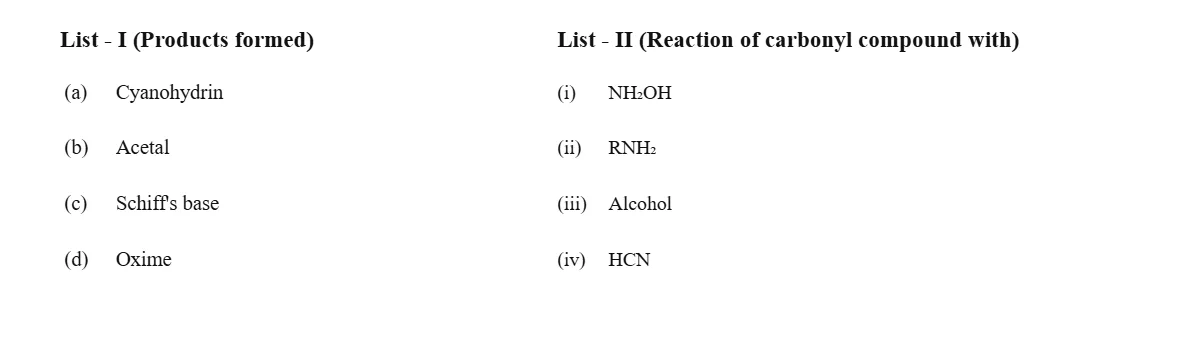 Choose the correct answer from the options given below:
- (A)(a)-(iv), (b)-(iii), (c)-(ii), (d)-(i)
- (B)(a)-(iii), (b)-(iv), (c)-(ii), (d)-(i)
- (C)(a)-(ii), (b)-(iii), (c)-(iv), (d)-(i)
- (D)(a)-(i), (b)-(iii), (c)-(ii), (d)-(iv)
- (A)
- 12.
NEET 2022
Given below are two statements: Statement I: The boiling points of aldehydes and ketones are higher than hydrocarbons of comparable molecular masses because of weak molecular association in aldehydes and ketones due to dipole-dipole interactions. Statement II: The boiling points of aldehydes and ketones are lower than the alcohols of similar molecular masses due to the absence of H-bonding. In the light of the above statements, choose the most appropriate answer from the options given below:- (A)Statement I is incorrect but Statement II is correct.
- (B)Both Statement I and Statement II are correct.
- (C)Both Statement I and Statement II are incorrect.
- (D)Statement I is correct but Statement II is incorrect.
- (A)
- 13.
NEET 2022
Which one of the following is not formed when acetone reacts with 2-pentanone in the presence of dilute NaOH followed by heating?- (A)a branched, methyl-substituted -unsaturated ketone product I (as drawn in the official question figure)
- (B)a branched, methyl-substituted -unsaturated ketone product II (as drawn in the official question figure)
- (C)a branched, methyl-substituted -unsaturated ketone product III (as drawn in the official question figure)
- (D)a branched, methyl-substituted -unsaturated ketone product IV (as drawn in the official question figure)
- (A)
- 14.
NEET 2021
What is the IUPAC name of the organic compound formed in the following chemical reaction ?- (A)2-methyl propan-2-ol
- (B)pentan-2-ol
- (C)pentan-3-ol
- (D)2-methyl butan-2-ol
- (A)
- 15.
NEET 2021
The intermediate compound 'X' in the following chemical reaction is :
- (A)

- (B)

- (C)

- (D)

- (A)
- 16.
NEET 2021
Match List - I with List - II. List - I: (a) benzene ; (b) ; (c) ; (d) List - II: (i) Hell-Volhard-Zelinsky reaction; (ii) Gattermann-Koch reaction; (iii) Haloform reaction; (iv) Esterification Choose the correct answer from the options given below.
- (A)(a)-(iv), (b)-(i), (c)-(ii), (d)-(iii)
- (B)(a)-(i), (b)-(iv), (c)-(iii), (d)-(ii)
- (C)(a)-(iii), (b)-(ii), (c)-(i), (d)-(iv)
- (D)(a)-(ii), (b)-(iii), (c)-(iv), (d)-(i)
- (A)
- 17.
NEET 2021
The product formed in the following chemical reaction is : Reactant: a cyclohexanone ring (C=O at carbon 1) carrying a group on carbon 2 and a group on carbon 3. Reagent: in .
- (A)

- (B)

- (C)

- (D)

- (A)
- 18.
NEET 2020
Identify compound X in the following sequence of reactions :
- (A)

- (B)

- (C)

- (D)

- (A)
- 19.
NEET 2020
Reaction between benzaldehyde and acetophenone in presence of dilute NaOH is known as :- (A)Aldol condensation
- (B)Cannizzaro's reaction
- (C)Cross Cannizzaro's reaction
- (D)Cross Aldol condensation
- (A)
- 20.
NEET 2020
Reaction between acetone and methylmagnesium chloride followed by hydrolysis will give :- (A)Isopropyl alcohol
- (B)Sec. butyl alcohol
- (C)Tert. butyl alcohol
- (D)Isobutyl alcohol
- (A)
Answer key
The answer key and step-by-step solutions are free with an Edurack account.
Log in to unlock