
NEET Morphology of Flowering Plants PYQ practice sheet
19 previous-year NEET Botany questions from Morphology of Flowering Plants, newest papers first. Morphology of Flowering Plants carries 27 of the Botany questions in NEET 2020 to 2026, so this is a good place to test yourself after revising the chapter. Marking: +4 correct, −1 wrong.
- 1.
RE-NEET 2026
Phyllotaxy is the pattern of arrangement of ________.- (A)leaves
- (B)sepals
- (C)flowers
- (D)fruits
- (A)
- 2.
RE-NEET 2026
Which of the following are characteristic features of Solanaceae family? (a) Flowers are bisexual and actinomorphic (b) Calyx have five sepals and are united (c) Androecium have five stamens and are epipetalous (d) Ovary is inferior Choose the correct answer from the options given below :- (A)(d) only
- (B)(a) and (b) only
- (C)(a), (b) and (c) only
- (D)(b), (c) and (d) only
- (A)
- 3.
RE-NEET 2026
Match List-I with List-II. List-I: A. Marginal placentation B. Axile placentation C. Parietal placentation D. Free central placentation List-II: I. Argemone II. Tomato III. Primrose IV. Pea Choose the correct answer from the options given below :- (A)A-IV, B-II, C-I, D-III
- (B)A-IV, B-III, C-I, D-II
- (C)A-IV, B-II, C-III, D-I
- (D)A-II, B-IV, C-I, D-III
- (A)
- 4.
NEET 2026
In angiosperms, root hairs arise from which one of the following regions of the root?- (A)The region of elongation
- (B)The root cap zone
- (C)The region of maturation
- (D)The region of meristematic activity
- (A)
- 5.
NEET 2026
Which of the following floral formula is the correct floral formula of Solanaceae family?- (A)
- (B)
- (C)
- (D)
- (A)
- 6.
NEET 2026
Match List I with List II: List I (Placentation): A. Marginal, B. Axile, C. Parietal, D. Basal List II (Example): I. Mustard, II. Pea, III. Marigold, IV. Lemon Choose the correct answer from the options given below:- (A)A-I, B-III, C-II, D-IV
- (B)A-II, B-IV, C-I, D-III
- (C)A-IV, B-II, C-I, D-III
- (D)A-III, B-I, C-IV, D-II
- (A)
- 7.
NEET 2024
Identify the part of the seed from the given figure which is destined to form root when the seed germinates. The figure shows a longitudinal section of a monocot (maize) grain with four labelled parts: A, B, C and D.
- (A)A
- (B)C
- (C)B
- (D)D
- (A)
- 8.
NEET 2024
Identify the type of flowers based on the position of calyx, corolla and androecium with respect to the ovary from the given figures (a) and (b). Both figures are longitudinal sections of flowers; (a) and (b) show the position of the floral parts relative to the ovary on the thalamus.
- (A)(a) Hypogynous; (b) Epigynous
- (B)(a) Perigynous; (b) Perigynous
- (C)(a) Epigynous; (b) Hypogynous
- (D)(a) Perigynous; (b) Epigynous
- (A)
- 9.
NEET 2024
Which of the following is an example of actinomorphic flower?- (A)Datura
- (B)Cassia
- (C)Pisum
- (D)Sesbania
- (A)
- 10.
NEET 2024
Match List-I with List-II. List-I: (A) Rose, (B) Pea, (C) Cotton, (D) Mango List-II: (I) Twisted aestivation, (II) Perigynous flower, (III) Drupe, (IV) Marginal placentation Choose the correct answer from the options given below:- (A)A-I, B-II, C-III, D-IV
- (B)A-II, B-III, C-IV, D-I
- (C)A-II, B-IV, C-I, D-III
- (D)A-IV, B-III, C-II, D-I
- (A)
- 11.
NEET 2024
Match List-I with List-II. List-I (Types of stamen): (A) Monoadelphous, (B) Diadelphous, (C) Polyadelphous, (D) Epiphyllous List-II (Example): (I) Citrus, (II) Pea, (III) Lily, (IV) China-rose Choose the correct answer from the options given below:- (A)A-III, B-I, C-IV, D-II
- (B)A-IV, B-II, C-I, D-III
- (C)A-IV, B-I, C-II, D-III
- (D)A-I, B-II, C-IV, D-III
- (A)
- 12.
NEET 2023
Family Fabaceae differs from Solanaceae and Liliaceae. With respect to the stamens, pick out the characteristics specific to family Fabaceae but not found in Solanaceae or Liliaceae.- (A)Epiphyllous and Dithecous anthers
- (B)Diadelphous and Dithecous anthers
- (C)Polyadelphous and epipetalous stamens
- (D)Monoadelphous and Monothecous anthers
- (A)
- 13.
NEET 2023
Given below are two statements : One is labelled as Assertion A and the other is labelled as Reason R : Assertion A : A flower is defined as modified shoot wherein the shoot apical meristem changes to floral meristem. Reason R : Internode of the shoot gets condensed to produce different floral appendages laterally at successive nodes instead of leaves. In the light of the above statements, choose the correct answer from the options given below :- (A)A is false but R is true.
- (B)Both A and R are true and R is the correct explanation of A.
- (C)Both A and R are true but R is NOT the correct explanation of A.
- (D)A is true but R is false.
- (A)
- 14.
NEET 2022
The flowers are Zygomorphic in: (a) Mustard (b) Gulmohar (c) Cassia (d) Datura (e) Chilly Choose the correct answer from the options given below:- (A)(c), (d), (e) Only
- (B)(a), (b), (c) Only
- (C)(b), (c) Only
- (D)(d), (e) Only
- (A)
- 15.
NEET 2022
Given below are two statements: Statement I: Cleistogamous flowers are invariably autogamous. Statement II: Cleistogamy is disadvantageous as there is no chance for cross pollination. In the light of the above statements, choose the correct answer from the options given below:- (A)Statement I is incorrect but Statement II is correct
- (B)Both Statement I and Statement II are correct
- (C)Both Statement I and Statement II are incorrect
- (D)Statement I is correct but Statement II is incorrect
- (A)
- 16.
NEET 2022
Identify the correct set of statements: (a) The leaflets are modified into pointed hard thorns in Citrus and Bougainvillea (b) Axillary buds form slender and spirally coiled tendrils in cucumber and pumpkin (c) Stem is flattened and fleshy in Opuntia and modified to perform the function of leaves (d) Rhizophora shows vertically upward growing roots that help to get oxygen for respiration (e) Subaerially growing stems help in vegetative propagation in grasses and strawberry Choose the correct answer from the options given below:- (A)(a), (b), (d) and (e) Only
- (B)(b) and (c) Only
- (C)(a) and (d) Only
- (D)(b), (c), (d) and (e) Only
- (A)
- 17.
NEET 2022
Which one of the following plants shows vexillary aestivation and diadelphous stamens?- (A)Solanum nigrum
- (B)Colchicum autumnale
- (C)Pisum sativum
- (D)Allium cepa
- (A)
- 18.
NEET 2021
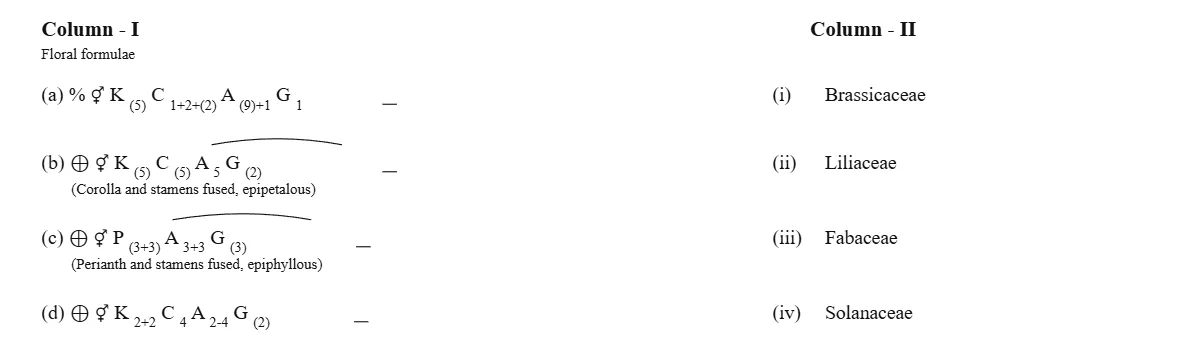 Select the correct answer from the options given below.
- (A)(a)-(iii), (b)-(iv), (c)-(ii), (d)-(i)
- (B)(a)-(ii), (b)-(iii), (c)-(iv), (d)-(i)
- (C)(a)-(i), (b)-(ii), (c)-(iii), (d)-(iv)
- (D)(a)-(iv), (b)-(ii), (c)-(i), (d)-(iii)
- (A)
- 19.
NEET 2020
The roots that originate from the base of the stem are :- (A)Fibrous roots
- (B)Primary roots
- (C)Prop roots
- (D)Lateral roots
- (A)
Answer key
The answer key and step-by-step solutions are free with an Edurack account.
Log in to unlock