
NEET Anatomy of Flowering Plants PYQ practice sheet
13 previous-year NEET Botany questions from Anatomy of Flowering Plants, newest papers first. Anatomy of Flowering Plants carries 19 of the Botany questions in NEET 2020 to 2026, so this is a good place to test yourself after revising the chapter. Marking: +4 correct, −1 wrong.
- 1.
NEET 2026
The main function of bulliform cells in grasses is:- (A)to minimize water loss during water stress.
- (B)to make the leaf impermeable to fungal spores.
- (C)to transport water.
- (D)to perform photosynthesis.
- (A)
- 2.
NEET 2026
Match List I with List II: List-I: A. Conjunctive tissue, B. Casparian strips, C. Subsidiary cells, D. Starch sheath List-II: I. Specialised cells in the vicinity of guard cells, II. Endodermal cells rich in starch, III. Tissue between xylem and phloem, IV. Endodermal cells with suberin deposition Choose the correct answer from the options given below:- (A)A-IV, B-III, C-II, D-I
- (B)A-III, B-IV, C-II, D-I
- (C)A-III, B-IV, C-I, D-II
- (D)A-IV, B-III, C-I, D-II
- (A)
- 3.
NEET 2024
In the given figure, which component has thin outer walls and highly thickened inner walls? The figure shows a stomatal complex in surface view with parts labelled A, B, C and D.
- (A)C
- (B)A
- (C)D
- (D)B
- (A)
- 4.
NEET 2024
Given below are two statements: Statement I: Parenchyma is living but collenchyma is dead tissue. Statement II: Gymnosperms lack xylem vessels but presence of xylem vessels is the characteristic of angiosperms. In the light of the above statements, choose the correct answer from the options given below:- (A)Both Statement I and Statement II are true.
- (B)Statement I is true but Statement II is false.
- (C)Both Statement I and Statement II are false.
- (D)Statement I is false but Statement II is true.
- (A)
- 5.
NEET 2023
Given below are two statements : Statement I : Endarch and exarch are the terms often used for describing the position of secondary xylem in the plant body. Statement II : Exarch condition is the most common feature of the root system. In the light of the above statements, choose the correct answer from the options given below :- (A)Statement I is incorrect but Statement II is true.
- (B)Both Statement I and Statement II are true.
- (C)Both Statement I and Statement II are false.
- (D)Statement I is true but Statement II is false.
- (A)
- 6.
NEET 2023
Given below are two statements : One is labelled as Assertion A and the other is labelled as Reason R : Assertion A : Late wood has fewer xylary elements with narrow vessels. Reason R : Cambium is less active in winters. In the light of the above statements, choose the correct answer from the options given below :- (A)A is false but R is true.
- (B)Both A and R are true and R is the correct explanation of A.
- (C)Both A and R are true but R is NOT the correct explanation of A.
- (D)A is true but R is false.
- (A)
- 7.
NEET 2023
Identify the correct statements : A. Lenticels are the lens-shaped openings permitting the exchange of gases. B. Bark formed early in the season is called hard bark. C. Bark is a technical term that refers to all tissues exterior to vascular cambium. D. Bark refers to periderm and secondary phloem. E. Phellogen is single-layered in thickness. Choose the correct answer from the options given below :- (A)B and C only
- (B)B, C and E only
- (C)A and D only
- (D)A, B and D only
- (A)
- 8.
NEET 2022
Read the following statements about the vascular bundles: (a) In roots, xylem and phloem in a vascular bundle are arranged in an alternate manner along the different radii. (b) Conjoint closed vascular bundles do not possess cambium. (c) In open vascular bundles, cambium is present in between xylem and phloem. (d) The vascular bundles of dicotyledonous stem possess endarch protoxylem. (e) In monocotyledonous root, usually there are more than six xylem bundles present. Choose the correct answer from the options given below:- (A)(a), (c), (d) and (e) Only
- (B)(a), (b) and (d) Only
- (C)(b), (c), (d) and (e) Only
- (D)(a), (b), (c) and (d) Only
- (A)
- 9.
NEET 2022
In old trees the greater part of secondary xylem becomes dark brown and resistant to insect attack due to: (a) secretion of secondary metabolites in the lumen of vessels (b) deposition of organic compounds like tannins and resins in the central layers of stem (c) deposition of suberin and aromatic substances in the outer layer of stem (d) deposition of tannins, gum, resin and aromatic substances in the peripheral layers of stem (e) presence of parenchyma cells, functionally active xylem elements and essential oils Choose the correct answer from the options given below:- (A)(b) and (d) Only
- (B)(a) and (b) Only
- (C)(c) and (d) Only
- (D)(d) and (e) Only
- (A)
- 10.
NEET 2022
The anatomy of springwood shows some peculiar features. Identify the correct set of statements about springwood. (a) It is also called as the earlywood (b) In spring season cambium produces xylem elements with narrow vessels (c) It is lighter in colour (d) The springwood along with autumnwood shows alternate concentric rings forming annual rings (e) It has lower density Choose the correct answer from the options given below:- (A)(c), (d) and (e) Only
- (B)(a), (b), (d) and (e) Only
- (C)(a), (c), (d) and (e) Only
- (D)(a), (b) and (d) Only
- (A)
- 11.
NEET 2021
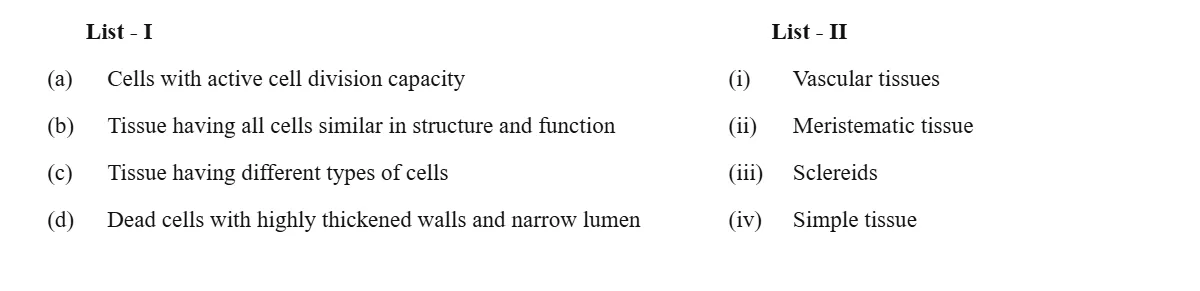 Select the correct answer from the options given below.
- (A)(a)-(iii), (b)-(ii), (c)-(iv), (d)-(i)
- (B)(a)-(i), (b)-(ii), (c)-(iii), (d)-(iv)
- (C)(a)-(iv), (b)-(iii), (c)-(ii), (d)-(i)
- (D)(a)-(ii), (b)-(iv), (c)-(i), (d)-(iii)
- (A)
- 12.
NEET 2021
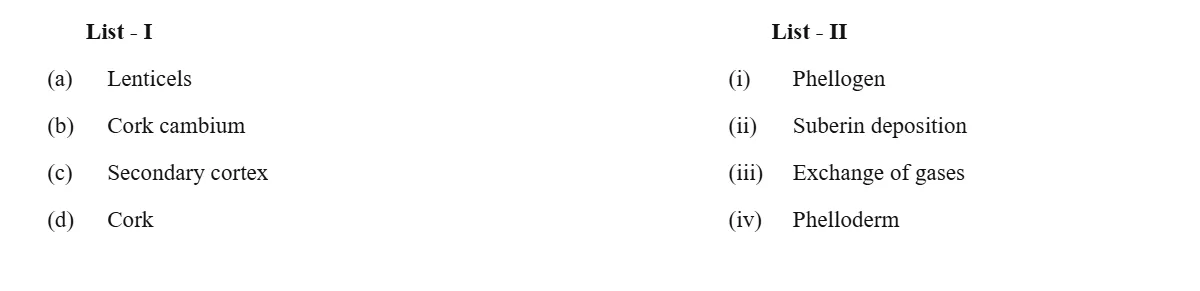 Choose the correct answer from the options given below.
- (A)(a)-(ii), (b)-(iii), (c)-(iv), (d)-(i)
- (B)(a)-(iii), (b)-(i), (c)-(iv), (d)-(ii)
- (C)(a)-(iv), (b)-(ii), (c)-(i), (d)-(iii)
- (D)(a)-(iv), (b)-(i), (c)-(iii), (d)-(ii)
- (A)
- 13.
NEET 2020
The transverse section of a plant shows following anatomical features: (a) Large number of scattered vascular bundles surrounded by bundle sheath. (b) Large conspicuous parenchymatous ground tissue. (c) Vascular bundles conjoint and closed. (d) Phloem parenchyma absent. Identify the category of plant and its part :- (A)Monocotyledonous stem
- (B)Monocotyledonous root
- (C)Dicotyledonous stem
- (D)Dicotyledonous root
- (A)
Answer key
The answer key and step-by-step solutions are free with an Edurack account.
Log in to unlock