JEE Main Maths Sets, Relations & Functions 2027: Equivalence Relations, One-One & Onto Functions
Venn diagram counting, equivalence relations, one-one and onto functions and composition, taught with worked examples and counting shortcuts.
Edurack
September 29, 2026
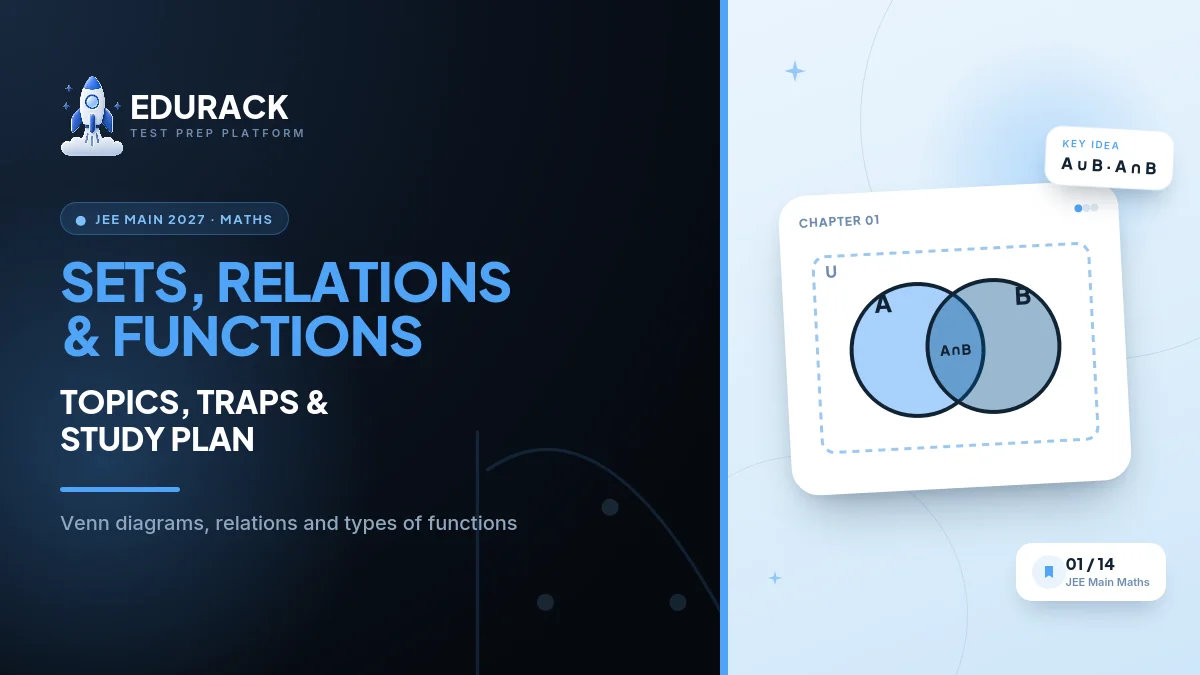
Sets, Relations and Functions is the language every other Maths chapter speaks. Calculus is about functions, probability is about sets of outcomes, and matrices are functions in disguise. The chapter itself is short, and its JEE Main questions mostly ask you to count: how many relations, how many one-one maps, how many elements.
Most questions in this chapter reduce to one skill: counting carefully.
Chapter at a Glance
| Snapshot | Detail |
|---|---|
| NTA unit | Unit 1 of 14: Sets, Relations & Functions |
| Priority (trend-based) | Moderate |
| Typical question style | Counting-based MCQs on relations and functions, plus composition problems |
| Best first step | Learn the three relation properties, then the counting formulas for functions |
Priority reflects past-paper trends, not an official NTA weightage.
What the NTA Syllabus Covers
- Sets and their representation, union, intersection and complement of sets and their algebraic properties, power set
- Relations, types of relations, equivalence relations
- Functions: one-one, into and onto functions, composition of functions
Master These Topics
1. Sets and Venn Diagram Counting
The operations you need are union , intersection , complement and difference . Three results do most of the work:
- De Morgan's laws: and
- A set with elements has subsets, so its power set has elements.
%20%3D%2035%20%2B%2030%20%E2%88%92%2010%20%3D%2055%2C%20so%2060%20%E2%88%92%2055%20%3D%205%20study%20neither%3C%2Ftext%3E%3C%2Fsvg%3E)
Worked example: Of 60 students, 35 study Maths, 30 study Physics and 10 study both. Then , so study neither.
Trap: Adding and counts the overlap twice. Always subtract .
2. Relations: Reflexive, Symmetric, Transitive
A relation from to is a subset of . A relation on a set is:
- reflexive if for every
- symmetric if implies
- transitive if and imply
An equivalence relation has all three properties and splits the set into disjoint equivalence classes.
For a set with elements, the number of relations is , reflexive relations and symmetric relations . For these are 512, 64 and 64.
Worked example: On the integers, let mean that is divisible by 3. It is reflexive since , symmetric, and transitive, so it is an equivalence relation with exactly 3 classes, one for each remainder .
Trap: Symmetric and transitive together do not force reflexive. An element related to nothing at all breaks reflexivity.
3. Functions: One-One, Onto and Composition
A function gives every element of exactly one image in . It is one-one if different inputs give different outputs, and onto if every element of is an image. A function that is not onto is called into.
If has elements and has elements:
- total functions:
- one-one functions: , which needs
- bijections exist only when , and then there are of them
- onto functions from 4 elements to 3 elements:
Worked example: From a 3-element set to a 4-element set, the number of one-one functions is .
Composition is , and it is not commutative. For and :
A function has an inverse only if it is a bijection. Here .
Trap: on all reals is neither one-one nor onto. Restricting the domain and codomain to makes it a bijection.
Common Traps to Avoid
- Forgetting to subtract the overlap in .
- Assuming symmetric plus transitive implies reflexive.
- Mixing up the order in : apply first, then .
- Calling a function onto without checking that its range equals the whole codomain.
60-Second Revision Sheet
- ; power set has elements
- Relations on elements: all , reflexive , symmetric
- One-one from to elements: ; bijections:
- Inverse exists if and only if the function is one-one and onto
Your Study Plan
- Day 1: set operations, De Morgan's laws and Venn diagram problems.
- Day 2: types of relations and proving equivalence relations.
- Day 3: one-one, onto and counting functions.
- Day 4: composition, inverse functions and a timed mixed set.
Practice Sets, Relations & Functions Questions Free → (opens in a new tab)
Continue Your Maths Journey
- Next chapter: Complex Numbers & Quadratic Equations
- All 14 JEE Main Maths chapters
- Complete JEE Main Syllabus 2027 guide
Frequently Asked Questions
What makes a relation an equivalence relation?
It must be reflexive, symmetric and transitive at the same time. Equivalence relations partition the set into equivalence classes.
How do I check whether a function is onto?
Show that for every in the codomain there is some in the domain with , or compare the range with the codomain.