JEE Main Maths Complex Numbers & Quadratic Equations 2027: Argand Plane, Modulus & Roots
Modulus, argument, polar form, loci in the Argand plane and the relations between roots and coefficients of quadratics, with worked examples.
Edurack
September 29, 2026
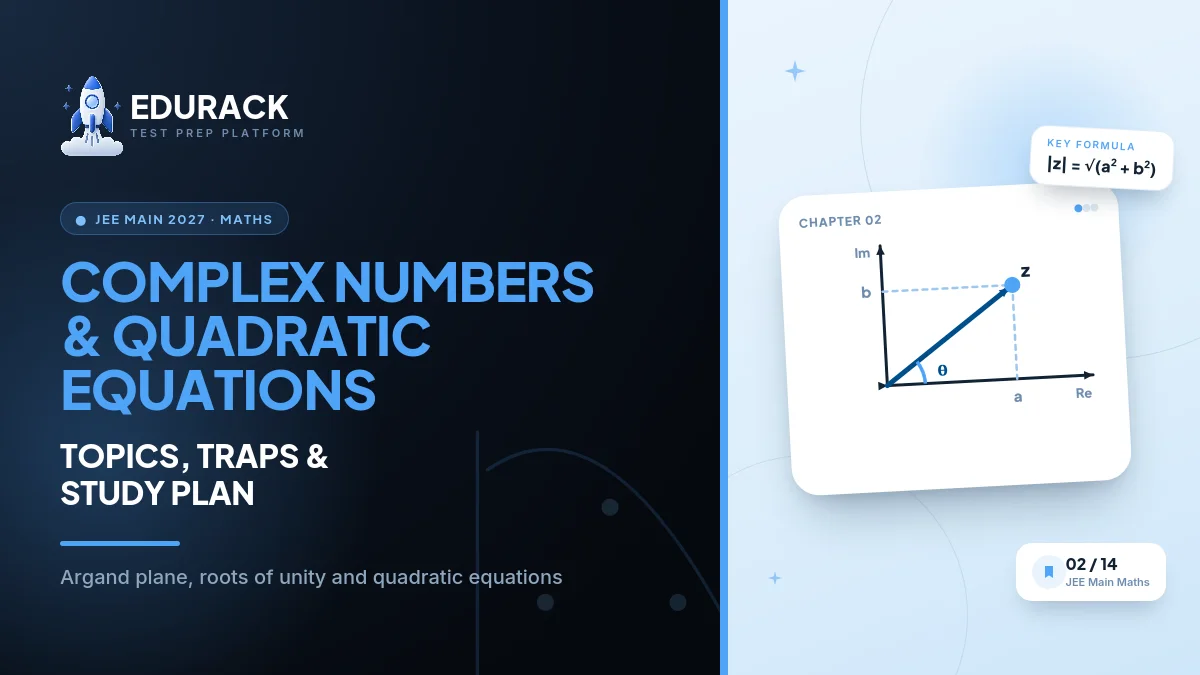
Complex numbers look exotic until you see them as points and arrows on a plane. Once you do, modulus becomes distance, multiplication becomes rotation, and locus problems become geometry you already know. Paired with quadratic equations, this chapter is one of the most dependable scoring units in JEE Main Maths.
A complex number is a point. Its modulus is the distance from the origin, and its argument is the angle.
Chapter at a Glance
| Snapshot | Detail |
|---|---|
| NTA unit | Unit 2 of 14: Complex Numbers & Quadratic Equations |
| Priority (trend-based) | High |
| Typical question style | Modulus and argument numericals, locus questions and root-relation problems |
| Best first step | Master polar form and the sum and product of roots |
Priority reflects past-paper trends, not an official NTA weightage.
What the NTA Syllabus Covers
- Complex numbers as ordered pairs of reals, the form and representation in a plane, Argand diagram
- Algebra of complex numbers, modulus and argument (amplitude)
- Quadratic equations in the real and complex number systems, relations between roots and coefficients, nature of roots, forming equations with given roots
Master These Topics
1. Modulus, Argument and Polar Form
For , the modulus is and the argument is the angle with the positive real axis. In polar form:
Key properties: , , and .
%22%2F%3E%3Cline%20x1%3D%22150.0%22%20y1%3D%22275.0%22%20x2%3D%22150.0%22%20y2%3D%2222.0%22%20stroke%3D%22%23475569%22%20stroke-width%3D%221.4%22%20marker-end%3D%22url(%23ar-ink)%22%2F%3E%3Ctext%20x%3D%22398.0%22%20y%3D%22168.0%22%20font-size%3D%2212%22%20fill%3D%22%23475569%22%20text-anchor%3D%22end%22%20font-weight%3D%22normal%22%20font-style%3D%22normal%22%3ERe%3C%2Ftext%3E%3Ctext%20x%3D%22162.0%22%20y%3D%2230.0%22%20font-size%3D%2212%22%20fill%3D%22%23475569%22%20text-anchor%3D%22start%22%20font-weight%3D%22normal%22%20font-style%3D%22normal%22%3EIm%3C%2Ftext%3E%3Cline%20x1%3D%22222.0%22%20y1%3D%2254.0%22%20x2%3D%22222.0%22%20y2%3D%22246.0%22%20stroke%3D%22%2394a3b8%22%20stroke-width%3D%221.2%22%20stroke-dasharray%3D%224%204%22%2F%3E%3Cline%20x1%3D%22150.0%22%20y1%3D%22150.0%22%20x2%3D%22222.0%22%20y2%3D%2254.0%22%20stroke%3D%22%232563eb%22%20stroke-width%3D%222.6%22%20marker-end%3D%22url(%23ar-blue)%22%2F%3E%3Cline%20x1%3D%22150.0%22%20y1%3D%22150.0%22%20x2%3D%22222.0%22%20y2%3D%22246.0%22%20stroke%3D%22%23dc2626%22%20stroke-width%3D%222%22%20stroke-dasharray%3D%226%204%22%20marker-end%3D%22url(%23ar-red)%22%2F%3E%3Cpath%20d%3D%22M188.0%2C150.0%20A38%2C38%200%200%200%20172.8%2C119.6%22%20fill%3D%22none%22%20stroke%3D%22%23475569%22%20stroke-width%3D%221.6%22%2F%3E%3Ctext%20x%3D%22200.0%22%20y%3D%22140.0%22%20font-size%3D%2213%22%20fill%3D%22%23475569%22%20text-anchor%3D%22start%22%20font-weight%3D%22normal%22%20font-style%3D%22italic%22%3E%CE%B8%3C%2Ftext%3E%3Ccircle%20cx%3D%22222.0%22%20cy%3D%2254.0%22%20r%3D%224.5%22%20fill%3D%22%232563eb%22%20stroke%3D%22none%22%20stroke-width%3D%221%22%20fill-opacity%3D%221%22%2F%3E%3Ccircle%20cx%3D%22222.0%22%20cy%3D%22246.0%22%20r%3D%224.5%22%20fill%3D%22%23dc2626%22%20stroke%3D%22none%22%20stroke-width%3D%221%22%20fill-opacity%3D%221%22%2F%3E%3Ctext%20x%3D%22232.0%22%20y%3D%2258.0%22%20font-size%3D%2213%22%20fill%3D%22%232563eb%22%20text-anchor%3D%22start%22%20font-weight%3D%22bold%22%20font-style%3D%22normal%22%3Ez%20%3D%203%20%2B%204i%3C%2Ftext%3E%3Ctext%20x%3D%22232.0%22%20y%3D%22250.0%22%20font-size%3D%2213%22%20fill%3D%22%23dc2626%22%20text-anchor%3D%22start%22%20font-weight%3D%22bold%22%20font-style%3D%22normal%22%3Econjugate%3A%203%20%E2%88%92%204i%3C%2Ftext%3E%3Ctext%20x%3D%22176.0%22%20y%3D%2296.0%22%20font-size%3D%2212%22%20fill%3D%22%230f172a%22%20text-anchor%3D%22end%22%20font-weight%3D%22normal%22%20font-style%3D%22normal%22%3E%7Cz%7C%20%3D%205%3C%2Ftext%3E%3Ctext%20x%3D%22222.0%22%20y%3D%22166.0%22%20font-size%3D%2212%22%20fill%3D%22%23475569%22%20text-anchor%3D%22middle%22%20font-weight%3D%22normal%22%20font-style%3D%22normal%22%3E3%3C%2Ftext%3E%3Ctext%20x%3D%22138.0%22%20y%3D%2258.0%22%20font-size%3D%2212%22%20fill%3D%22%23475569%22%20text-anchor%3D%22end%22%20font-weight%3D%22normal%22%20font-style%3D%22normal%22%3E4%3C%2Ftext%3E%3Ctext%20x%3D%22300.0%22%20y%3D%22268.0%22%20font-size%3D%2212%22%20fill%3D%22%230f172a%22%20text-anchor%3D%22middle%22%20font-weight%3D%22normal%22%20font-style%3D%22normal%22%3Er%20%3D%20%E2%88%9A(3%C2%B2%20%2B%204%C2%B2)%20%3D%205%2C%20%20%CE%B8%20%3D%20tan%E2%81%BB%C2%B9(4%2F3)%20%E2%89%88%2053.13%C2%B0%3C%2Ftext%3E%3C%2Fsvg%3E)
Worked example (division): , so the modulus is .
Worked example (powers): , so .
Trap: Always place the argument in the correct quadrant. alone gives the wrong angle when .
2. Loci in the Argand Plane
- is a circle with centre and radius .
- is the perpendicular bisector of the segment joining and .
- The triangle inequality states .
Worked example: For with , we get , which simplifies to , a straight line.
3. Quadratic Equations and the Nature of Roots
For with discriminant :
| Discriminant | Nature of roots |
|---|---|
| Real and distinct | |
| Real and equal | |
| Complex conjugate pair (for real coefficients) |
The relations between roots and coefficients are and . To form an equation with given roots, use .
Worked example (forming): Roots and have sum and product , so the equation is .
Worked example (symmetric functions): If are roots of , then and .
Trap: Complex roots come in conjugate pairs only when all coefficients are real.
4. A Handy Extra: Cube Roots of Unity
The unit cube roots satisfy and . The NTA Main text does not name them explicitly, but they are a common tool in problems on complex numbers.
Common Traps to Avoid
- Placing the argument in the wrong quadrant.
- Forgetting that conjugate-pair roots need real coefficients.
- Using as if it were always an equality.
- Dropping the sign of in the sum of roots .
60-Second Revision Sheet
- ; ;
- Circle: ; perpendicular bisector:
- , ,
Your Study Plan
- Day 1: algebra of complex numbers, conjugates and division.
- Day 2: polar form, powers and arguments in all four quadrants.
- Day 3: loci and geometry in the Argand plane.
- Day 4: quadratic roots, symmetric functions and a timed mixed set.
Practice Complex Numbers & Quadratic Equations Questions Free → (opens in a new tab)
Continue Your Maths Journey
- Previous chapter: Sets, Relations & Functions
- Next chapter: Matrices & Determinants
- All 14 JEE Main Maths chapters
- Complete JEE Main Syllabus 2027 guide
Frequently Asked Questions
What is the modulus of a complex number?
It is the distance of the point from the origin in the Argand plane, .
When are the roots of a quadratic complex?
When the discriminant is negative and the coefficients are real, the roots form a complex conjugate pair.