JEE Main Chemistry p-Block Elements 2027: Groups 13 to 18 Trends & Anomalies
Group-wise trends for boron to noble gases, the unique behaviour of each first element, inert pair effect and key exam facts, with worked examples.
Edurack
September 28, 2026
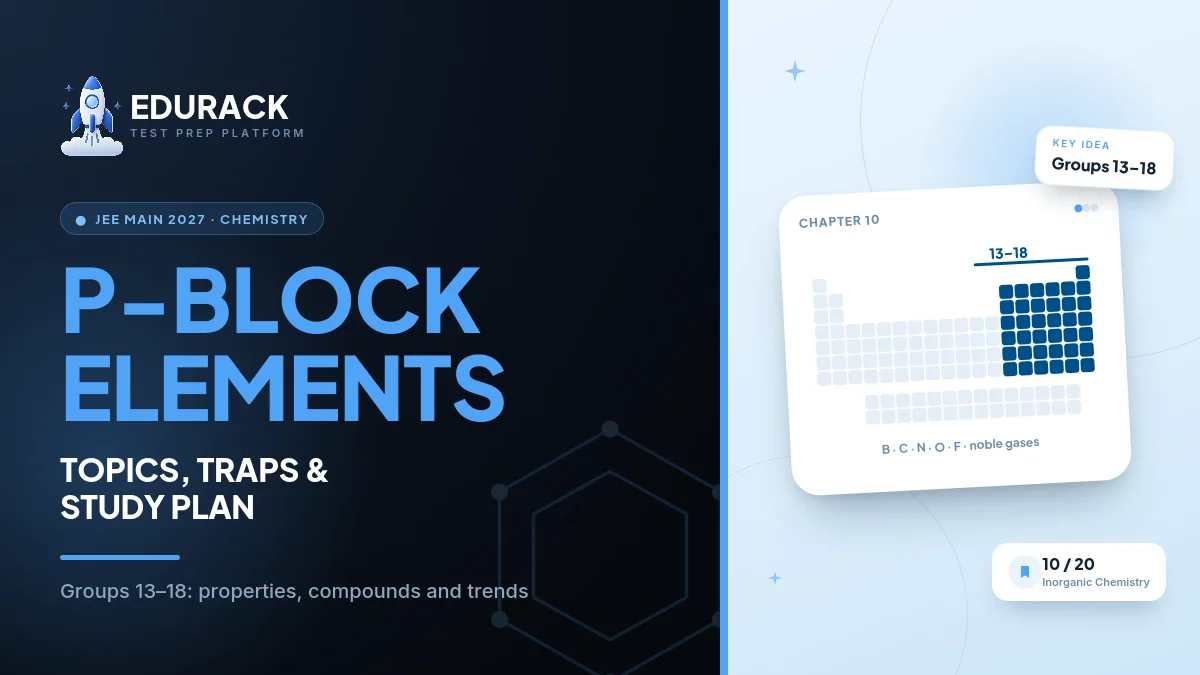
The NTA description of this unit is only two lines long: general trends in groups 13 to 18 and the unique behaviour of the first element in each group. Those two ideas explain most of what the exam asks, which is why a group-by-group study routine pays off.
The first element of a p-block group is the odd one out. Learn why, and the questions answer themselves.
Chapter at a Glance
| Snapshot | Detail |
|---|---|
| NTA unit | Unit 10 of 20: p-Block Elements |
| Priority (trend-based) | High |
| Typical question style | Trend-and-comparison MCQs on acidity, bond angle, stability and structure |
| Best first step | Study one group at a time and focus on the anomalous first element |
Priority reflects past-paper trends, not an official NTA weightage.
What the NTA Syllabus Covers
- Groups 13 to 18: electronic configuration and general trends in physical and chemical properties across periods and down groups
- Unique behaviour of the first element in each group
Master These Topics
1. Why the First Element Is Different
The first element of each group (B, C, N, O, F) is small, highly electronegative and has no d orbitals, so its maximum covalency is limited to four (for period 2).
| Group | First element | Anomaly |
|---|---|---|
| 13 | Boron | Non-metal, forms covalent compounds, electron deficient |
| 14 | Carbon | Strong catenation, forms pπ-pπ multiple bonds |
| 15 | Nitrogen | Very inert N₂, cannot expand octet, max covalency 4 |
| 16 | Oxygen | Forms H-bonds, no expanded octet |
| 17 | Fluorine | Only −1 oxidation state, weakest F-F bond in the group |
2. Group 13 and 14: Inert Pair Effect
Down group 13, the +1 state becomes more stable than +3 because the ns² pair is reluctant to participate. So Tl⁺ is more stable than Tl³⁺. In group 14, the +2 state becomes more stable down the group (Pb²⁺ over Pb⁴⁺).
Boron halides are Lewis acids, and the counter-intuitive order is BF₃ < BCl₃ < BBr₃. Fluorine's small size allows strong back bonding from its lone pairs into boron's empty p orbital, partly offsetting the electron deficiency.
Carbon has extensive catenation, giving chains and rings, and CO₂ is a gas while SiO₂ is a giant network solid.
3. Group 15 and 16
Bond angle in hydrides falls down the group: NH₃ (107°) > PH₃ (93.5°) > AsH₃ > SbH₃, because the central atom becomes larger and less electronegative and the bond pairs sit further from it.
Water has an anomalously high boiling point because of hydrogen bonding, while H₂S, H₂Se, H₂Te show a gradual increase. Sulphur shows more catenation than oxygen.
4. Group 17 and 18
Acid strength of hydrogen halides: HI > HBr > HCl > HF, because bond strength falls down the group even though electronegativity also falls. Oxidising power falls in the order F₂ > Cl₂ > Br₂ > I₂.
Worked example: F₂ has a lower bond enthalpy than Cl₂ because of repulsion between lone pairs in the very small F-F bond. The bond enthalpy order is Cl₂ > Br₂ > F₂ > I₂.
Noble gases are chemically inert, but xenon forms compounds such as XeF₂ (linear), XeF₄ (square planar) and XeF₆ (distorted octahedral). Helium has the lowest boiling point of any substance.
Trap: HF is the weakest hydrohalic acid in water despite fluorine being the most electronegative. The strong H-F bond and hydrogen bonding make it a weak acid.
Common Traps to Avoid
- Expecting BF₃ to be the strongest Lewis acid among boron halides.
- Forgetting that nitrogen and oxygen cannot expand their octets.
- Mixing up bond angle order in group 15 hydrides.
- Believing acid strength of HX follows electronegativity.
60-Second Revision Sheet
- Inert pair effect: lower oxidation state stable down the group (Tl⁺, Pb²⁺)
- Lewis acidity of boron halides: BF₃ < BCl₃ < BBr₃
- Hydrides: bond angle
NH₃ > PH₃ > AsH₃ > SbH₃ - HX acidity
HI > HBr > HCl > HF
Your Study Plan
- Day 1: group 13, boron anomalies and inert pair effect.
- Day 2: group 14 and 15 trends, hydrides and oxides.
- Day 3: group 16, 17 and 18 trends and noble gas compounds.
- Day 4: NCERT line reading and a timed mixed set.
Practice p-Block Elements Questions Free → (opens in a new tab)
Continue Your Chemistry Journey
- Previous chapter: Classification of Elements & Periodicity
- Next chapter: d- & f-Block Elements
- All JEE Main Chemistry chapters
- Complete JEE Main Syllabus 2027 guide
Frequently Asked Questions
What is the inert pair effect?
The reluctance of the two ns electrons to take part in bonding in heavier p-block elements, making the oxidation state two units below the group valence more stable.
Why is BF₃ a weaker Lewis acid than BBr₃?
Because fluorine's lone pair back-donates efficiently into boron's empty 2p orbital, reducing boron's electron deficiency more than in the bigger halides.