JEE Main Chemistry Periodicity 2027: Periodic Trends, Ionisation Enthalpy & Exceptions
Periodic trends in radius, ionisation enthalpy, electron gain enthalpy and electronegativity, with the exceptions and isoelectronic orders that JEE loves.
Edurack
September 28, 2026
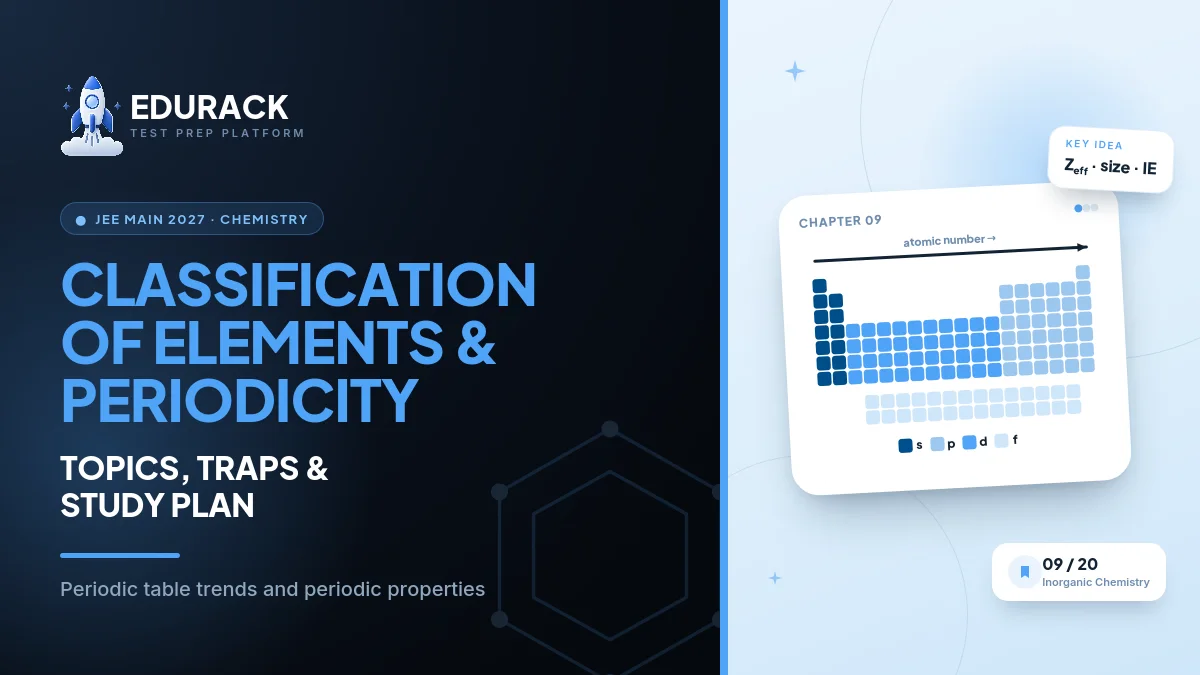
This chapter is mostly about spotting exceptions. Anyone can state 'ionisation enthalpy increases across a period'. The marks go to the student who knows that boron dips below beryllium and oxygen dips below nitrogen, and why.
A trend tells you the rule. An exception shows you understood the reason.
Chapter at a Glance
| Snapshot | Detail |
|---|---|
| NTA unit | Unit 9 of 20: Classification of Elements & Periodicity |
| Priority (trend-based) | Moderate |
| Typical question style | Short comparison and ordering MCQs based on trends and exceptions |
| Best first step | Learn each trend, then memorise its famous exceptions |
Priority reflects past-paper trends, not an official NTA weightage.
What the NTA Syllabus Covers
- Modern periodic law and the present form of the periodic table, s, p, d and f blocks
- Periodic trends in atomic and ionic radii, ionisation enthalpy, electron gain enthalpy, valence, oxidation states and chemical reactivity
Master These Topics
1. Atomic and Ionic Radii
Atomic radius decreases across a period (rising nuclear charge, same shell) and increases down a group (new shells added). A cation is smaller than its parent atom, and an anion is larger.
For isoelectronic species (same number of electrons), the one with more protons is smaller:
N³⁻ > O²⁻ > F⁻ > Na⁺ > Mg²⁺ > Al³⁺
2. Ionisation Enthalpy and Its Exceptions
Ionisation enthalpy generally rises across a period and falls down a group. Two exceptions appear in every period:
- Be > B and Mg > Al: the p electron in boron and aluminium is easier to remove than an s electron from a filled s subshell.
- N > O and P > S: nitrogen has a stable half-filled p³ arrangement, while oxygen's paired electron feels repulsion.
Worked example (second period order): Li < B < Be < C < O < N < F < Ne.
Trap: Successive ionisation enthalpies always increase, and there is a huge jump when an electron is removed from a noble-gas core. That jump is used to find the group of an unknown element.
3. Electron Gain Enthalpy and Electronegativity
Electron gain enthalpy is most negative for chlorine, not fluorine. Fluorine's small size causes strong electron-electron repulsion in its compact 2p subshell. The order of magnitude is Cl > F > Br > I, and similarly S > O. Noble gases have positive values, because the added electron must enter a new shell.
Electronegativity increases across a period and decreases down a group, with fluorine the highest on the Pauling scale (4.0).
4. Identifying Blocks from Atomic Number
Write the configuration and look at the last electron entering.
Worked example: Z = 35 gives [Ar] 3d¹⁰ 4s² 4p⁵, a p-block element in period 4 and group 17 (bromine). Z = 26 gives [Ar] 3d⁶ 4s², a d-block element in period 4 and group 8 (iron).
5. Valence and Oxidation States
Along a period the valence rises from 1 to 4 and then falls back. Oxides change from basic on the left to amphoteric (Al₂O₃) to acidic on the right (SO₃, Cl₂O₇), showing the trend in metallic to non-metallic character.
Common Traps to Avoid
- Assuming fluorine has the most negative electron gain enthalpy. Chlorine does.
- Ignoring the Be/B, Mg/Al, N/O and P/S exceptions in ionisation enthalpy.
- Comparing radii of isoelectronic ions by size of atom instead of nuclear charge.
- Forgetting that noble gases have positive electron gain enthalpy.
60-Second Revision Sheet
- Isoelectronic radii: more protons means smaller
- IE order in period 2: Li < B < Be < C < O < N < F < Ne
- Electron gain enthalpy: Cl > F > Br > I
- Oxides: basic to amphoteric to acidic across a period
Your Study Plan
- Day 1: radius trends and isoelectronic series.
- Day 2: ionisation enthalpy, exceptions and successive IE jumps.
- Day 3: electron gain enthalpy, electronegativity and oxidation states.
- Day 4: identifying blocks and groups, plus a timed comparison set.
Practice Classification of Elements & Periodicity Questions Free → (opens in a new tab)
Continue Your Chemistry Journey
- Previous chapter: Chemical Kinetics
- Next chapter: p-Block Elements
- All JEE Main Chemistry chapters
- Complete JEE Main Syllabus 2027 guide
Frequently Asked Questions
Why is chlorine's electron gain enthalpy more negative than fluorine's?
Fluorine's very small 2p subshell causes strong repulsion between the incoming electron and the electrons already present, reducing the energy released.
Why is the ionisation enthalpy of nitrogen higher than oxygen?
Nitrogen has a stable half-filled p³ configuration, whereas oxygen loses a paired electron that experiences extra repulsion.