JEE Main Chemistry d- & f-Block Elements 2027: Transition Metals, KMnO₄, K₂Cr₂O₇ & Lanthanoids
Transition metal properties, magnetic moment, colour, K₂Cr₂O₇ and KMnO₄ chemistry, lanthanoid contraction and actinoids, taught with worked examples.
Edurack
September 28, 2026
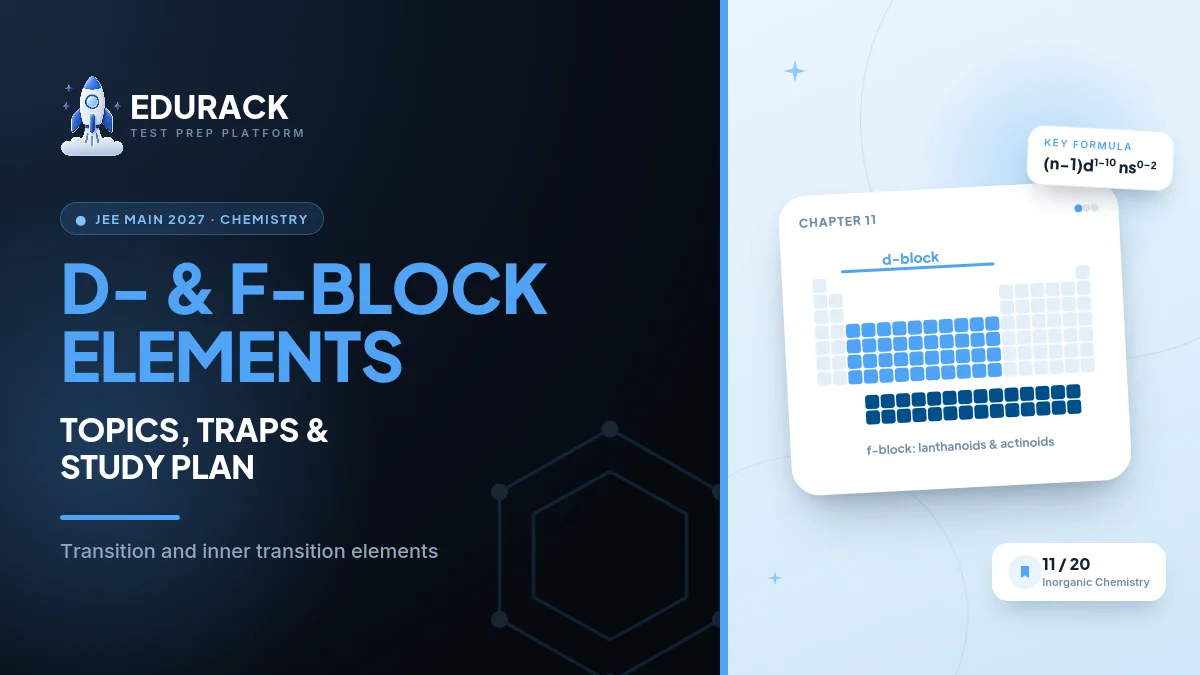
Why is a solution of copper sulphate blue and zinc sulphate colourless? Why does KMnO₄ give different products in acidic, neutral and alkaline solution? The d- and f-block chapter is built on a few unifying ideas, and once you see them, the long lists of facts start to connect.
Partly filled d orbitals explain nearly every property of transition metals: colour, magnetism, catalysis and variable oxidation states.
Chapter at a Glance
| Snapshot | Detail |
|---|---|
| NTA unit | Unit 11 of 20: d- & f-Block Elements |
| Priority (trend-based) | Moderate |
| Typical question style | Magnetic moment numericals and reaction-based MCQs on KMnO₄ and K₂Cr₂O₇ |
| Best first step | Learn the magnetic moment formula and the two oxidant reactions |
Priority reflects past-paper trends, not an official NTA weightage.
What the NTA Syllabus Covers
- Transition elements: electronic configuration, occurrence, general trends in physical properties, ionisation enthalpy, oxidation states, atomic radii, colour, catalytic behaviour, magnetic properties, complex formation, interstitial compounds, alloy formation
- Preparation, properties and uses of K₂Cr₂O₇ and KMnO₄
- Inner transition elements: lanthanoids (configuration, oxidation states, lanthanoid contraction) and actinoids (configuration, oxidation states)
Master These Topics
1. Magnetic Moment and Colour
Spin-only magnetic moment is μ = √(n(n + 2)) BM, where n is the number of unpaired electrons.
| Ion | d electrons | Unpaired n | μ (BM) |
|---|---|---|---|
| Ti³⁺ | d¹ | 1 | 1.73 |
| Cu²⁺ | d⁹ | 1 | 1.73 |
| Ni²⁺ | d⁸ | 2 | 2.83 |
| Fe³⁺, Mn²⁺ | d⁵ | 5 | 5.92 |
Colour arises from d-d transitions, which need partially filled d orbitals. So Sc³⁺ (d⁰) and Zn²⁺ (d¹⁰) are colourless, while Cu²⁺ (d⁹) is blue.
Trap: Cu⁺ (d¹⁰) is colourless and diamagnetic, but Cu²⁺ is coloured and paramagnetic. Always write the configuration of the ion, not the atom.
2. Variable Oxidation States and Other Properties
Transition metals show several oxidation states because ns and (n−1)d electrons have similar energies. Manganese shows the widest range, +2 to +7. Other properties to know:
- Catalysis: variable oxidation states and surface adsorption, for example Fe in Haber's process and V₂O₅ in the contact process.
- Interstitial compounds: small atoms (H, C, N) fill lattice gaps, making them hard and chemically inert.
- Alloys: similar atomic sizes allow substitution, as in brass and steel.
3. K₂Cr₂O₇ and KMnO₄
Potassium dichromate: chromite ore FeCr₂O₄ is fused with sodium carbonate in air to give sodium chromate. Acidification gives sodium dichromate, and adding KCl crystallises K₂Cr₂O₇. Chromate and dichromate interconvert with pH: 2CrO₄²⁻ + 2H⁺ ⇌ Cr₂O₇²⁻ + H₂O, yellow in base and orange in acid. As an oxidant in acid: Cr₂O₇²⁻ + 14H⁺ + 6e⁻ → 2Cr³⁺ + 7H₂O.
Potassium permanganate: MnO₂ is fused with KOH and an oxidising agent to give green K₂MnO₄, which is then oxidised to purple KMnO₄. Its behaviour depends on pH:
| Medium | Product | Electrons gained |
|---|---|---|
| Strongly acidic | Mn²⁺ | 5 |
| Neutral or weakly alkaline | MnO₂ | 3 |
| Strongly alkaline | MnO₄²⁻ | 1 |
Equivalent weight of KMnO₄ in acidic medium is M/5, a frequent numerical point.
4. Lanthanoids and Actinoids
Lanthanoids (4f series) mainly show +3, with Ce⁴⁺ and Eu²⁺ as notable exceptions. Lanthanoid contraction is the steady decrease in ionic size across the series, caused by poor shielding by 4f electrons. It explains why 4d and 5d elements of the same group (Zr and Hf) have nearly identical radii and similar chemistry.
Actinoids show a wider range of oxidation states (+3 to +7) than lanthanoids, because 5f, 6d and 7s energies are close, and they are radioactive.
Common Traps to Avoid
- Using the configuration of the neutral atom to count unpaired electrons in an ion.
- Forgetting that transition metals lose 4s electrons before 3d electrons when ionising.
- Mixing up the products of KMnO₄ in acidic, neutral and alkaline media.
- Confusing lanthanoid contraction (4f shielding) with the general period trend.
60-Second Revision Sheet
μ = √(n(n + 2))BM: n = 1, 2, 3, 4, 5 gives 1.73, 2.83, 3.87, 4.90, 5.92- KMnO₄: acid gives Mn²⁺, neutral gives MnO₂, strong alkali gives MnO₄²⁻
- Chromate is yellow, dichromate is orange (pH controlled)
- Lanthanoid contraction makes Zr and Hf nearly identical in size
Your Study Plan
- Day 1: transition metal configurations, exceptions and oxidation states.
- Day 2: magnetic moment, colour and catalytic behaviour.
- Day 3: K₂Cr₂O₇ and KMnO₄ preparation and reactions.
- Day 4: lanthanoids, actinoids and a timed set.
Practice d- & f-Block Elements Questions Free → (opens in a new tab)
Continue Your Chemistry Journey
- Previous chapter: p-Block Elements
- Next chapter: Coordination Compounds
- All JEE Main Chemistry chapters
- Complete JEE Main Syllabus 2027 guide
Frequently Asked Questions
Why are Zn²⁺ salts colourless?
Zn²⁺ has a fully filled d¹⁰ configuration, so no d-d transitions are possible and it does not absorb visible light.
What is lanthanoid contraction?
The gradual decrease in size of lanthanoid ions from La³⁺ to Lu³⁺, because poorly shielding 4f electrons let the increasing nuclear charge pull the outer electrons inward.