JEE Main Chemistry Coordination Compounds 2027: Nomenclature, Isomerism & Crystal Field Theory
Werner's theory, IUPAC naming, isomerism, valence bond and crystal field theory with CFSE and magnetic moment examples for one of JEE Chemistry's favourite chapters.
Edurack
September 28, 2026
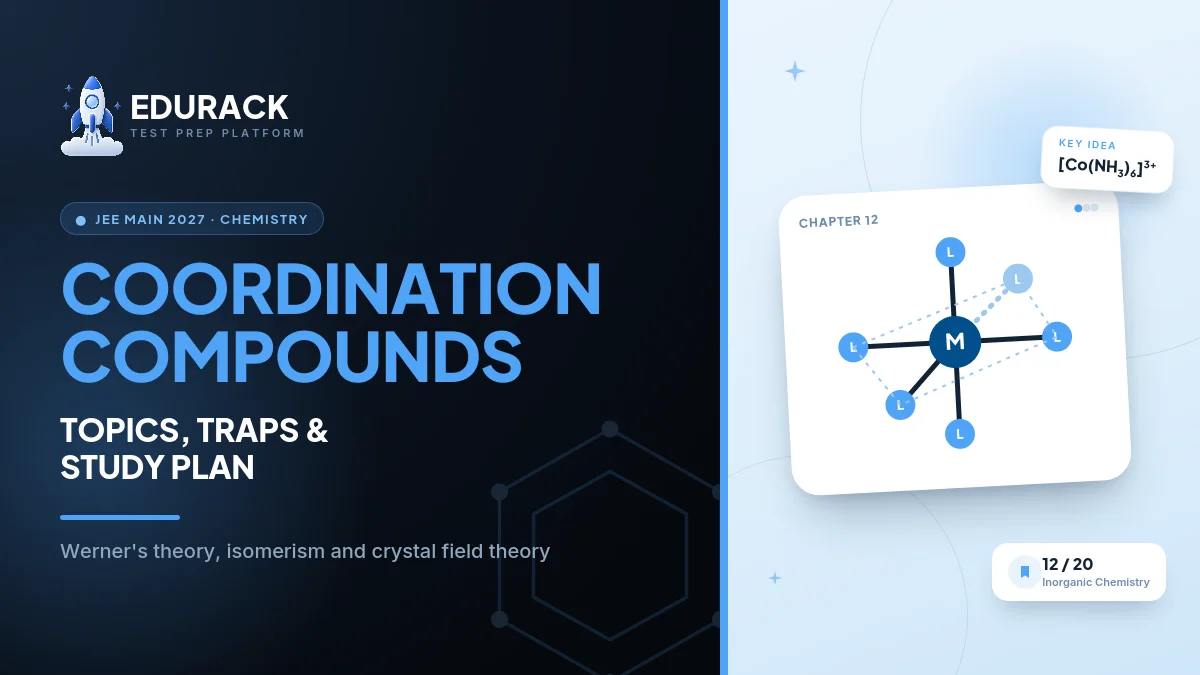
Haemoglobin, chlorophyll, vitamin B12 and the cancer drug cisplatin are all coordination compounds. In JEE Main, this chapter is a dependable source of marks because its questions follow clear patterns: name it, count isomers, or find unpaired electrons.
Strong-field ligands pair electrons up. Weak-field ligands leave them unpaired.
Chapter at a Glance
| Snapshot | Detail |
|---|---|
| NTA unit | Unit 12 of 20: Coordination Compounds |
| Priority (trend-based) | High |
| Typical question style | Naming, isomer counting and CFT-based magnetic and CFSE questions |
| Best first step | Learn naming rules, then crystal field splitting in octahedral fields |
Priority reflects past-paper trends, not an official NTA weightage.
What the NTA Syllabus Covers
- Introduction, Werner's theory, ligands, coordination number, denticity, chelation
- IUPAC nomenclature of mononuclear coordination compounds, isomerism
- Bonding: valence bond approach and basic ideas of crystal field theory, colour and magnetic properties
- Importance of coordination compounds in qualitative analysis, extraction of metals and biological systems
Master These Topics
1. Naming Coordination Compounds
Rules: name the cation first and the anion second. Inside the complex, ligands come first in alphabetical order, then the metal, with its oxidation state in Roman numerals. Negative ligands end in -o (chlorido, cyanido), and neutral ligands keep their names (ammine, aqua). For anionic complexes, the metal takes the suffix -ate.
[Co(NH₃)₅Cl]Cl₂is pentaamminechloridocobalt(III) chloride.K₃[Fe(CN)₆]is potassium hexacyanidoferrate(III).
2. Isomerism
| Type | What differs | Example |
|---|---|---|
| Ionisation | Ion inside versus outside the sphere | [Co(NH₃)₅Br]SO₄ and [Co(NH₃)₅SO₄]Br |
| Linkage | Donor atom of an ambidentate ligand | NO₂⁻ bonding through N or O |
| Coordination | Ligand exchange between cation and anion complexes | [Co(NH₃)₆][Cr(CN)₆] and its partner |
| Hydrate | Water inside or outside the sphere | [Cr(H₂O)₆]Cl₃ and [Cr(H₂O)₅Cl]Cl₂·H₂O |
| Geometrical | cis or trans arrangement | [Pt(NH₃)₂Cl₂] square planar |
| Optical | Non-superimposable mirror images | [Co(en)₃]³⁺ and cis-[Co(en)₂Cl₂]⁺ |
Trap: Trans-[Co(en)₂Cl₂]⁺ is optically inactive because it has a plane of symmetry, but the cis form is optically active.
3. Crystal Field Theory
In an octahedral field, the d orbitals split into lower t₂g (three orbitals) and higher e_g (two orbitals), separated by Δo. In a tetrahedral field the splitting is inverted and smaller: Δt = (4/9) Δo.
Whether electrons pair or spread depends on the ligand. The spectrochemical series orders ligands from weak to strong field:
I⁻ < Br⁻ < Cl⁻ < F⁻ < OH⁻ < H₂O < NH₃ < en < NO₂⁻ < CN⁻ < CO
Crystal field stabilisation energy for an octahedral complex is CFSE = (−0.4 x + 0.6 y) Δo, where x is the number of t₂g electrons and y the number of e_g electrons.
Worked example (d⁶ Fe²⁺):
[Fe(CN)₆]⁴⁻with strong-field CN⁻: t₂g⁶ e_g⁰, no unpaired electrons, diamagnetic, CFSE = −2.4 Δo.[Fe(H₂O)₆]²⁺with weak-field H₂O: t₂g⁴ e_g², four unpaired electrons, μ = √24 ≈ 4.90 BM, paramagnetic.
4. Valence Bond Theory Quick Reference
[Ni(CN)₄]²⁻is dsp² hybridised, square planar and diamagnetic.[NiCl₄]²⁻is sp³ hybridised, tetrahedral and paramagnetic (two unpaired electrons).- Inner-orbital (d²sp³) complexes are low spin, and outer-orbital (sp³d²) complexes are high spin.
5. Why the Chapter Matters
Coordination compounds appear in chlorophyll (Mg), haemoglobin (Fe), vitamin B12 (Co) and the anticancer drug cisplatin (Pt). EDTA titration is used to measure hardness of water, and complexation is used to extract silver and gold in metallurgy.
Common Traps to Avoid
- Listing ligands in the order of their charge instead of alphabetical order when naming.
- Assuming every complex with a strong-field ligand is diamagnetic. Check the d electron count.
- Using the octahedral splitting order for a tetrahedral complex.
- Counting optical isomers of trans-bis(en) complexes, which have a mirror plane.
60-Second Revision Sheet
- Naming: ligands alphabetically, then metal with oxidation state in brackets
- Octahedral:
t₂gbelowe_g;Δt = (4/9)Δo CFSE = (−0.4x + 0.6y)Δo;μ = √(n(n + 2))- Strong field: CN⁻, CO, en; weak field: I⁻, Br⁻, Cl⁻
Your Study Plan
- Day 1: ligands, denticity, coordination number and IUPAC naming.
- Day 2: all isomerism types including counting stereoisomers.
- Day 3: valence bond theory and crystal field splitting, CFSE.
- Day 4: magnetic moments, colour and a timed mixed set.
Practice Coordination Compounds Questions Free → (opens in a new tab)
Continue Your Chemistry Journey
- Previous chapter: d- & f-Block Elements
- Next chapter: Purification & Characterisation of Organic Compounds
- All JEE Main Chemistry chapters
- Complete JEE Main Syllabus 2027 guide
Frequently Asked Questions
What decides whether an octahedral complex is high spin or low spin?
The size of Δo compared with the pairing energy. Strong-field ligands give a large Δo and low-spin complexes, while weak-field ligands give high-spin complexes.
Why are many coordination compounds coloured?
Light excites an electron between the split d orbitals (d-d transition), so the complex absorbs some visible wavelengths and shows the complementary colour.