JEE Main Chemistry Purification & Characterisation of Organic Compounds 2027: Lassaigne, Kjeldahl & Dumas
Purification methods, Lassaigne's tests, and Kjeldahl, Dumas and Carius calculations, taught with worked numerical examples.
Edurack
September 28, 2026
How do you separate two liquids with nearly the same boiling point, and how do you prove a compound contains nitrogen? This chapter answers both. It is compact, and its numericals are short substitutions that reward anyone who knows the formulas.
Choose the purification technique by the property that differs: boiling point, solubility, or adsorption.
Chapter at a Glance
| Snapshot | Detail |
|---|---|
| NTA unit | Unit 13 of 20: Purification & Characterisation of Organic Compounds |
| Priority (trend-based) | Moderate |
| Typical question style | Percentage-composition numericals and test-based conceptual MCQs |
| Best first step | Learn which purification method fits which situation, then the N and CH formulas |
Priority reflects past-paper trends, not an official NTA weightage.
What the NTA Syllabus Covers
- Purification: crystallisation, sublimation, distillation, differential extraction and chromatography, with principles and applications
- Qualitative analysis: detection of nitrogen, sulphur, phosphorus and halogens
- Quantitative analysis (basic principles): estimation of C, H, N, halogens, S and P
- Empirical and molecular formula calculations and numerical problems in organic quantitative analysis
Master These Topics
1. Choosing a Purification Method
| Method | Used when | Example |
|---|---|---|
| Crystallisation | Solid differs in solubility from impurities | Sugar purification |
| Sublimation | Solid converts to vapour without melting | Camphor, naphthalene |
| Simple distillation | Liquids with boiling point difference above about 40 K | Ether and toluene |
| Fractional distillation | Boiling points close together | Petroleum fractions |
| Steam distillation | Compound is steam volatile and immiscible with water | Aniline |
| Vacuum distillation | Compound decomposes at its boiling point | Glycerol |
| Chromatography | Components adsorb or partition differently | Pigments, amino acids |
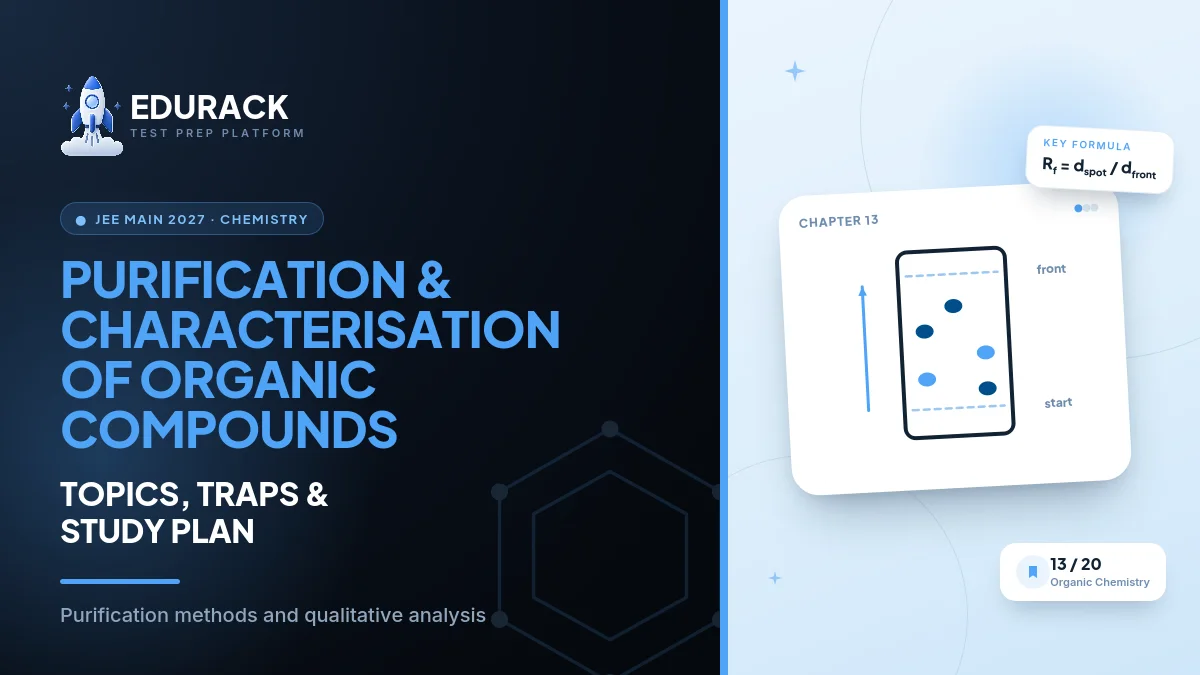
In chromatography, Rf = distance moved by the compound / distance moved by the solvent front, and Rf is always less than 1.
2. Lassaigne's Test: Detecting N, S and Halogens
The organic compound is fused with sodium metal, converting covalent elements to ionic form: N to NaCN, S to Na₂S and halogens to NaX. The aqueous extract is then tested.
- Nitrogen: Prussian blue colour after adding FeSO₄ and acidifying.
- Sulphur: violet colour with sodium nitroprusside, or a black precipitate with lead acetate.
- Halogens: AgNO₃ gives a white curdy precipitate of AgCl (soluble in NH₃), a pale yellow precipitate of AgBr (partly soluble) or a yellow precipitate of AgI (insoluble).
- Nitrogen and sulphur together: blood-red colour from ferric thiocyanate.
3. Estimation of Carbon and Hydrogen
Carbon and hydrogen are converted to CO₂ and H₂O by combustion:
% C = (12/44) × (mass of CO₂ / mass of compound) × 100% H = (2/18) × (mass of H₂O / mass of compound) × 100
Worked example: 0.2 g of a compound gives 0.44 g CO₂ and 0.18 g H₂O. Then %C = (12/44) × (0.44/0.2) × 100 = 60% and %H = (2/18) × (0.18/0.2) × 100 = 10%. The rest (30%) is oxygen, if no other elements are present.
4. Estimation of Nitrogen: Dumas and Kjeldahl
- Dumas method: nitrogen is converted to N₂ gas and its volume is measured at STP.
% N = (28 × V) / (22400 × m) × 100, where V is in mL and m is the mass in grams. - Kjeldahl method: nitrogen is converted to ammonium sulphate, then to NH₃, which is absorbed in a known volume of standard acid.
% N = 1.4 × N × V / m, where N is the normality of the acid used, V its volume in mL and m the mass of the compound in grams.
Worked example: 0.5 g of a compound gives ammonia that neutralises 20 mL of 0.5 N H₂SO₄. Then %N = 1.4 × 0.5 × 20 / 0.5 = 28%.
Trap: The Kjeldahl method does not work for compounds containing nitro or azo groups, or nitrogen in a ring (as in pyridine). These need the Dumas method.
Halogens and sulphur are estimated by the Carius method, and phosphorus is converted to phosphate and precipitated as ammonium phosphomolybdate.
Common Traps to Avoid
- Using Kjeldahl for nitro or azo compounds or ring nitrogen.
- Mixing up the roles of N, V and m in the Kjeldahl formula.
- Forgetting that AgI is insoluble in ammonia while AgCl dissolves.
- Picking fractional distillation when steam distillation is the correct choice for a steam-volatile compound.
60-Second Revision Sheet
Rf < 1; Rf is the ratio of distances travelled% C = (12/44)(m CO₂/m) × 100;% H = (2/18)(m H₂O/m) × 100- Kjeldahl
% N = 1.4 N V / m; Dumas% N = 28V / (22400 m) × 100 - Lassaigne: N gives Prussian blue; S gives violet with nitroprusside
Your Study Plan
- Day 1: purification methods and choosing the right one.
- Day 2: Lassaigne's tests and confirmatory reactions.
- Day 3: C, H, N percentage calculations and empirical formulae.
- Day 4: Carius method, phosphorus estimation and a timed set.
Practice Purification & Characterisation of Organic Compounds Questions Free → (opens in a new tab)
Continue Your Chemistry Journey
- Previous chapter: Coordination Compounds
- Next chapter: Basic Principles of Organic Chemistry
- All JEE Main Chemistry chapters
- Complete JEE Main Syllabus 2027 guide
Frequently Asked Questions
Why is sodium fusion used in Lassaigne's test?
It converts covalently bonded N, S and halogens into ionic sodium salts that dissolve in water and can be identified by simple ionic tests.
When is steam distillation used?
For substances that are volatile in steam, immiscible with water and would decompose at their own boiling point, such as aniline.