JEE Main Physics Units & Measurements 2027: Dimensions, Errors & Significant Figures
The quietest scoring chapter in JEE Physics. Learn dimensional analysis, error rules and significant figures with worked examples and the traps NTA loves.
Edurack
September 28, 2026
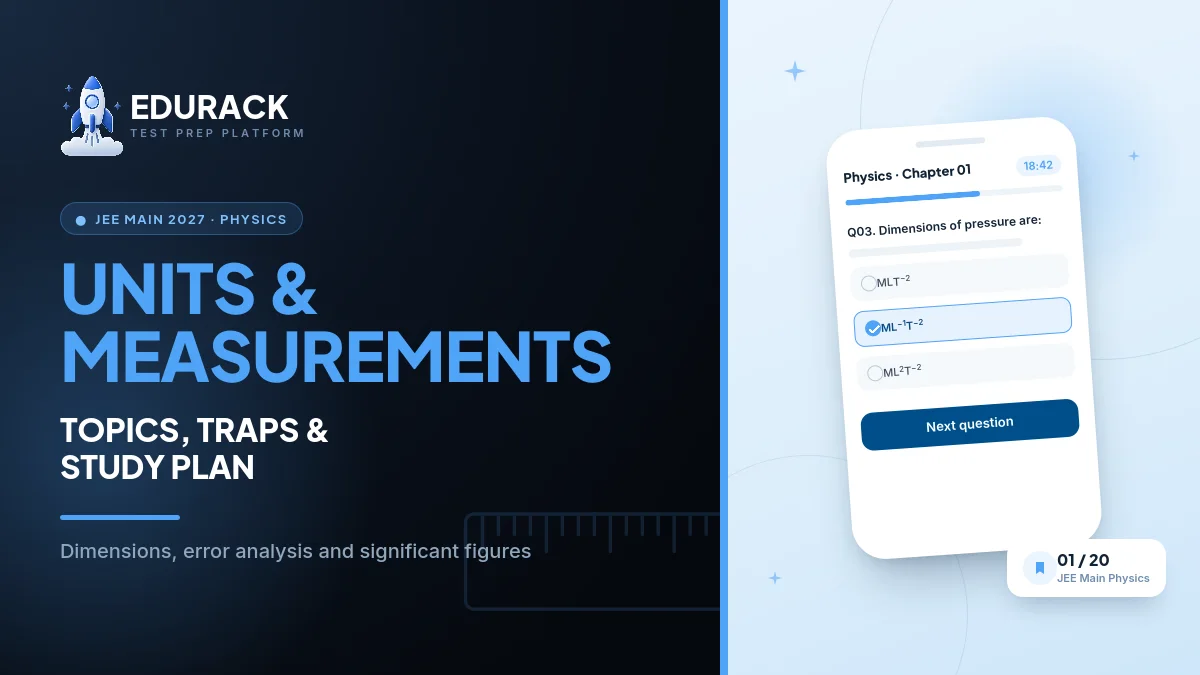
Here is a secret most toppers use: a single dimension check can cross out three wrong options in about 15 seconds. Units & Measurements is the first chapter of JEE Main Physics, and because it feels 'too easy', most students skim it. That is exactly why it is a reliable source of quick marks.
Dimensions do not solve the problem for you. They tell you which answers are impossible.
Chapter at a Glance
| Snapshot | Detail |
|---|---|
| NTA unit | Unit 1 of 20 — Units & Measurements |
| Priority (trend-based) | Moderate |
| Typical question style | Short conceptual MCQs and error-percentage numericals |
| Best first step | Memorise the dimensions table, then drill error propagation |
Priority reflects past-paper trends, not an official NTA weightage.
What the NTA Syllabus Covers
- Units of measurement, SI system, fundamental and derived units
- Least count and significant figures
- Errors in measurement
- Dimensions of physical quantities, dimensional analysis and its applications
Master These Topics
1. Dimensional Analysis: Your 15-Second Answer Filter
Every physical quantity can be written in terms of base dimensions: mass M, length L and time T (plus current A and temperature K when needed). The principle of homogeneity says that every term in a valid equation must have the same dimensions.
| Quantity | Dimensions |
|---|---|
| Force | MLT⁻² |
| Work, energy | ML²T⁻² |
| Power | ML²T⁻³ |
| Pressure, stress | ML⁻¹T⁻² |
| Momentum, impulse | MLT⁻¹ |
| Angular momentum, Planck's constant | ML²T⁻¹ |
| Surface tension | MT⁻² |
| Coefficient of viscosity | ML⁻¹T⁻¹ |
| Gravitational constant G | M⁻¹L³T⁻² |
Dimensional analysis does three jobs: it checks whether a formula can be right, converts units, and derives relations.
Worked example (derive a formula): Suppose the time period of a pendulum depends on length l, mass m and gravity g. Write T = k · l^a · m^b · g^c. Matching dimensions: T¹ = L^a · M^b · (LT⁻²)^c. Mass has no partner on the left, so b = 0. Time gives −2c = 1, so c = −½. Length gives a + c = 0, so a = ½. Hence T ∝ √(l/g), and we found it without any physics beyond dimensions.
Trap: Dimensions can never give you numerical constants such as 2π, cannot handle formulas that are sums of several terms, and the argument of sin, log or exponential must always be dimensionless.
2. Error Analysis: Rules That Never Change
Three rules cover almost every question.
- Sum or difference: absolute errors add.
Δ(A ± B) = ΔA + ΔB. Yes, even for subtraction. - Product or quotient: relative (percentage) errors add.
- Power:
A^nhas relative errorn · (ΔA / A).
Worked example: To find g from a pendulum, g = 4π²l / T². Suppose l = 100.0 cm with error 0.1 cm (0.1%) and T = 2.00 s with error 0.02 s (1%). Then Δg/g = 0.1% + 2 × 1% = 2.1%. The squared term doubles the contribution of the time error, which is why timing accuracy matters most in this experiment.
Second example: A cube has side 2.0 cm ± 0.02 cm and mass 16.0 g ± 0.1 g. Density is m / a³. Relative error is 0.1/16 + 3 × (0.02/2.0) = 0.625% + 3% ≈ 3.6%. The density is 2.0 g/cm³ with an error of about 0.07.
3. Significant Figures and Least Count
- Non-zero digits are always significant. Zeros between them are significant.
- Leading zeros are not significant: 0.0250 has 3 significant figures.
- Trailing zeros after a decimal point are significant.
- Addition and subtraction: keep the fewest decimal places. Example: 12.11 + 0.023 = 12.133, reported as 12.13.
- Multiplication and division: keep the fewest significant figures. Example: 4.0 × 2.35 = 9.4.
Least count is the smallest reading an instrument can measure. For a vernier caliper it is 1 main scale division minus 1 vernier scale division. For a screw gauge it is pitch divided by the number of circular scale divisions. A screw gauge with pitch 0.5 mm and 50 divisions has a least count of 0.01 mm.
Common Traps to Avoid
- Subtracting errors when two quantities are subtracted. Absolute errors always add.
- Forgetting that a squared or cubed quantity multiplies its percentage error.
- Treating dimensional agreement as proof that a formula is correct. It is only a necessary condition.
- Counting leading zeros as significant figures.
60-Second Revision Sheet
- Force
MLT⁻², energyML²T⁻², pressureML⁻¹T⁻², GM⁻¹L³T⁻² - Error in
A^m · B^n:m(ΔA/A) + n(ΔB/B) - Add or subtract: fewest decimal places. Multiply or divide: fewest significant figures
- Vernier least count = 1 MSD − 1 VSD; screw gauge = pitch ÷ divisions
Your Study Plan
- Day 1: learn the dimensions table until you can write it from memory.
- Day 2: derive three relations by dimensional analysis (pendulum, orbital speed, drag).
- Day 3: solve ten percentage-error problems, mixing powers and quotients.
- Day 4: attempt a timed set of chapter questions and log every slip.
Practice Units & Measurements Questions Free → (opens in a new tab)
Continue Your Physics Journey
Frequently Asked Questions
How many marks can Units and Measurements give in JEE Main?
It usually contributes one or two questions, but the skills (dimensions and error analysis) are reused across the entire Physics paper, especially in experimental-skills questions.
Is dimensional analysis enough to solve a full problem?
No. It filters wrong options and derives proportionality, but it can never supply pure numbers like 2π or ½. Use it as a check, not a full solution.