JEE Main Maths Vector Algebra 2027: Dot Product, Cross Product & the Parallelogram Law
Vector addition, components, the scalar (dot) and vector (cross) products, taught with worked examples that connect back to geometry.
Edurack
October 1, 2026
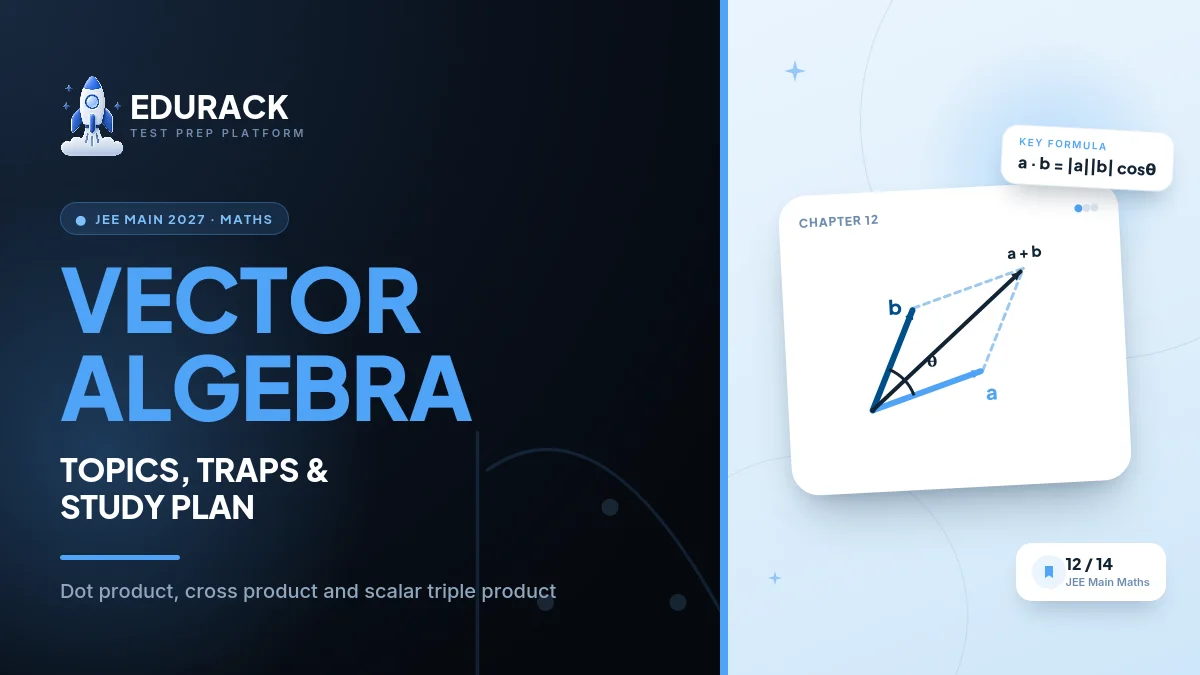
Two operations power this entire chapter: the dot product, which measures how aligned two vectors are, and the cross product, which measures the area they span. Once those two ideas are intuitive, Vector Algebra becomes fast and mechanical.
The dot product answers 'how much do these vectors agree in direction?' The cross product answers 'how much area do they enclose?'
Chapter at a Glance
| Snapshot | Detail |
|---|---|
| NTA unit | Unit 12 of 14: Vector Algebra |
| Priority (trend-based) | Moderate |
| Typical question style | Dot and cross product numericals, angle-between-vectors and area problems |
| Best first step | Learn what dot and cross products mean geometrically |
Priority reflects past-paper trends, not an official NTA weightage.
What the NTA Syllabus Covers
- Vectors and scalars, addition of vectors
- Components of a vector in two dimensions and three-dimensional spaces
- Scalar and vector products
Master These Topics
1. Vector Addition and Components
By the triangle law, placing vectors head to tail gives their sum. The equivalent parallelogram law places both vectors from a common point, and the sum is the diagonal.
%22%2F%3E%3Cline%20x1%3D%2270.0%22%20y1%3D%22214.0%22%20x2%3D%22150.0%22%20y2%3D%22108.0%22%20stroke%3D%22%2316a34a%22%20stroke-width%3D%222.6%22%20marker-end%3D%22url(%23ar-green)%22%2F%3E%3Cline%20x1%3D%2270.0%22%20y1%3D%22214.0%22%20x2%3D%22330.0%22%20y2%3D%2284.0%22%20stroke%3D%22%23dc2626%22%20stroke-width%3D%223%22%20marker-end%3D%22url(%23ar-red)%22%2F%3E%3Cpath%20d%3D%22M113.6%2C208.2%20A44%2C44%200%200%200%2096.5%2C178.9%22%20fill%3D%22none%22%20stroke%3D%22%23475569%22%20stroke-width%3D%221.6%22%2F%3E%3Ctext%20x%3D%22128.0%22%20y%3D%22188.0%22%20font-size%3D%2214%22%20fill%3D%22%23475569%22%20text-anchor%3D%22start%22%20font-weight%3D%22normal%22%20font-style%3D%22italic%22%3E%CE%B8%3C%2Ftext%3E%3Ctext%20x%3D%22160.0%22%20y%3D%22224.0%22%20font-size%3D%2215%22%20fill%3D%22%232563eb%22%20text-anchor%3D%22middle%22%20font-weight%3D%22bold%22%20font-style%3D%22italic%22%3Ea%3C%2Ftext%3E%3Ctext%20x%3D%2296.0%22%20y%3D%22161.0%22%20font-size%3D%2215%22%20fill%3D%22%2316a34a%22%20text-anchor%3D%22middle%22%20font-weight%3D%22bold%22%20font-style%3D%22italic%22%3Eb%3C%2Ftext%3E%3Ctext%20x%3D%22206.0%22%20y%3D%22127.0%22%20font-size%3D%2214%22%20fill%3D%22%23dc2626%22%20text-anchor%3D%22middle%22%20font-weight%3D%22bold%22%20font-style%3D%22normal%22%3Ea%20%2B%20b%3C%2Ftext%3E%3Ctext%20x%3D%2226.0%22%20y%3D%2234.0%22%20font-size%3D%2213%22%20fill%3D%22%230f172a%22%20text-anchor%3D%22start%22%20font-weight%3D%22bold%22%20font-style%3D%22normal%22%3EParallelogram%20law%3C%2Ftext%3E%3Ctext%20x%3D%2226.0%22%20y%3D%2254.0%22%20font-size%3D%2212%22%20fill%3D%22%230f172a%22%20text-anchor%3D%22start%22%20font-weight%3D%22normal%22%20font-style%3D%22normal%22%3EDiagonal%20%3D%20a%20%2B%20b%3C%2Ftext%3E%3Ctext%20x%3D%2226.0%22%20y%3D%2272.0%22%20font-size%3D%2212%22%20fill%3D%22%230f172a%22%20text-anchor%3D%22start%22%20font-weight%3D%22normal%22%20font-style%3D%22normal%22%3EArea%20%3D%20%7Ca%20%C3%97%20b%7C%3C%2Ftext%3E%3Ctext%20x%3D%2226.0%22%20y%3D%2290.0%22%20font-size%3D%2212%22%20fill%3D%22%230f172a%22%20text-anchor%3D%22start%22%20font-weight%3D%22normal%22%20font-style%3D%22normal%22%3Ea%20%C2%B7%20b%20%3D%20%7Ca%7C%7Cb%7C%20cos%20%CE%B8%3C%2Ftext%3E%3Ctext%20x%3D%22210.0%22%20y%3D%22262.0%22%20font-size%3D%2211%22%20fill%3D%22%23475569%22%20text-anchor%3D%22middle%22%20font-weight%3D%22normal%22%20font-style%3D%22normal%22%3EDot%20product%20measures%20alignment%3B%20cross%20product%20measures%20the%20area%20spanned%3C%2Ftext%3E%3C%2Fsvg%3E)
A vector has magnitude . A unit vector in its direction is .
2. Scalar (Dot) Product
The dot product is zero exactly when the vectors are perpendicular, and it gives the angle between two vectors directly.
Worked example: , . Then , and , so , giving .
The projection of onto (a scalar length) is .
Trap: The dot product of two vectors is a scalar, not a vector. Never write as if it had a direction.
3. Vector (Cross) Product
where is the unit vector perpendicular to both, by the right-hand rule. In components,
The magnitude equals the area of the parallelogram formed by and , so the area of the triangle they form is half that.
Worked example: , : , magnitude , matching the unit square they span.
Worked example (2D area, matching the diagram): , . Treating these as vectors in the plane, the parallelogram area is , and the diagonal has magnitude .
Trap: The cross product is anti-commutative: . Order matters.
4. Quick Reference: When to Use Which
| Question asks for | Use |
|---|---|
| Angle between two vectors | Dot product |
| Whether vectors are perpendicular | Dot product |
| Area of a triangle or parallelogram | Cross product |
| A vector perpendicular to two given vectors | Cross product |
Common Traps to Avoid
- Writing the dot product result as a vector instead of a scalar.
- Forgetting that .
- Using the cross product magnitude directly as the triangle's area instead of halving it.
- Confusing the projection formula (a scalar) with the projection vector.
60-Second Revision Sheet
- ; zero when perpendicular
- ; area of parallelogram
- Triangle area
- (anti-commutative)
Your Study Plan
- Day 1: vector addition, components and magnitude.
- Day 2: dot product, angle between vectors and projections.
- Day 3: cross product and area problems.
- Day 4: mixed application problems and a timed set.
Practice Vector Algebra Questions Free → (opens in a new tab)
Continue Your Maths Journey
- Previous chapter: Three Dimensional Geometry
- Next chapter: Statistics & Probability
- All 14 JEE Main Maths chapters
- Complete JEE Main Syllabus 2027 guide
Frequently Asked Questions
How do I find the angle between two vectors?
Use , computing the dot product and magnitudes from the components.
What does the magnitude of a cross product represent?
The area of the parallelogram formed by the two vectors. Halving it gives the area of the triangle they form.