JEE Main Chemistry Organic Compounds Containing Nitrogen 2027: Amines, Basicity & Diazonium Salts
Amine classification, basic strength order, tests for 1°, 2° and 3° amines and the synthetic power of diazonium salts, with worked examples.
Edurack
September 28, 2026
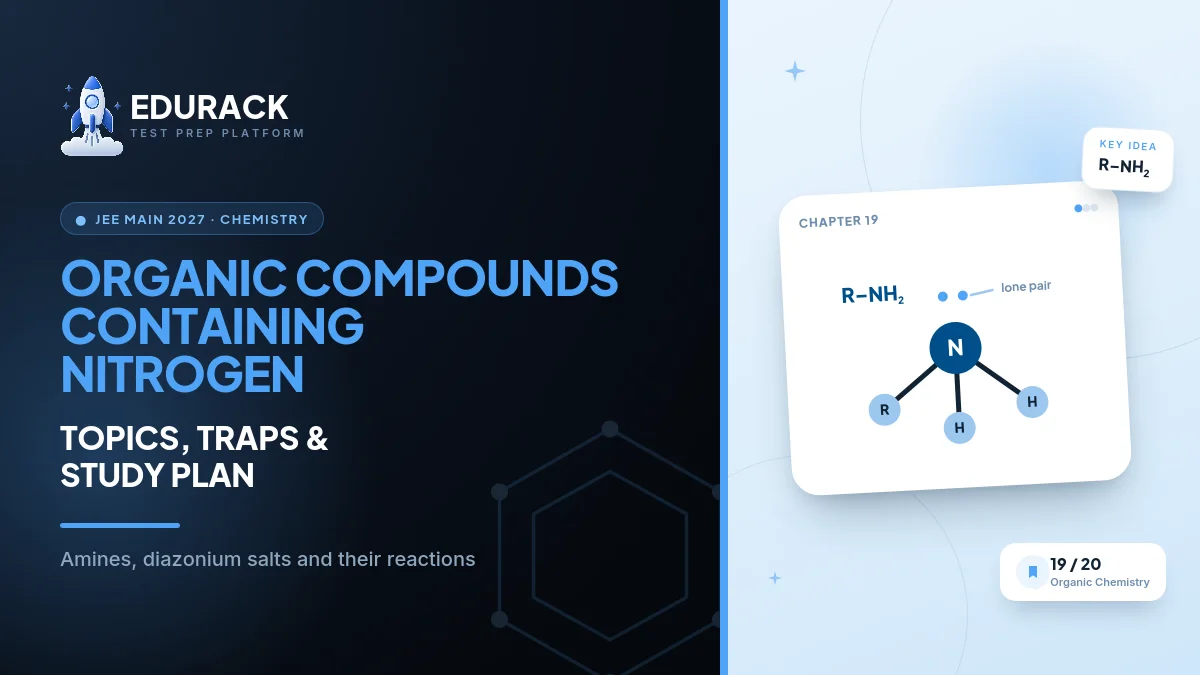
Amines are bases, and diazonium salts are the Swiss army knife of aromatic chemistry. JEE Main draws on both: a basicity ordering question, a test to tell amine types apart, or a conversion that runs through a diazonium salt.
A diazonium salt lets you swap the nitrogen group for almost anything: halogen, cyanide, hydroxyl or hydrogen.
Chapter at a Glance
| Snapshot | Detail |
|---|---|
| NTA unit | Unit 18 of 20: Organic Compounds Containing Nitrogen |
| Priority (trend-based) | Moderate |
| Typical question style | Basicity ordering, test-based and conversion MCQs |
| Best first step | Learn the basicity orders and the diazonium reaction map |
Priority reflects past-paper trends, not an official NTA weightage.
What the NTA Syllabus Covers
- General methods of preparation, properties, reactions and uses
- Amines: nomenclature, classification, structure, basic character, identification of primary, secondary and tertiary amines
- Diazonium salts: importance in synthetic organic chemistry
Master These Topics
1. Basic Character of Amines
Amines are basic because of the lone pair on nitrogen. Electron-donating alkyl groups increase basicity, but solvation and steric effects complicate the order in water.
Aqueous methyl amines: (CH₃)₂NH > CH₃NH₂ > (CH₃)₃N > NH₃
Aqueous ethyl amines: (C₂H₅)₂NH > (C₂H₅)₃N > C₂H₅NH₂ > NH₃
Approximate pKb values: methylamine 3.38, dimethylamine 3.27, trimethylamine 4.22, ammonia 4.75 and aniline 9.38. In the gas phase, the order is simply 3° > 2° > 1°.
Aromatic amines are much weaker bases, because the lone pair is delocalised into the ring. Electron-donating groups on the ring raise basicity (p-toluidine > aniline), and electron-withdrawing groups lower it (p-nitroaniline < aniline).
Trap: In water, tertiary amines are not the strongest bases, since poor solvation of their conjugate acids offsets the inductive effect.
2. Preparation of Amines
- Reduction of nitro compounds with
Sn/HClorH₂/Pd. - Hofmann bromamide degradation: an amide with Br₂ and NaOH gives a primary amine with one carbon fewer, for example
CH₃CONH₂ → CH₃NH₂. - Gabriel phthalimide synthesis: gives pure primary aliphatic amines, but not aromatic ones.
- Ammonolysis of alkyl halides gives a mixture of 1°, 2°, 3° amines and quaternary salts.
3. Distinguishing 1°, 2° and 3° Amines
- Carbylamine test: primary amines heated with CHCl₃ and KOH give a foul-smelling isocyanide. Secondary and tertiary amines do not.
- Hinsberg's reagent (benzenesulphonyl chloride): the primary amine product dissolves in NaOH, the secondary amine product is insoluble, and the tertiary amine does not react.
- Nitrous acid: aliphatic primary amines give alcohols with nitrogen gas, while aromatic primary amines at 273-278 K give diazonium salts.
4. Diazonium Salts: Reaction Map
Aniline with NaNO₂ + HCl at 273-278 K gives benzene diazonium chloride. It is stable only in the cold, and aromatic diazonium salts are more stable than aliphatic ones due to resonance.
| Reagent | Product |
|---|---|
| CuCl/HCl, CuBr/HBr, CuCN/KCN (Sandmeyer) | Ar-Cl, Ar-Br, Ar-CN |
| Cu powder with HX (Gattermann) | Ar-X |
| KI | Ar-I |
| HBF₄ then heat (Balz-Schiemann) | Ar-F |
| Warm water | Phenol |
| H₃PO₂ | Benzene (removes the group) |
| Phenol or aniline (coupling) | Azo dyes |
Worked example: Benzene diazonium chloride with β-naphthol in alkaline medium gives an orange-red azo dye by coupling at the para position (or ortho if para is blocked). This is a classic test for aromatic primary amines.
Common Traps to Avoid
- Assuming tertiary amines are the strongest bases in water.
- Using Gabriel synthesis for aromatic amines.
- Running diazotisation at room temperature instead of 273-278 K.
- Forgetting that Hofmann degradation gives an amine with one carbon fewer.
60-Second Revision Sheet
- Aqueous basicity for methyl amines:
2° > 1° > 3° > NH₃; aromatic amines are weak bases - Carbylamine test for primary amines only
- Hofmann bromamide: amide gives amine with one fewer carbon
- Diazonium: Sandmeyer (CuX), KI, HBF₄, H₃PO₂, coupling gives azo dyes
Your Study Plan
- Day 1: amine classification, nomenclature and preparation methods.
- Day 2: basicity orders and factors, including aromatic amines.
- Day 3: distinguishing tests and Hofmann/Gabriel reactions.
- Day 4: diazonium reactions and multi-step conversions, timed set.
Practice Organic Compounds Containing Nitrogen Questions Free → (opens in a new tab)
Continue Your Chemistry Journey
- Previous chapter: Aldehydes, Ketones & Carboxylic Acids
- Next chapter: Biomolecules
- All JEE Main Chemistry chapters
- Complete JEE Main Syllabus 2027 guide
Frequently Asked Questions
Why is aniline less basic than methylamine?
In aniline the nitrogen lone pair is delocalised into the benzene ring by resonance, so it is less available to accept a proton.
Why must diazotisation be carried out at 273-278 K?
Above this range diazonium salts decompose, releasing nitrogen and forming phenol.