JEE Main Chemistry Aldehydes, Ketones & Carboxylic Acids 2027: Aldol, Cannizzaro & Haloform
Nucleophilic addition, Aldol, Cannizzaro and haloform reactions, Wolff-Kishner and Clemmensen reductions, tests for carbonyls and acidity of carboxylic acids.
Edurack
September 28, 2026
Ask any JEE Chemistry teacher for the most productive Organic chapter and the answer is usually this one. Its named reactions, Aldol, Cannizzaro and haloform, appear again and again, and every one of them has clear conditions that you can learn in an evening.
The question to ask first: does the carbonyl compound have an alpha hydrogen?
Chapter at a Glance
| Snapshot | Detail |
|---|---|
| NTA unit | Unit 17 (part 2) of 20: Organic Compounds Containing Oxygen: Aldehydes, Ketones & Carboxylic Acids |
| Priority (trend-based) | High |
| Typical question style | Named-reaction product prediction, test-based and acidity-order MCQs |
| Best first step | Learn the four named reactions with their conditions |
Priority reflects past-paper trends, not an official NTA weightage.
What the NTA Syllabus Covers
- Nature of the carbonyl group, nucleophilic addition, relative reactivities of aldehydes and ketones
- Addition of HCN, NH₃ and its derivatives, Grignard reagent, oxidation, reduction (Wolff-Kishner and Clemmensen), acidity of α-hydrogen
- Aldol condensation, Cannizzaro reaction, haloform reaction, tests to distinguish aldehydes from ketones
- Carboxylic acids: acidic strength and factors affecting it
Master These Topics
1. Nucleophilic Addition
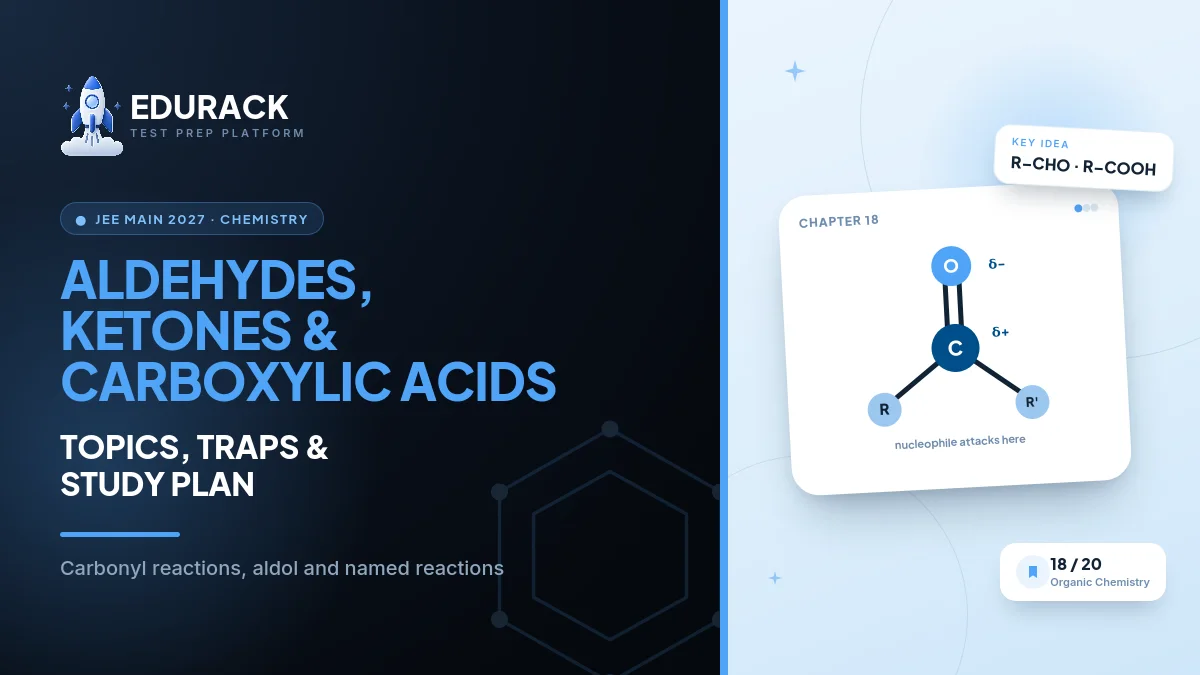
The carbonyl carbon is electrophilic, so nucleophiles attack it. Aldehydes are more reactive than ketones, because they have less steric hindrance and only one electron-donating alkyl group.
- HCN gives cyanohydrins.
- NH₃ derivatives give C=N compounds: hydroxylamine gives oximes, hydrazine gives hydrazones, and 2,4-DNP gives an orange precipitate used as a test for carbonyls.
- Grignard reagent: RMgX with formaldehyde gives a primary alcohol, other aldehydes give secondary alcohols, and ketones give tertiary alcohols (after hydrolysis).
2. Reduction of the Carbonyl to CH₂
- Clemmensen:
Zn-Hg / conc. HCl(acidic conditions). - Wolff-Kishner:
NH₂NH₂ / KOHin ethylene glycol on heating (basic conditions).
Choose based on what else the molecule can tolerate: an acid-sensitive group needs Wolff-Kishner.
3. The Big Three Named Reactions
Aldol condensation needs an α-hydrogen. Dilute NaOH converts two molecules into a β-hydroxy carbonyl compound, and heat causes dehydration to an α,β-unsaturated carbonyl. Worked example: 2CH₃CHO gives 3-hydroxybutanal, which loses water to give crotonaldehyde.
Cannizzaro reaction occurs in aldehydes with no α-hydrogen (HCHO, benzaldehyde) in concentrated NaOH. One molecule is oxidised and the other reduced. Worked example: 2HCHO + NaOH → CH₃OH + HCOONa.
Haloform reaction: compounds with a CH₃CO− group, or CH₃CH(OH)− that can be oxidised to it, react with I₂ and NaOH to give yellow iodoform (CHI₃). Acetone, acetaldehyde, ethanol and propan-2-ol give it. Methanol, formaldehyde, benzaldehyde and 3-pentanone do not.
Trap: Ethanal is the only aldehyde that gives the iodoform test, and ethanol is the only primary alcohol that does.
4. Distinguishing Aldehydes from Ketones
- Tollens' reagent (ammoniacal silver nitrate) gives a silver mirror with aldehydes.
- Fehling's solution gives a red precipitate of Cu₂O with aliphatic aldehydes only. Aromatic aldehydes do not respond.
- Ketones give neither test.
5. Acidity of Carboxylic Acids
Carboxylic acids are stronger than phenols and alcohols, because the carboxylate ion is resonance-stabilised by two equivalent structures. Electron-withdrawing groups increase acidity and electron-donating groups decrease it.
Order: Cl₃CCOOH > Cl₂CHCOOH > ClCH₂COOH > CH₃COOH. Also, HCOOH > CH₃COOH, and fluoroacetic acid is stronger than chloroacetic acid. For acetic acid, pKa is about 4.76.
Common Traps to Avoid
- Applying Aldol to compounds without α-hydrogen, or Cannizzaro to compounds that have one.
- Assuming aromatic aldehydes give Fehling's test.
- Using Clemmensen when the molecule contains an acid-sensitive group.
- Forgetting that only compounds with the CH₃CO− or CH₃CH(OH)− unit give the iodoform test.
60-Second Revision Sheet
- Aldol needs α-H; Cannizzaro needs no α-H and conc. NaOH
- Haloform: I₂ + NaOH gives yellow CHI₃ with CH₃CO− or CH₃CH(OH)− groups
- Grignard: HCHO gives 1° alcohol, other aldehydes give 2°, ketones give 3°
- Tollens gives a silver mirror; Fehling works only with aliphatic aldehydes
Your Study Plan
- Day 1: nucleophilic addition, reactivity order and Grignard products.
- Day 2: Aldol and Cannizzaro, with crossed variants.
- Day 3: haloform reaction, Wolff-Kishner, Clemmensen and identification tests.
- Day 4: carboxylic acid acidity ordering and a timed mixed set.
Practice Aldehydes, Ketones & Carboxylic Acids Questions Free → (opens in a new tab)
Continue Your Chemistry Journey
- Previous chapter: Alcohols, Phenols & Ethers
- Next chapter: Organic Compounds Containing Nitrogen
- All JEE Main Chemistry chapters
- Complete JEE Main Syllabus 2027 guide
Frequently Asked Questions
Which compounds give the iodoform test?
Those containing a CH₃CO− group or a CH₃CH(OH)− group, such as acetaldehyde, acetone, ethanol and propan-2-ol.
What is the difference between Aldol and Cannizzaro reactions?
Aldol needs an α-hydrogen and adds two carbonyl molecules to form a carbon-carbon bond. Cannizzaro needs no α-hydrogen and disproportionates the aldehyde into an alcohol and a carboxylate.