JEE Main vs JEE Advanced: differences and which to prepare
72% of JoSAA seats are allotted on JEE Main rank alone. See the real differences between JEE Main and JEE Advanced, how the funnel works, and which one to prepare for your target.
Edurack
October 1, 2026
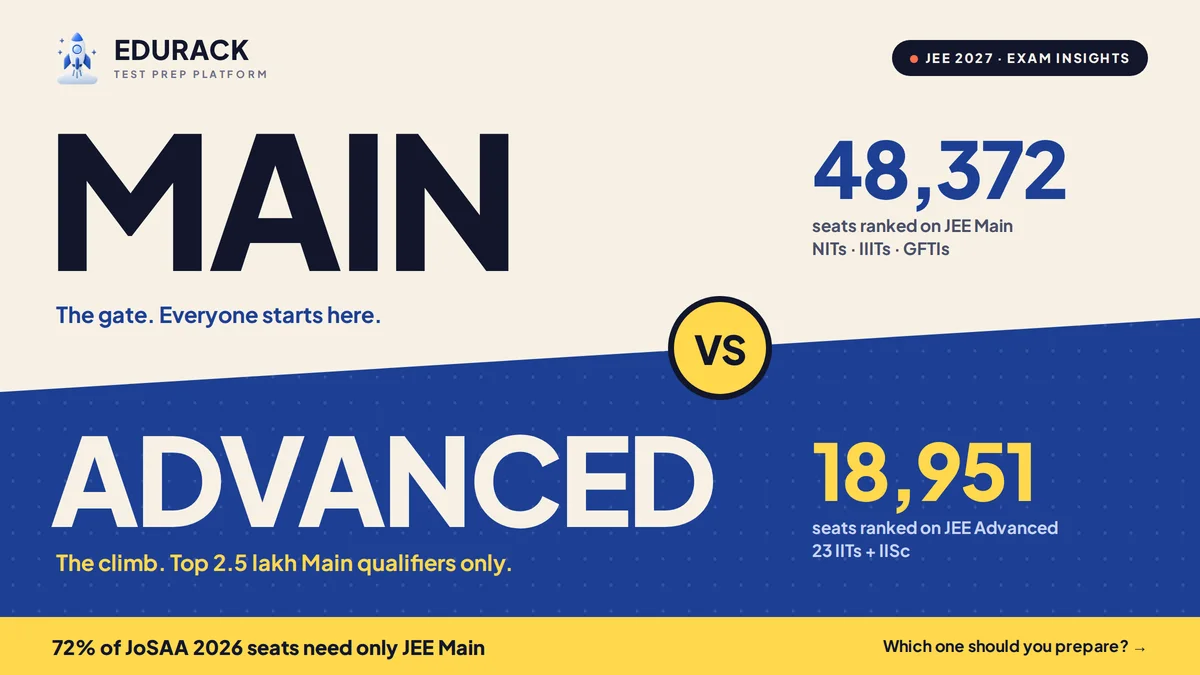
Here is a number most JEE aspirants never see: of the 67,323 seats offered through JoSAA in 2026, 48,372 (about 72%) were allotted on your JEE Main rank. Only 18,951 seats, the 23 IITs plus IISc Bengaluru, were allotted on JEE Advanced. So when people ask "Main or Advanced?", they are usually asking the wrong question. The real question is which seats you are aiming for, and what each exam has to do with them.
JEE Main vs JEE Advanced at a glance
| Feature | JEE Main | JEE Advanced |
|---|---|---|
| Conducted by | National Testing Agency (NTA) | One of seven IITs in rotation (IIT Roorkee in 2026) |
| Who can sit | Anyone eligible after Class 12 | Only the top 2.5 lakh JEE Main qualifiers |
| How often | Two sessions a year (January and April in 2026) | Once a year (17 May in 2026) |
| Attempt limit | Three consecutive years from your Class 12 passing year | Two attempts in two consecutive years |
| Paper | One paper, 75 questions, 300 marks | Two papers, both compulsory (360 marks in total in 2026) |
| Question style | MCQs plus numerical answers, fixed pattern | Mixed question types, and the pattern changes from year to year |
| Result | NTA percentile, then All India Rank | Marks-based rank |
| Opens the door to | NITs, IIITs, GFTIs, many state and private colleges | The 23 IITs and IISc Bengaluru |
| 2026 numbers | About 15.4 lakh candidates appeared | 1,79,694 appeared, 56,880 qualified |
Two things in that table matter more than the rest. Main is a gate: you cannot sit Advanced without clearing it. Main is also a destination: it directly fills the majority of JoSAA seats.
The funnel: how 15 lakh becomes 56,880
Think of the two exams as one long funnel, with each stage filtering the one before it.
| Stage (2026) | Candidates |
|---|---|
| Appeared in JEE Main (across both sessions) | About 15.4 lakh |
| Qualified for JEE Advanced | 2,50,182 |
| Registered for JEE Advanced | 1,87,389 |
| Appeared in both Advanced papers | 1,79,694 |
| Qualified in JEE Advanced | 56,880 |
Some quick maths from those numbers:
- About 1 in 6 JEE Main candidates made the Advanced eligibility list. For the General category, that meant a percentile of 93.4123549 or higher (the 2026 qualifying cutoff).
- About 1 in 3 of those who actually wrote Advanced qualified (56,880 of 1,79,694, roughly 32%).
- Fewer than 4 in 100 of all Main candidates ended up Advanced-qualified. Candidates who attempt twice are counted each year, so treat this as a rough picture.
Notice something else: about 70,000 of the 2.5 lakh eligible candidates never wrote Advanced at all. Some were not interested, some were not prepared, and some were happy with their Main-rank options.
Where the seats actually are
This is the table that should shape your preparation. JoSAA 2026 had 138 participating institutes and 67,323 seats in total.
| Institutes | Seats (2026) | Rank used |
|---|---|---|
| 23 IITs + IISc Bengaluru | 18,951 | JEE Advanced |
| 31 NITs | 25,162 | JEE Main |
| 26 IIITs | 11,518 | JEE Main |
| 56 GFTIs | 11,692 | JEE Main |
| Total | 67,323 |
Add the three Main-rank lines and you get 48,372 seats, which is about 72% of the pool. Put the other way, there is roughly one IIT seat for every 80 JEE Main candidates, so the IITs are the narrowest door in the building.
So which one should you prepare?
You do not choose between the exams. You choose a target, and the target tells you how to split your effort. Here is a simple way to decide.
| Your target | What to prepare | Why |
|---|---|---|
| An IIT, any branch | Advanced-level depth from day one, with Main as the gate | You must clear Main to qualify, and Advanced decides the seat |
| A top NIT or IIIT branch | JEE Main, treated as the main event | Your Main rank is the only rank that counts |
| A good government college, safely | JEE Main, maximising both sessions | You need a strong, reliable percentile, not a lucky shift |
| Not sure yet (Class 11) | Concepts at Advanced depth, tested in Main format | The core syllabus overlaps heavily, so early depth helps both |
| Dropper with one year | Decide by your last 3 mock percentiles (see below) | One honest data point beats a hopeful plan |
A 60-second self-check
Take your last three full-length mocks in Main format and ask yourself:
- Is my percentile above the qualifying cutoff with room to spare? If you are scoring comfortably above 93.4 (General), Advanced is on the table.
- Do I enjoy slow, multi-step problems? Advanced rewards patient reasoning. Main rewards speed and accuracy on standard problems.
- Would I be happy with a top NIT or IIIT seat? If yes, your Main rank is your product, and extra Advanced hours may be better spent on Main accuracy.
What each exam rewards
The syllabus overlaps heavily, but the skills tested are different, and that changes how you should practise.
| JEE Main | JEE Advanced | |
|---|---|---|
| Core skill | Speed and accuracy on standard-level problems | Reasoning across several concepts in one question |
| Typical trap | Careless errors and negative marking | Problems that look unfamiliar and need a first-principles approach |
| Pattern | Stable from year to year | Changes year to year, so past papers teach you thinking, not format |
| Best practice | Timed full-length mocks, chapter-wise accuracy drills | Deep problem sets, then Advanced-level papers |
| Marking | Negative marking on MCQs (check the NTA bulletin for the numerical section) | Varies by question type and year, so read the instructions first |
A simple preparation timeline
You do not need two separate plans, just a sequence that makes sense.
- Class 11 to mid-Class 12: build depth. Learn concepts properly and solve problems beyond the textbook level. This helps both exams.
- A few months before Main: switch to Main mode. Full-length timed mocks, accuracy drills, and revision. Main is your gate and your seat source.
- After Main results: flip to Advanced mode. In 2026 the Session 2 result came on 20 April and Advanced was on 17 May, a gap of just 27 days. That is not much time to start from scratch.
- After Advanced: counselling. IIT seats go on Advanced rank, and NITs, IIITs and GFTIs go on Main rank, all through JoSAA.
Three myths worth dropping
Myth 1: "Advanced has a completely different syllabus"
It does not. The Class 11 and 12 Physics, Chemistry and Maths core is shared. Advanced goes deeper and asks harder, more integrated questions, and there are small differences at the edges, so read both official syllabi.
Myth 2: "If I score well in Main, I will clear Advanced"
Main success shows speed and solid fundamentals. Advanced asks for something else. Plenty of strong Main scorers struggle with Advanced-style problems, so test yourself on Advanced papers before assuming.
Myth 3: "If I miss the IITs, my JEE was wasted"
With 72% of JoSAA seats on Main rank, that is simply not true. NITs, IIITs and GFTIs are real destinations, and many students choose them on purpose.
Find out where you stand today
The fastest way to decide is to measure. Take a timed mock, note your percentile band, and compare it with the qualifying cutoff.
Frequently Asked Questions
Is JEE Main compulsory for JEE Advanced?
Yes. Only candidates in the top 2.5 lakh JEE Main qualifiers (across categories) are allowed to register for JEE Advanced, so you need a strong Main result to sit it.
Can I get an IIT seat with only JEE Main?
No. IIT and IISc seats are allotted on JEE Advanced rank. NITs, IIITs and GFTIs are allotted on JEE Main rank, all through JoSAA counselling.
Which is harder, JEE Main or JEE Advanced?
Advanced is generally considered harder because it tests deeper, multi-concept reasoning, and the format changes year to year. Main is easier per question, but it is far more competitive in numbers, with about 15.4 lakh candidates in 2026.
How many attempts do I get for each exam?
JEE Main can be attempted for three consecutive years from the year you pass Class 12, with two sessions each year. JEE Advanced allows a maximum of two attempts in two consecutive years.
How many seats are available through each exam?
In JoSAA 2026, 18,951 seats (IITs plus IISc) were allotted on JEE Advanced. 48,372 seats across NITs, IIITs and GFTIs were allotted on JEE Main. The total was 67,323.
Should I prepare for both from Class 11?
For most students, yes. The core syllabus overlaps heavily, so build concepts at Advanced depth early. Then narrow your focus based on your target and your mock percentiles as the exams get closer.