JEE Main Marks vs Percentile vs Rank
Marks, percentile and rank are three different numbers. See how NTA normalization works, estimate your AIR with a simple formula, and bust the four myths that confuse JEE Main aspirants.
Edurack
October 1, 2026
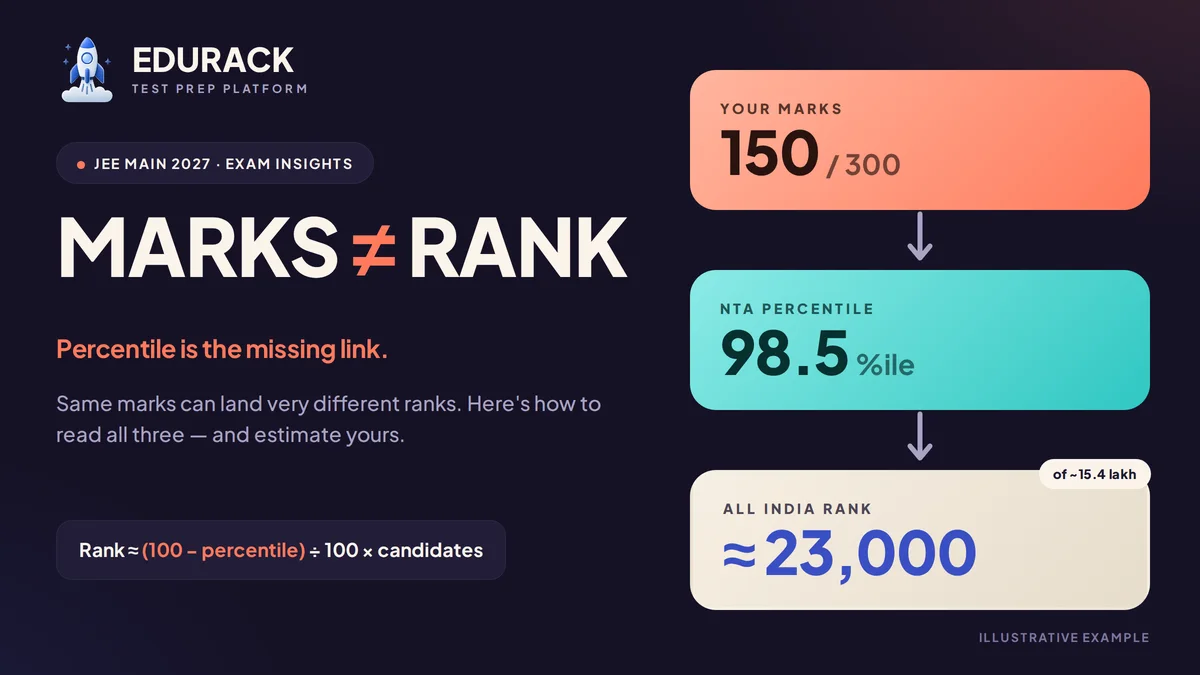
Two students open their JEE Main scorecards on the same day. One scored 150. The other scored 171. Both see the same number next to their name: 98.5 percentile. Same rank zone, same college list, and one of them scored 21 marks fewer. That is not a glitch. It is normalization doing exactly what it was built to do, and until you understand how marks, percentile and rank connect, you will keep misjudging your own mock scores.
Marks, percentile and rank: the one-minute version
These are three different numbers answering three different questions. Mixing them up is the most common mistake in JEE Main result season.
| Number | What it tells you | Compared against | Where you see it |
|---|---|---|---|
| Marks | Your raw score out of 300 | Nobody. It is just your paper | Your answer-key calculation |
| Percentile | The share of candidates in your shift who scored at or below you | Everyone in your shift | NTA scorecard |
| Rank (AIR) | Your position in the final merit list | Every candidate across both sessions | Final rank list |
The chain always runs in one direction: marks → percentile → rank. NTA releases results as percentile (NTA score), not raw marks, and the rank is built from that percentile.
How NTA turns marks into a percentile
JEE Main is held across multiple shifts, and no two question papers are equally hard. So NTA does not rank raw marks. It calculates a percentile inside each shift:
A quick example. Your shift had 1,00,000 candidates, and 98,500 of them scored equal to or below you. Your percentile is 100 × 98,500 ÷ 1,00,000 = 98.5.
Two details most students miss:
- The topper of every shift gets 100 percentile, whether that shift was brutal or easy. That is why 100 percentile does not mean 300 marks.
- Percentiles run to seven decimal places so that ties between candidates become extremely rare before any tie-breaker is needed.
Why 150 can beat 171
Now the opening puzzle makes sense. Imagine two shifts:
| Shift A (tough paper) | Shift B (easy paper) | |
|---|---|---|
| Marks | 150 | 171 |
| Percentile | 98.5 | 98.5 |
In the tough shift, only 1.5% of candidates managed 150 or more. In the easy shift, you needed 171 to be in that same top 1.5%. The percentile removes the "shift luck" and compares you only with people who sat the same paper.
From percentile to rank: a formula you can use today
Once you know your percentile, a good estimate of your All India Rank is:
Roughly 15.4 lakh unique candidates appeared across both 2026 sessions, so use 15.4 lakh as your pool size. Here is what that gives you:
| Percentile | Approximate AIR |
|---|---|
| 99.9 | ~1,500 |
| 99.5 | ~7,700 |
| 99.0 | ~15,400 |
| 98.5 | ~23,100 |
| 98.0 | ~30,800 |
| 97.0 | ~46,200 |
| 95.0 | ~77,000 |
| 93.4 | ~1,01,000 |
| 90.0 | ~1,54,000 |
The ballpark map: marks to percentile to rank
If you want to turn a mock score into a rough rank, this table chains everything together. The marks-to-percentile column is based on the commonly circulated prediction tables, and the rank column uses the formula above with a 15.4 lakh pool.
| Marks (out of 300) | Ballpark percentile | Rough AIR |
|---|---|---|
| 200 to 214 | 99.6 to 99.7 | 4,000 to 6,600 |
| 175 to 188 | 99.0 to 99.3 | 10,000 to 15,000 |
| 160 to 174 | 98.5 to 99.0 | 16,000 to 23,000 |
| 149 to 159 | 98.1 to 98.5 | 23,000 to 30,000 |
| 132 to 148 | 97.0 to 98.0 | 31,000 to 46,000 |
| 120 to 131 | 96.1 to 96.9 | 47,000 to 60,000 |
| 102 to 109 | 94.0 to 95.0 | 78,000 to 92,000 |
Treat every row as a range, never a point. Even two popular prediction tables disagree by almost a full percentile at the same marks, because each shift has its own difficulty. Nobody can give you an exact conversion before the shift data is out.
The 2026 numbers worth knowing
- Session 1 result: 16 February 2026. Session 2 result: 20 April 2026.
- Candidates: about 15.4 lakh unique candidates appeared across both sessions, a record.
- JEE Advanced qualifiers: 2,50,182 candidates cleared the cutoff.
- General category qualifying cutoff: 93.4123549 percentile, up from 93.1023262 in 2025. Prediction tables place that at roughly 95 to 100 marks.
- Best score counts: if you appear in both sessions, your final AIR is based on the higher of your two NTA scores.
That last point matters. A bad Session 1 does not sink you, and a good Session 1 is not wasted if Session 2 goes wrong.
Four myths that cost aspirants sleep
Myth 1: "Percentile means percentage"
It does not. 98.5 percentile means you beat or matched 98.5% of candidates in your shift. It says nothing about getting 98.5% of the marks.
Myth 2: "More marks always means a better rank"
Only within the same shift. Across shifts, the harder paper's 150 can outrank the easier paper's 160.
Myth 3: "100 percentile means 300 out of 300"
The highest scorer in each shift is awarded 100, however many marks that took. Several shifts produce several 100-percentilers.
Myth 4: "Predicted cutoffs are the real cutoffs"
Prediction pages are educated guesses. Last cycle, widely shared expected General cutoffs landed below the official figure of 93.41. Plan with the official number, and keep a margin.
How to use this after every mock
- Note your raw score, and also how hard the paper felt compared with your last mock.
- Convert it to a percentile range using the ballpark map, never a single number.
- Apply the rank formula to the lower end of that range, so your estimate is conservative.
- Set targets in percentile, not marks. For example, aim to clear the 93.4 General cutoff with room to spare.
- Track the trend across five or six mocks instead of reacting to one result.
Tie-breaking: when two candidates share a percentile
With seven decimal places, ties are rare, but NTA still has an order for them. As reported from the JEE Main 2026 information bulletin, ties for B.E./B.Tech (Paper 1) are resolved by:
- Higher NTA score in Mathematics
- Higher NTA score in Physics
- Higher NTA score in Chemistry
Frequently Asked Questions
What is the difference between marks, percentile and rank in JEE Main?
Marks are your raw score out of 300. Percentile is the share of candidates in your shift who scored at or below you. Rank is your position in the final merit list, built from NTA percentile scores.
How is the JEE Main percentile calculated?
NTA takes the number of candidates in your shift who scored equal to or less than you, divides it by the total candidates in that shift, and multiplies by 100. The result is reported to seven decimal places.
Does a higher percentile always mean a better rank?
Yes. The rank list is sorted by total NTA percentile, and only exact ties are split using Mathematics, then Physics, then Chemistry.
Can two students with the same marks get different percentiles?
Yes, if they sat different shifts. The same raw score can be a higher percentile in a tough shift and a lower one in an easy shift.
How are ranks decided when there are two sessions?
Each session is normalized separately into percentile scores. If you appear in both, the higher of your two NTA scores is used for the final All India Rank.
What rank can I expect with 99 percentile in JEE Main?
With roughly 15.4 lakh candidates, 99 percentile works out to around 15,000 to 16,000. Treat that as an estimate, because the official rank depends on the final merged list.