JEE Main Chemistry Practical Chemistry 2027: Salt Analysis, Titrations & Organic Tests
Qualitative salt analysis for the listed cations and anions, oxalic acid and Mohr's salt titrations with KMnO₄, functional group tests and preparations, with a worked example.
Edurack
September 28, 2026
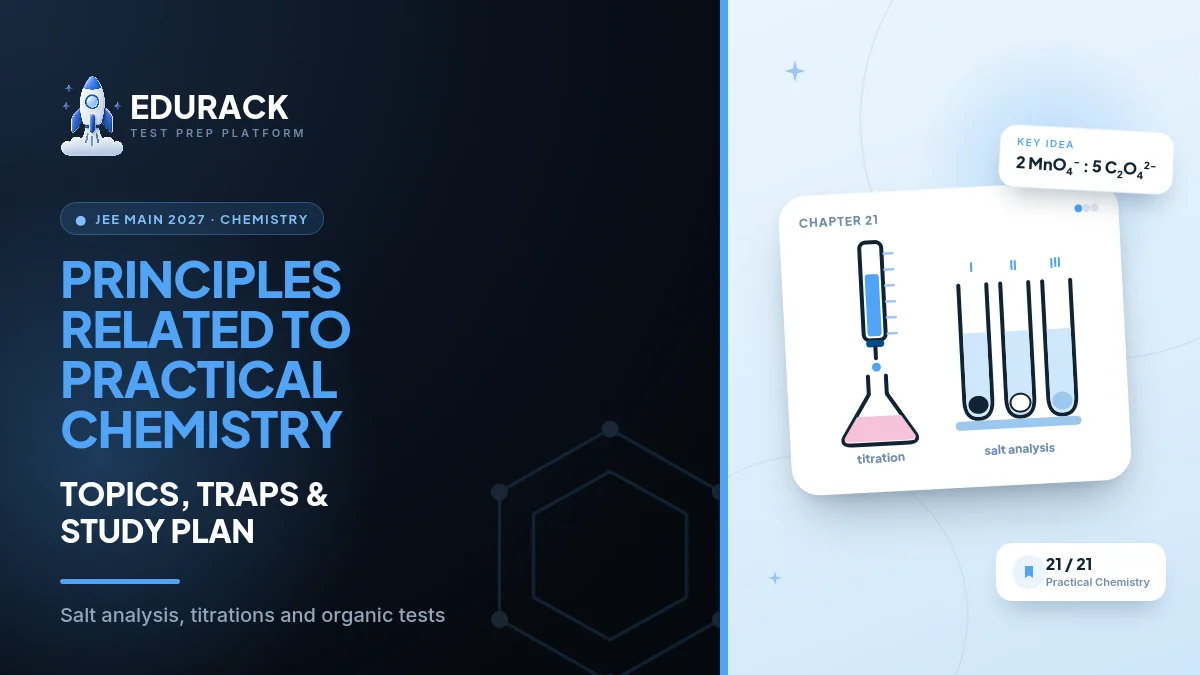
This is the unit students most often leave out because it feels like lab work. Yet the NTA syllabus lists it as Unit 20, and its questions are straightforward observations and small titration calculations. It is a chapter where a single evening of focused revision buys real marks.
In salt analysis, every ion has one signature observation. Learn the signature, and you can name the ion.
Chapter at a Glance
| Snapshot | Detail |
|---|---|
| NTA unit | Unit 20 of 20: Principles Related to Practical Chemistry |
| Priority (trend-based) | Moderate |
| Typical question style | Test-observation MCQs and short titration numericals |
| Best first step | Learn the cation groups and the anion confirmatory tests |
Priority reflects past-paper trends, not an official NTA weightage.
What the NTA Syllabus Covers
- Detection of extra elements (N, S, halogens) and functional groups (hydroxyl, carbonyl, carboxyl, amino) in organic compounds
- Preparation of Mohr's salt, potash alum, acetanilide, p-nitroacetanilide, aniline yellow and iodoform
- Titrimetric exercises: acids and bases with indicators, oxalic acid versus KMnO₄, Mohr's salt versus KMnO₄
- Qualitative salt analysis: cations Pb²⁺, Cu²⁺, Al³⁺, Fe³⁺, Zn²⁺, Ni²⁺, Ca²⁺, Ba²⁺, Mg²⁺, NH₄⁺ and anions CO₃²⁻, S²⁻, SO₄²⁻, NO₃⁻, NO₂⁻, Cl⁻, Br⁻, I⁻
- Experiments: enthalpy of solution of CuSO₄, enthalpy of neutralisation, lyophilic and lyophobic sols, kinetics of iodide with hydrogen peroxide
Master These Topics
1. Cations: Group-Wise Signatures
| Group | Cation | Group reagent and observation |
|---|---|---|
| I | Pb²⁺ | Dilute HCl gives white precipitate of PbCl₂ |
| II | Cu²⁺ | H₂S in dilute HCl gives black CuS |
| III | Fe³⁺, Al³⁺ | NH₄Cl and NH₄OH: reddish-brown Fe(OH)₃, white gelatinous Al(OH)₃ |
| IV | Zn²⁺, Ni²⁺ | H₂S in ammoniacal medium: white ZnS, black NiS |
| V | Ca²⁺, Ba²⁺ | (NH₄)₂CO₃ gives white carbonates |
| VI | Mg²⁺ | NH₄OH with sodium phosphate gives white precipitate |
| Zero | NH₄⁺ | Warming with NaOH releases ammonia, which turns Nessler's reagent brown |
2. Anions: Confirmatory Tests
- Carbonate: dilute HCl gives effervescence of CO₂, which turns lime water milky.
- Sulphide: dilute acid gives H₂S with a rotten-egg smell that blackens lead acetate paper.
- Sulphate: BaCl₂ gives a white precipitate insoluble in dilute HCl.
- Nitrite: dilute acid gives brown fumes of NO₂.
- Nitrate: brown ring test with FeSO₄ and concentrated H₂SO₄.
- Chloride, bromide, iodide: AgNO₃ gives a white curdy precipitate of AgCl (soluble in NH₃), a pale yellow AgBr (sparingly soluble) or a yellow AgI (insoluble).
Trap: The brown ring test confirms nitrate only if nitrite is absent, because nitrite gives a similar result and must be removed first.
3. Titrations with KMnO₄
Potassium permanganate acts as its own indicator, since the first permanent pink colour marks the end point. In the oxalic acid titration, the solution is warmed to about 60-70 °C, and Mn²⁺ produced then catalyses the reaction (autocatalysis). Mohr's salt is titrated at room temperature, without heating.
Reaction: 2MnO₄⁻ + 5C₂O₄²⁻ + 16H⁺ → 2Mn²⁺ + 10CO₂ + 8H₂O
Worked example: 20 mL of 0.05 M oxalic acid contains 1 × 10⁻³ mol of oxalate. The ratio is 2 MnO₄⁻ to 5 oxalate, so KMnO₄ needed = 0.4 × 10⁻³ mol. At 0.02 M, the volume is 0.4 × 10⁻³ / 0.02 = 0.02 L = 20 mL.
4. Organic Tests and Preparations
- Hydroxyl: sodium metal releases H₂, and phenol gives a violet colour with neutral FeCl₃.
- Carbonyl: 2,4-DNP gives an orange precipitate, and Tollens' reagent distinguishes aldehydes.
- Carboxyl: effervescence with NaHCO₃.
- Amino: carbylamine test for primary amines, or azo dye formation.
Preparations: Mohr's salt is FeSO₄·(NH₄)₂SO₄·6H₂O, potash alum is K₂SO₄·Al₂(SO₄)₃·24H₂O, acetanilide comes from aniline and acetic anhydride, and iodoform from acetone or ethanol with I₂ and NaOH.
5. Thermochemistry and Colloid Experiments
The enthalpy of neutralisation of a strong acid and strong base is close to −57 kJ/mol. Lyophilic sols (starch, gum) are easy to prepare and stable, while lyophobic sols (Fe(OH)₃, As₂S₃) need special methods and are unstable without stabilisers. The iodide-hydrogen peroxide reaction is studied by timing the appearance of blue colour with starch.
Common Traps to Avoid
- Forgetting to warm oxalic acid before titrating with KMnO₄.
- Running the brown ring test without removing nitrite first.
- Mixing up the group reagents and the colours of the precipitates.
- Using an external indicator for KMnO₄. It is self-indicating.
60-Second Revision Sheet
- Group I Pb²⁺ (HCl), II Cu²⁺ (H₂S in acid), III Fe³⁺/Al³⁺ (NH₄OH), IV Zn²⁺/Ni²⁺, V Ca²⁺/Ba²⁺, VI Mg²⁺
- AgCl white and soluble in NH₃; AgBr pale yellow; AgI yellow and insoluble
- KMnO₄ self-indicating; oxalic acid needs warming, Mohr's salt does not
2MnO₄⁻ : 5C₂O₄²⁻mole ratio
Your Study Plan
- Day 1: cation groups and characteristic precipitates.
- Day 2: anion tests and interference points.
- Day 3: KMnO₄ titrations and titration numericals.
- Day 4: organic functional group tests, preparations and a timed set.
Practice Principles Related to Practical Chemistry Questions Free → (opens in a new tab)
Continue Your Chemistry Journey
Frequently Asked Questions
Why is KMnO₄ used without an external indicator?
Its deep purple colour disappears as it is reduced, so the first permanent faint pink shade after the end point signals completion.
Why is oxalic acid warmed before titration with KMnO₄?
The reaction is slow at room temperature at first. Warming speeds it up, and the Mn²⁺ formed then acts as an autocatalyst.