JEE Main Chemistry Organic Compounds Containing Halogens 2027: SN1, SN2 & Environmental Effects
Nature of the C-X bond, SN1 and SN2 mechanisms, elimination, haloarene reactivity and the environmental effects of chloroform, freons and DDT.
Edurack
September 28, 2026
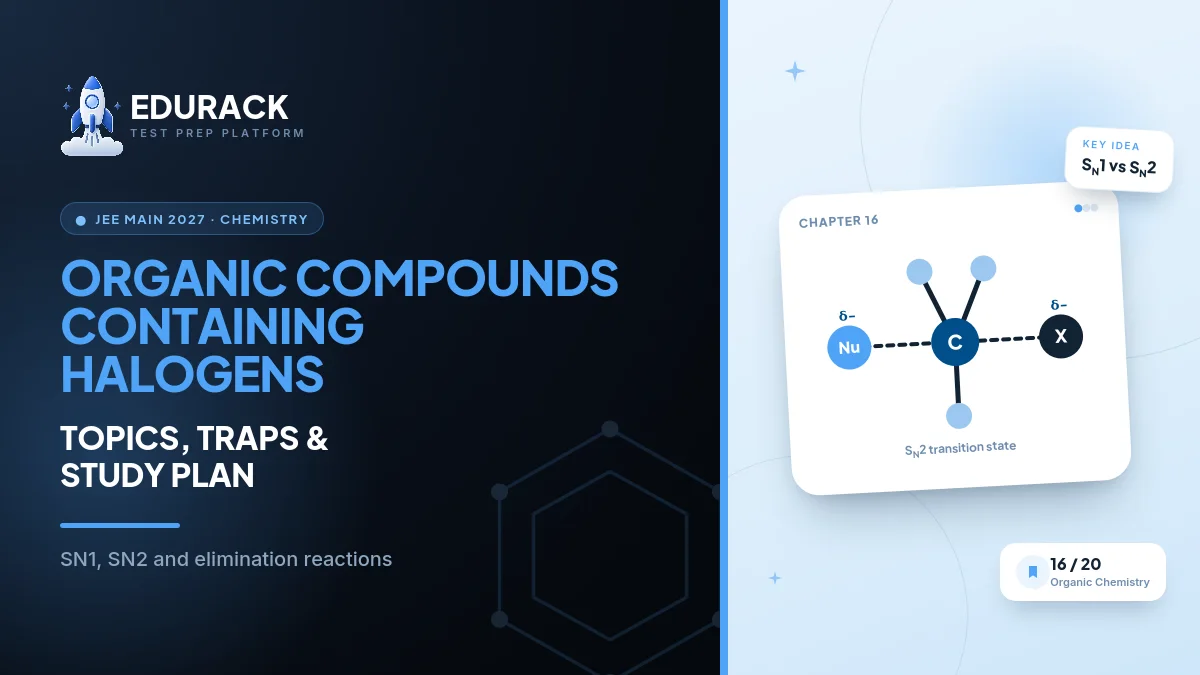
Two mechanisms, SN1 and SN2, explain almost every substitution question in this chapter, and JEE Main keeps returning to them. Learn the differences in rate law, stereochemistry and conditions, and a huge share of Organic Chemistry becomes predictable.
SN2 inverts. SN1 racemises. That single contrast answers a surprising number of questions.
Chapter at a Glance
| Snapshot | Detail |
|---|---|
| NTA unit | Unit 16 of 20: Organic Compounds Containing Halogens |
| Priority (trend-based) | Moderate |
| Typical question style | SN1 versus SN2 comparison MCQs and stereochemistry-based questions |
| Best first step | Learn SN1 versus SN2 as a comparison table |
Priority reflects past-paper trends, not an official NTA weightage.
What the NTA Syllabus Covers
- General methods of preparation, properties and reactions, nature of the C-X bond
- Mechanisms of substitution reactions
- Uses and environmental effects of chloroform, iodoform, freons and DDT
Master These Topics
1. The C-X Bond and Preparation
The C-X bond is polar, with carbon partially positive and open to nucleophilic attack. Bond strength falls in the order C-F > C-Cl > C-Br > C-I, so iodides are the most reactive and easiest to substitute.
Common preparations:
- From alcohols with
SOCl₂(best method, gaseous by-products),PCl₅, orHX/ZnCl₂. - Free-radical halogenation of alkanes.
- Finkelstein reaction: alkyl chloride or bromide with NaI in dry acetone gives the iodide.
- Swarts reaction: alkyl chloride or bromide with AgF or Hg₂F₂ gives the fluoride.
- Sandmeyer reaction for aryl halides from diazonium salts.
2. SN2 versus SN1
| Feature | SN2 | SN1 |
|---|---|---|
| Rate law | Rate = k [RX][Nu] | Rate = k [RX] |
| Steps | One (concerted) | Two (carbocation intermediate) |
| Best substrate | Methyl > 1° > 2° | 3° > 2° |
| Stereochemistry | Inversion (Walden inversion) | Racemisation |
| Preferred solvent | Polar aprotic | Polar protic |
| Nucleophile | Strong | Weak is fine |
Leaving group ability follows I⁻ > Br⁻ > Cl⁻ > F⁻ in both mechanisms.
Worked example: (R)-2-bromobutane reacting with OH⁻ in a polar aprotic solvent by SN2 gives (S)-butan-2-ol, the inverted product. Under SN1 conditions (water, heat), it gives a racemic mixture.
Trap: Inversion of the spatial arrangement does not always mean R changes to S in the name. It depends on the CIP priorities, so always assign priorities before naming.
3. Substitution versus Elimination
Aqueous KOH favours substitution to give alcohols. Alcoholic KOH with heat favours elimination (E2) to give alkenes, following Zaitsev's rule (the more substituted alkene is the major product). Bulky bases and tertiary halides favour elimination.
4. Why Haloarenes Are Less Reactive
In chlorobenzene the C-Cl bond has partial double bond character from resonance and involves an sp² carbon, so it is stronger and harder to break. Nucleophilic substitution is possible only when strong electron-withdrawing groups such as −NO₂ are at ortho or para positions, as in 2,4-dinitrochlorobenzene.
5. Environmental and Everyday Effects
- Chloroform: oxidises slowly in air and light to toxic phosgene (COCl₂), so it is stored in dark bottles filled to the brim, with about 1% ethanol as a stabiliser.
- Iodoform: used as an antiseptic because of the iodine it releases.
- Freons (CFCs): chlorine radicals released in the stratosphere destroy ozone.
- DDT: a non-biodegradable pesticide that accumulates in food chains and thins bird eggshells.
Common Traps to Avoid
- Assuming SN2 always changes R to S. Assign CIP priorities before deciding.
- Predicting SN2 at a tertiary carbon. It is blocked by steric hindrance.
- Ignoring solvent: polar protic favours SN1 and polar aprotic favours SN2.
- Treating haloarenes like haloalkanes in nucleophilic substitution.
60-Second Revision Sheet
- SN2: one step, inversion,
3° < 2° < 1° < CH₃for rate - SN1: carbocation, racemisation,
3° > 2° > 1° - Leaving group:
I⁻ > Br⁻ > Cl⁻ > F⁻ - Alcoholic KOH gives elimination; aqueous KOH gives substitution
Your Study Plan
- Day 1: preparation methods and named reactions (Finkelstein, Swarts, Sandmeyer).
- Day 2: SN1 and SN2 mechanisms, stereochemistry and factors.
- Day 3: elimination reactions and haloarene reactivity.
- Day 4: environmental effects and a timed mixed set.
Practice Organic Compounds Containing Halogens Questions Free → (opens in a new tab)
Continue Your Chemistry Journey
- Previous chapter: Hydrocarbons
- Next chapter: Alcohols, Phenols & Ethers
- All JEE Main Chemistry chapters
- Complete JEE Main Syllabus 2027 guide
Frequently Asked Questions
How do I decide between SN1 and SN2?
Look at the substrate, nucleophile and solvent. Primary halides with strong nucleophiles in polar aprotic solvents go SN2, while tertiary halides in polar protic solvents go SN1.
Why is chloroform stored in dark bottles?
In light and air it oxidises to poisonous phosgene, so it is kept in dark, tightly filled bottles with a little ethanol to convert any phosgene into harmless diethyl carbonate.