JEE Main Chemistry Basic Concepts 2027: Mole Concept, Stoichiometry & Limiting Reagent
The mole concept, limiting reagent, empirical formula and concentration terms, taught with worked examples. Master this chapter and Physical Chemistry becomes easier.
Edurack
September 28, 2026
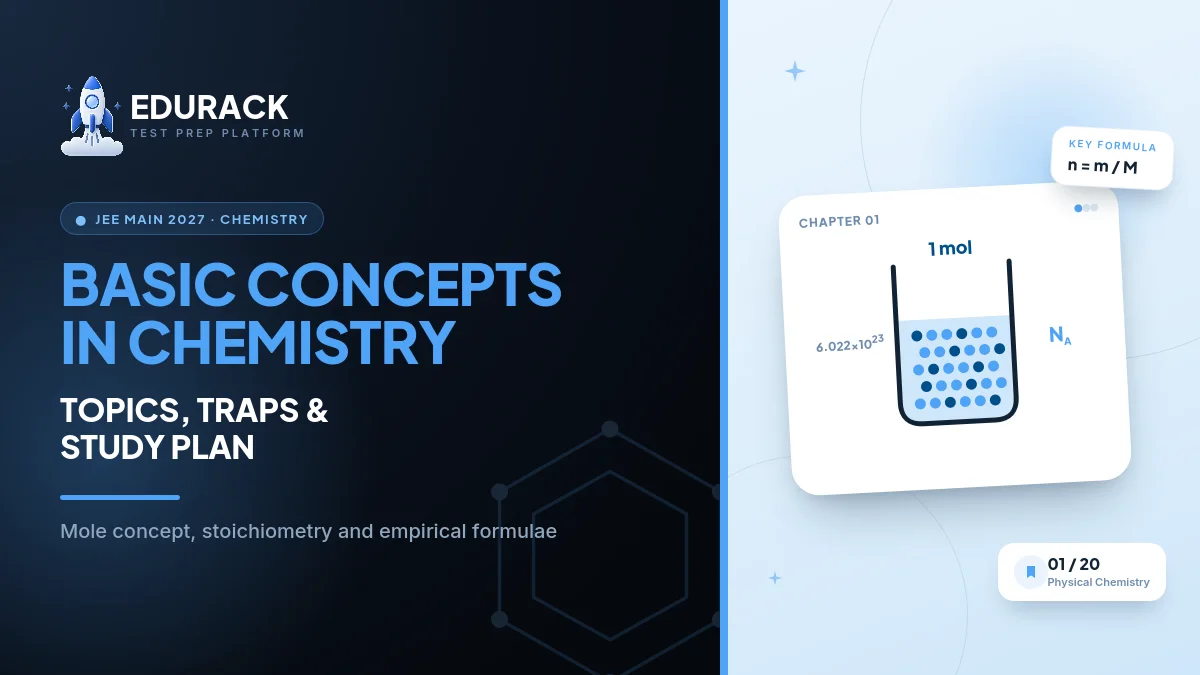
Every numerical in Physical Chemistry starts with the same move: convert to moles. Students who make that a reflex solve Solutions, Equilibrium, Electrochemistry and Kinetics faster, because the mole is the common currency of chemistry. This first chapter is short, but it quietly powers half the syllabus.
If you are stuck on a chemistry numerical, convert to moles and the path usually appears.
Chapter at a Glance
| Snapshot | Detail |
|---|---|
| NTA unit | Unit 1 of 20: Basic Concepts in Chemistry |
| Priority (trend-based) | Moderate |
| Typical question style | Numerical value questions on moles, limiting reagent and concentration |
| Best first step | Convert everything to moles first, always |
Priority reflects past-paper trends, not an official NTA weightage.
What the NTA Syllabus Covers
- Matter and its nature, Dalton's atomic theory, atom, molecule, element and compound
- Laws of chemical combination, atomic and molecular masses
- Mole concept, molar mass, percentage composition, empirical and molecular formulae
- Chemical equations and stoichiometry
Master These Topics
1. The Mole and Its Three Conversions
One mole contains 6.022 × 10²³ particles (Avogadro's number). Three conversions cover most problems:
- Mass to moles:
n = m / M - Particles to moles:
n = N / N_A - Gas volume to moles:
n = V / 22.4 Lat 0 °C and 1 atm (STP as used in JEE Main problems)
The laws of chemical combination are the logic behind all this: conservation of mass, definite proportions, multiple proportions, Gay-Lussac's law of combining volumes and Avogadro's law.
2. Stoichiometry and the Limiting Reagent
The limiting reagent is the reactant that runs out first, so it decides how much product forms.
Worked example: In 2H₂ + O₂ → 2H₂O, 6 g of H₂ (3 mol) reacts with 32 g of O₂ (1 mol). The equation needs 2 mol of H₂ for every 1 mol of O₂. Oxygen would consume only 2 mol of H₂, so O₂ is limiting. Water formed = 2 mol = 36 g, and 1 mol (2 g) of H₂ is left over.
Trap: Never compare masses directly to decide the limiting reagent. Compare mole ratios with the coefficients in the balanced equation.
3. Empirical and Molecular Formula
Empirical formula gives the simplest whole-number ratio of atoms. Molecular formula is n times the empirical formula, where n = molar mass / empirical formula mass.
Worked example: A compound contains 40% C, 6.7% H and 53.3% O by mass. Moles per 100 g: C 3.33, H 6.7, O 3.33. Dividing by the smallest gives C : H : O = 1 : 2 : 1, so the empirical formula is CH₂O (mass 30). If the molar mass is 180, then n = 6 and the molecular formula is C₆H₁₂O₆.
4. Concentration Terms
- Molarity
M = moles of solute / litres of solution - Molality
m = moles of solute / kg of solvent - Mole fraction
x = moles of component / total moles
Worked example: 4 g of NaOH (M = 40) in 500 mL of solution gives 0.1 mol / 0.5 L = 0.2 M.
Molality does not change with temperature because it uses mass, while molarity changes because volume changes. That is why colligative property formulas use molality.
Common Traps to Avoid
- Deciding the limiting reagent from masses instead of mole ratios.
- Mixing up molarity (per litre of solution) with molality (per kg of solvent).
- Forgetting that the molecular formula is a whole-number multiple of the empirical formula.
- Using 22.4 L for a gas that is not at STP.
60-Second Revision Sheet
n = m/M = N/N_A = V/22.4(at STP)- Limiting reagent: compare moles divided by coefficients
- Molecular formula =
n× empirical formula - Molality is temperature independent; molarity is not
Your Study Plan
- Day 1: mole conversions and percentage composition.
- Day 2: balancing equations and limiting-reagent problems.
- Day 3: empirical and molecular formula from percentage data.
- Day 4: concentration terms and a timed mixed set.
Practice Basic Concepts in Chemistry Questions Free → (opens in a new tab)
Continue Your Chemistry Journey
Frequently Asked Questions
Is the mole concept enough to solve all Physical Chemistry numericals?
It is the starting point for nearly all of them. After moles, you apply the chapter's own formula, whether for solutions, equilibrium or electrochemistry.
What is the difference between empirical and molecular formula?
The empirical formula shows the simplest ratio of atoms, while the molecular formula shows the actual number of atoms in one molecule.