Solving Pedigree Analysis Problems Without Misidentifying Traits
Most pedigree mistakes happen in a fixed order — skipped generation, ratio check, X-link test. Walk the same four checks every time and misidentification stops happening.
Edurack
October 10, 2026
Why Pedigree Questions Feel Harder Than They Are
Pedigree analysis isn't actually a content-heavy topic — there's no long list of facts to memorise. The difficulty is procedural: students look at the chart, form a hasty impression, and lock onto a conclusion before checking it against the evidence the chart is actually showing. The fix is to run the same ordered sequence of checks on every pedigree, every time, rather than eyeballing it.
Reading the Symbols Correctly First
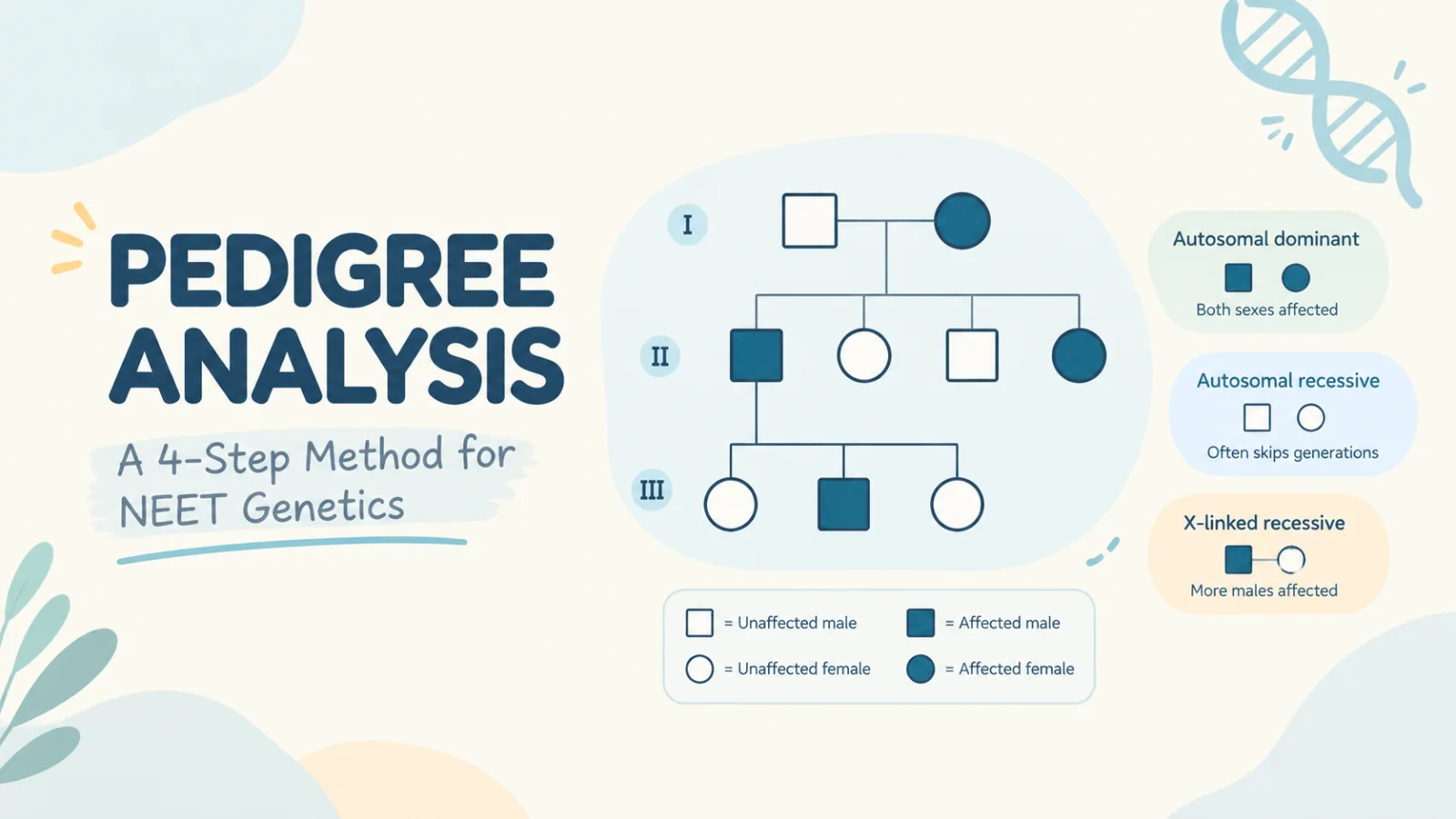
Before any analysis: squares are males, circles are females, filled (shaded) symbols show the trait/condition is expressed, unfilled symbols show it is not. A horizontal line connects mates; a vertical line drops to their offspring, connected by a horizontal "sibling line." Getting the generations and connecting lines misread is the single most common source of an otherwise "correct method, wrong answer" mistake — slow down on this step specifically.
Check 1 — Does the Trait Skip a Generation?
If affected individuals appear in every generation with no skipping: the trait is very likely dominant. A dominant trait generally shows up whenever at least one copy of the allele is inherited, so it rarely disappears for a full generation and then reappears.
If the trait disappears for one or more generations and then reappears: the trait is very likely recessive. This is the single most reliable first signal in most textbook pedigrees — two unaffected (carrier) parents can produce an affected child, which is exactly what "skipping a generation" looks like on the chart.
Check 2 — Ratio Check Among Offspring
Once you have a tentative dominant/recessive call, verify it against the offspring ratios shown, wherever the chart gives you enough children to check:
- Two affected parents → all children affected: consistent with dominant (if homozygous dominant parents) OR could still appear in some recessive scenarios — not decisive alone, but worth noting.
- Two unaffected parents → some children affected: this is the single most decisive observation in the whole chart. Two unaffected parents can only produce an affected child if the trait is recessive (both parents are unaffected carriers, Aa × Aa → some aa offspring). This single observation, if present anywhere in the pedigree, overrides a "looks dominant" first impression.
- Affected father × unaffected mother → all daughters affected, sons unaffected: classic signature pattern worth recognising directly (see X-linked dominant below).
Check 3 — Autosomal or X-Linked?
Once dominant/recessive is settled, test whether the trait tracks with sex:
- Autosomal: Affects males and females in roughly equal proportion; an affected mother can have affected sons AND affected daughters equally; trait doesn't show a strong sex skew across the pedigree.
- X-linked recessive: Shows up far more often in males than females (since males are hemizygous — one X copy is enough to express it). A classic signature: an affected father cannot pass the trait to his sons (sons get their X from the mother, Y from the father) but ALL his daughters become carriers (obligate carriers) if the mother is unaffected.
- X-linked dominant: Affected father → ALL daughters affected (they must inherit his only X), ALL sons unaffected (they get his Y, not his X). This particular signature — one specific parent-to-offspring-sex pattern — is one of the most directly testable facts in this entire topic, because it's the one pattern that can be confirmed from a single mating pair without needing the rest of the pedigree.
- Y-linked: Only affects males, passed directly from affected father to ALL sons, never to daughters, and never skips a generation among the male line (no carriers possible, since there's no second Y copy to mask it).
Check 4 — Consistency Across the Whole Chart, Not Just One Family Unit
A frequent error is confirming a pattern using one mating pair in the pedigree and stopping there, without checking whether every other mating pair in the same chart is also consistent with that same conclusion. A correct inheritance-pattern call must explain every affected and unaffected individual in the entire pedigree — if even one individual's status contradicts your working hypothesis, the hypothesis is wrong and needs revisiting, not the individual dismissed as an "exception."
A Worked Mini-Example
A pedigree shows: Generation I — unaffected mother, unaffected father. Generation II — one affected daughter, one unaffected son, one unaffected daughter. Generation III — the affected daughter from Gen II (now married to an unaffected man) has one affected son.
- Check 1: Trait appears in Gen II after both Gen I parents were unaffected → recessive is strongly indicated.
- Check 2: Two unaffected Gen I parents produced an affected child → confirms recessive (decisive, per the rule above).
- Check 3: Both an affected female (Gen II) and an affected male (Gen III) appear, with no strong sex skew visible yet in this small sample → tentatively autosomal recessive, pending more data. If the chart were larger and showed affected males consistently outnumbering affected females, X-linked recessive would need reconsideration.
- Check 4: Every individual's status is consistent with autosomal recessive inheritance (Aa × Aa → aa possible in Gen II; aa × AA or Aa → aa possible in Gen III) → conclusion holds.
Frequently Asked Questions
What's the single fastest way to rule out dominant inheritance in a pedigree? Find any instance of two unaffected parents having an affected child. This single observation is only possible under recessive inheritance (both parents being unaffected carriers), so it immediately and decisively rules out dominant inheritance for that trait, overriding any other first impression from the chart.
How do I tell X-linked recessive apart from autosomal recessive quickly? Check whether affected individuals are overwhelmingly male rather than evenly split between sexes, and specifically check whether an affected father's daughters are all unaffected-but-carriers while his sons are entirely unaffected (since sons don't inherit their father's X at all). A strong male skew plus that father-to-daughter carrier pattern points to X-linked recessive over autosomal recessive.
Can a single pedigree chart have more than one valid inheritance pattern explanation? In genuine textbook and NEET-style pedigrees, no — the chart is constructed to have exactly one inheritance pattern consistent with every individual shown. If your working hypothesis fits most but not all individuals, the hypothesis is incomplete or wrong, not the chart ambiguous; re-run the four checks rather than picking the "closest fit."
Why do I keep getting dominant and recessive mixed up even though I know the definitions? This usually isn't a definition problem — it's a sequencing problem. Students often eyeball the chart's overall "density" of filled symbols rather than running the specific skip-a-generation and two-unaffected-parents checks in order. Following the fixed four-check sequence above, rather than relying on a visual impression, is what actually prevents the mix-up.
Is Y-linked inheritance actually tested in NEET, or is it mostly autosomal and X-linked questions? Autosomal and X-linked patterns (both dominant and recessive) are tested far more frequently, but Y-linked inheritance does appear, usually as a direct factual question (e.g., identifying that a trait passed only father-to-son, never skipping, is consistent with Y-linkage) rather than embedded in a complex multi-generation chart.
Pedigree problems are exactly the kind of topic where seeing many worked charts matters more than reading theory once more. Edurack's Genetics practice sets include fully worked pedigree problems with the reasoning shown step by step, not just the final answer.