Overcoming Mock Test Panic & Negative Marking Fear in NEET
If mock tests make you freeze or guess randomly out of fear, the fix isn't "calm down" — it's a concrete attempt strategy built around NEET's actual negative marking math.
Edurack
October 10, 2026
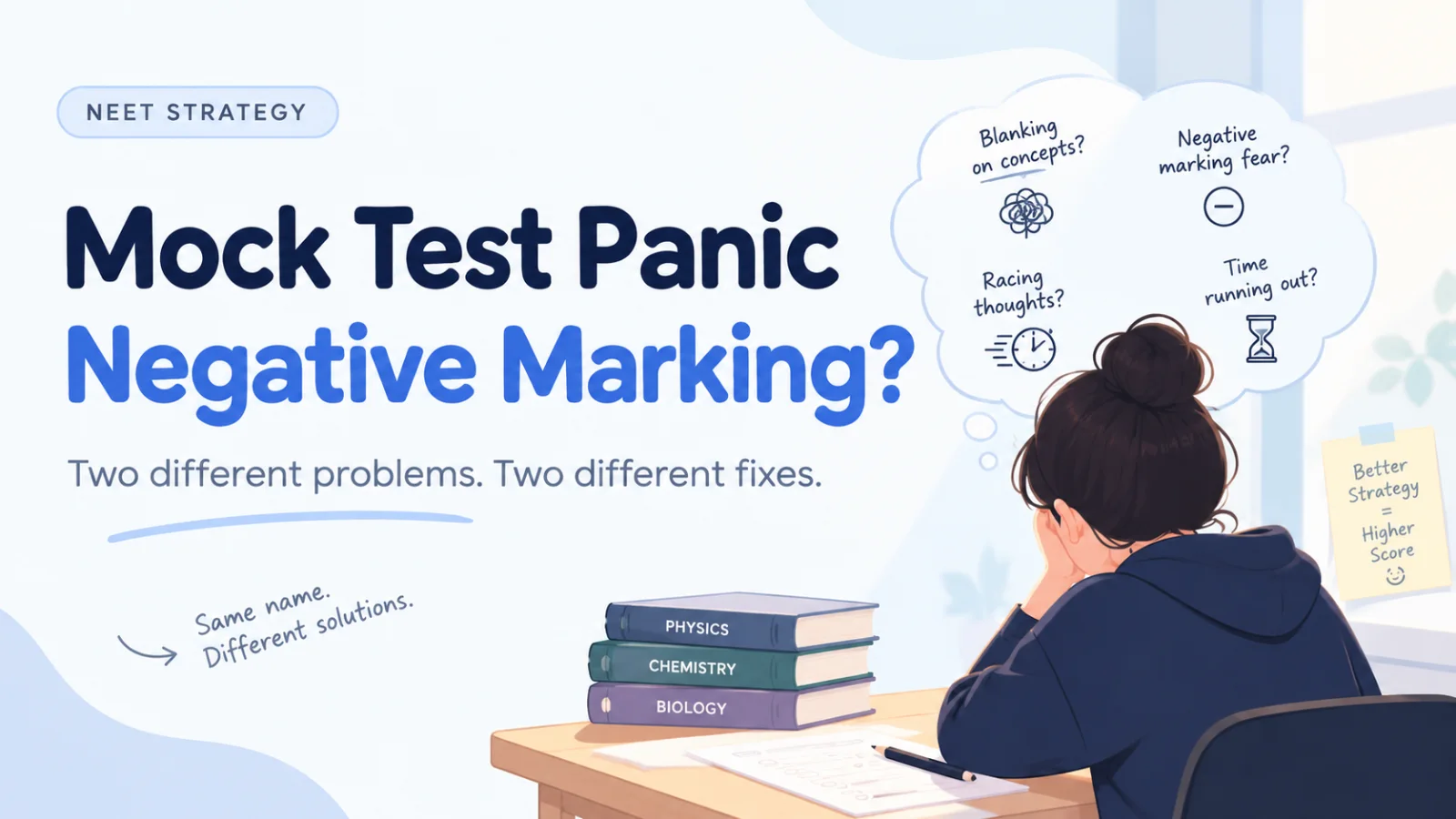
Two Different Problems Wearing the Same Name
"Mock test panic" usually hides two separate issues that need different fixes:
- *Panic that happens during the test* — racing thoughts, blanking on concepts you clearly know, rushing through the first section and running out of time for the rest.
- *Panic that happens before you even answer*** — specifically around negative marking, where fear of losing marks makes you leave attemptable questions blank, or second-guess answers you were initially confident about.
Both feel like "I'm bad at mock tests," but they respond to completely different fixes. Let's take them one at a time.
Understanding NEET's Negative Marking — With Real Numbers
NEET awards +4 for a correct answer and −1 for a wrong one; an unattempted question scores 0. Most of the fear around negative marking comes from treating every guess as equally risky, which isn't mathematically true.
The actionable rule this produces: never leave a question blank if you can eliminate even one option. The fear of negative marking should stop you from blind-guessing on questions where you have zero idea — not from attempting questions where partial knowledge lets you narrow it down.
A Three-Bucket Attempt Strategy
Stop thinking of questions as "attempt" or "skip." Use three buckets instead, decided in the first few seconds of reading each question:
- Bucket A — Know it cold: Answer immediately, move on. Don't re-read the question a second time "just to be sure" — that habit alone costs many aspirants 15–20 minutes across a paper.
- Bucket B — Can eliminate 1–2 options: Mark it, make your best elimination-based guess, flag it if your test platform allows review, and move on. Per the math above, this is a positive-expected-value attempt, not a reckless guess.
- Bucket C — No idea at all: Skip immediately. Don't dwell, don't re-read it three times hoping clarity will appear. Mark it for review only if time remains at the end.
Deciding the bucket in the first 5–10 seconds, rather than deliberating mid-question, is what actually saves time — most wasted exam minutes go to indecision, not to the genuinely hard questions.
Why You Freeze on Topics You Actually Know
This is almost always a working-memory hijack caused by acute stress, not a knowledge gap. Under panic, the brain's stress response narrows attention and makes retrieval of stored information harder — which is why students report "blanking" on a fact they could recite perfectly 20 minutes before the exam started.
The fix is a pre-built physical reset, used the moment you notice the freeze:
- Stop reading the question. Put your pen down for 3 seconds.
- Take two slow breaths — in through the nose for 4 counts, out for 6. The longer exhale is what actually calms the stress response; a few long exhales measurably matter more than many short ones.
- Re-read the question fresh, as if seeing it the first time, rather than continuing to stare at the same frozen attempt.
Practising this reset during mock tests, not just reading about it, is what makes it available on the real exam day — a technique you've never rehearsed under pressure won't reliably appear when you need it.
Treat Every Mock Test as Exposure Therapy, Not Just a Score
If mock tests themselves trigger dread, part of the fix is changing what you're measuring. Scores fluctuate for reasons that have nothing to do with your actual preparation — paper difficulty, sleep the night before, which section you happened to start with. Chasing a mock score as the only signal of progress guarantees anxiety on any test that goes badly, even a well-prepared one.
Track these instead, every single mock:
- Number of Bucket-C (no-idea) questions — should trend down over weeks as your syllabus coverage improves.
- Time spent per question in your weakest subject — should trend down as pattern-recognition improves.
- Number of silly errors (calculation slips, misread questions) — a separate, fixable category from genuine knowledge gaps.
These three numbers tell you far more about your trajectory than a single mock's percentile, and they're much harder to spiral over because they're concrete and controllable.
The Night Before and Morning Of
Panic compounds when it starts the night before. A few concrete guardrails:
- No new topics the night before a mock (or the real exam) — only light revision of formula sheets or NCERT lines you already know.
- Sleep on a consistent schedule in the week leading up to any test, mock or real — sleep deprivation directly worsens the working-memory freeze described above.
- On the morning of, do one small, easy recall task (a few flashcards, one question you know well) to build early confidence before walking in, rather than cramming something unfamiliar.
Frequently Asked Questions
Should I ever leave a question completely blank in NEET? Only when you can't eliminate even a single option. If you have any partial knowledge that lets you rule out one or more choices, attempting has a positive expected score based on NEET's +4/−1 marking scheme — leaving it blank in that situation usually costs you expected marks, not saves them.
Why do I blank on easy topics specifically during mock tests, even though I know them at home? This is a stress-induced working-memory effect, not a knowledge gap — acute anxiety narrows attention and makes retrieval harder under time pressure. A practised breathing reset and treating the freeze as temporary (rather than panicking further about "forgetting everything") usually restores recall within seconds.
How many mock tests should I take before I stop feeling anxious about them? There's no fixed number, but anxiety typically drops noticeably after 8–10 full-length mocks taken under real exam conditions (timed, no pausing, OMR-style marking) — repeated exposure is what desensitises the panic response, more than any single piece of advice.
Is it bad to review my mock test performance immediately after finishing, or should I wait? A short break (even 15–20 minutes) before reviewing helps you look at errors analytically rather than emotionally. Reviewing while still flooded with post-test stress tends to produce either excessive self-criticism or defensive dismissal of genuine mistakes — neither helps you improve.
My score dropped in a recent mock even though I studied more. Does that mean my preparation is going backwards? Not necessarily — mock scores are noisy by nature (paper difficulty, fatigue, and section order all affect a single attempt). Look at the three trend metrics above (no-idea questions, time per question, silly errors) across several mocks instead of reacting to one score in isolation.
Want mock tests that actually mirror NEET's real difficulty curve and give you a bucket-by-bucket error breakdown instead of just a score? Edurack's test series is built to show you exactly where time and marks are leaking — not just what you got wrong.