Miller–Urey Experiment: How Amino Acids Formed in a Flask (NEET Biology)
The Miller–Urey experiment is the classic laboratory evidence for chemical evolution. Learn the apparatus, the gases, the products and every NEET trap, plus what came after.
Edurack
September 28, 2026
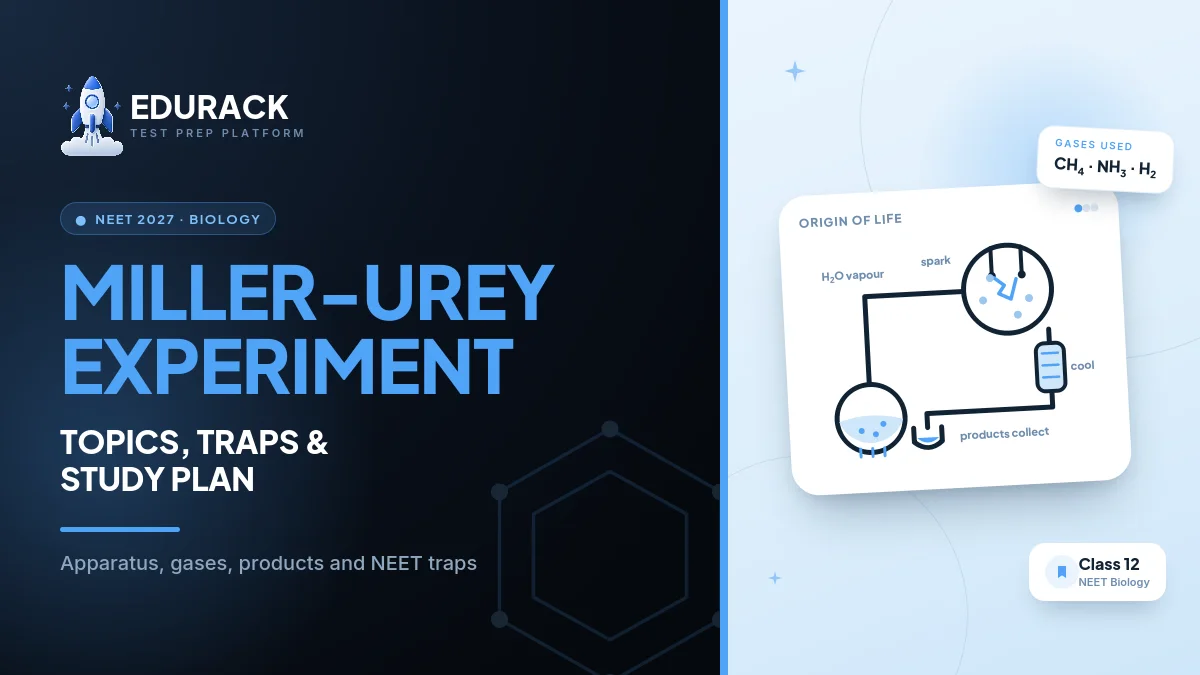
Ask a NEET aspirant who proved chemical evolution in a lab and most will say Miller. Ask which gases went into the flask and the answers get shaky, and one wrong gas costs you the mark. The Miller–Urey experiment takes about twenty minutes to master, and it is one of the most predictable fact-based topics in Evolution.
Miller did not create life. He showed that the building blocks of life can form from simple gases.
Chapter at a Glance
| Snapshot | Detail |
|---|---|
| NCERT chapter | Evolution (Class 12): origin of life |
| Priority (trend-based) | Moderate |
| Typical question style | Fact-based MCQs and assertion-reason questions on gases, temperature, products and scientists |
| Best first step | Learn the four inputs and the apparatus labels, then the steps that came after |
Priority reflects past-paper trends, not an official NTA weightage.
What the NEET Syllabus Covers
- Origin of life and the Oparin–Haldane theory of chemical evolution
- Miller's experiment as laboratory evidence for chemical evolution
- The conditions of the early Earth: a reducing atmosphere, high temperature and volcanic storms
- The path from organic molecules to the first cells (NCERT covers this briefly, so the extra steps below are for understanding)
Master These Topics
1. The Idea Being Tested: Chemical Evolution
Oparin in Russia and Haldane in England each proposed that the first life came from non-living organic molecules, and that those molecules had themselves formed from inorganic ones. This is called chemical evolution. It happened in a young Earth with high temperatures, volcanic storms and a reducing atmosphere rich in CH₄ and NH₃, with no free oxygen.
An idea like this needs a test. Stanley Miller, working under Harold Urey at the University of Chicago, built that test.
2. The Setup: What Went In and What Each Part Did
NCERT describes a closed flask containing CH₄, H₂, NH₃ and water vapour at 800°C, with an electric discharge passed through it.
| Apparatus part | What it imitated |
|---|---|
| Sealed flask with two electrodes | The early atmosphere, with sparks standing in for lightning |
| Gas mixture: CH₄, NH₃, H₂ plus water vapour | A reducing atmosphere with no free O₂ |
| Flask of boiling water | Oceans and evaporation |
| Condenser | Cooling and rain returning to the sea |
| Trap at the bottom | Where the newly formed compounds collected |
The water kept cycling through the loop. Vapour rose, met the sparks, cooled in the condenser and dripped back down carrying whatever had formed.
3. The Result: What Formed
Analysis of the collected liquid showed amino acids. Glycine and alanine are the ones reliably reported, and aspartic acid is commonly listed alongside them in exam notes. NCERT adds that similar experiments by other scientists produced sugars, nitrogen bases, pigments and fats.
The conclusion is the important part for the exam: organic molecules can form from inorganic ones under early-Earth conditions, which supports chemical evolution.
Note on duration and year: Coaching notes quote anything from a week to 15 or 18 days, and NCERT gives no figure. Miller's own report describes about a week. NCERT dates the experiment to 1953 (the work began in 1952), so use 1953. Do not spend memory on the duration.
4. Why It Matters and Where It Falls Short
- It was the first laboratory demonstration that amino acids can form without living organisms.
- Only small building blocks formed. No proteins, no cells and no life.
- Many scientists now think the early atmosphere was less reducing than Miller's mixture, with more CO₂ and N₂. The experiment is still taught as the classic evidence for chemical evolution.
5. What Came Next: From Molecules to Cells
NCERT is brief here, so treat this as background that helps you answer statement-based questions.
- Complex molecules built up from the simple ones in the early oceans.
- Protobionts appeared: droplet-like aggregates that kept an internal environment. Oparin called his version coacervates, and Sidney Fox produced microspheres in the lab. They could not reproduce.
- RNA first: proteins need nucleic acids to be made, and nucleic acids need proteins to copy themselves. RNA can carry information and also act as a catalyst, so it is the leading answer to that chicken-and-egg problem. Later, DNA took over as the stable genetic material.
- First cells: anaerobic, heterotrophic prokaryotes.
- Photosynthesis: some cells learned to make their own food, first by chemosynthesis and then by photosynthesis. The oxygen released changed the atmosphere from reducing to oxidising.
- Eukaryotes: membrane-bound organelles evolved. The symbiotic theory (Lynn Margulis) says mitochondria and chloroplasts began as independent prokaryotes living inside a larger host cell. The presence of DNA and ribosomes inside them is the key supporting evidence.
Common Traps to Avoid
- Adding oxygen to the gas list. The atmosphere was reducing, so there was no free O₂.
- Claiming Miller made proteins or life. Only small organic molecules formed.
- Mixing up Oparin–Haldane (the theory) with Miller (the experimental evidence).
- Mixing up coacervates (Oparin) with microspheres (Fox).
- Confusing Miller's work with Pasteur's swan-neck flask experiment, which disproved spontaneous generation.
- Giving the date as 1952 when the answer options follow NCERT's 1953.
Test Yourself
- Which of these was not part of the gas mixture in Miller's experiment? (a) CH₄ (b) NH₃ (c) O₂ (d) H₂. Answer: (c).
- Miller's experiment gave direct support to which idea? Answer: chemical evolution of life.
- Assertion: Oxygen was deliberately left out of Miller's apparatus. Reason: The early atmosphere is believed to have been reducing. Answer: both are true and the reason explains the assertion.
60-Second Revision Sheet
- Gases: CH₄, NH₃, H₂ with water vapour. No O₂.
- Conditions in NCERT: closed flask, electric discharge, 800°C.
- Result: amino acids (glycine, alanine), with sugars, nitrogen bases, pigments and fats in later experiments.
- Year: 1953 (NCERT). Oparin–Haldane proposed the theory, Miller tested it.
- Protobionts: coacervates (Oparin), microspheres (Fox).
- First cells: anaerobic heterotrophic prokaryotes, then photosynthesis, then O₂, then eukaryotes.
Your Study Plan
- Day 1: draw the apparatus and label each part with what it imitated.
- Day 2: learn the gases, the conditions and the products until you can list them from memory.
- Day 3: revise the six steps after Miller and the scientist attached to each.
- Day 4: attempt a timed set of Evolution questions and log every slip.
Practice Evolution Questions Free → (opens in a new tab)
Continue Your Biology Journey
Frequently Asked Questions
Did Urey take part in the experiment?
Urey was Miller's supervisor and helped shape the idea. Miller ran the experiment, and Urey declined to be a co-author so that Miller would get the credit. The experiment is still called Miller–Urey.
Does the experiment prove that life began this way?
No. It shows that amino acids can form from simple gases under early-Earth conditions. How those molecules became living cells is still an open question, which is why NCERT presents it as evidence for chemical evolution and not as proof of how life began.