Mastering NCERT Line-by-Line for NEET Without Feeling Overwhelmed
"Read NCERT line by line" is the most repeated NEET advice and the least explained. Here's an actual method, chapter by chapter, that doesn't take forever.
Edurack
October 10, 2026
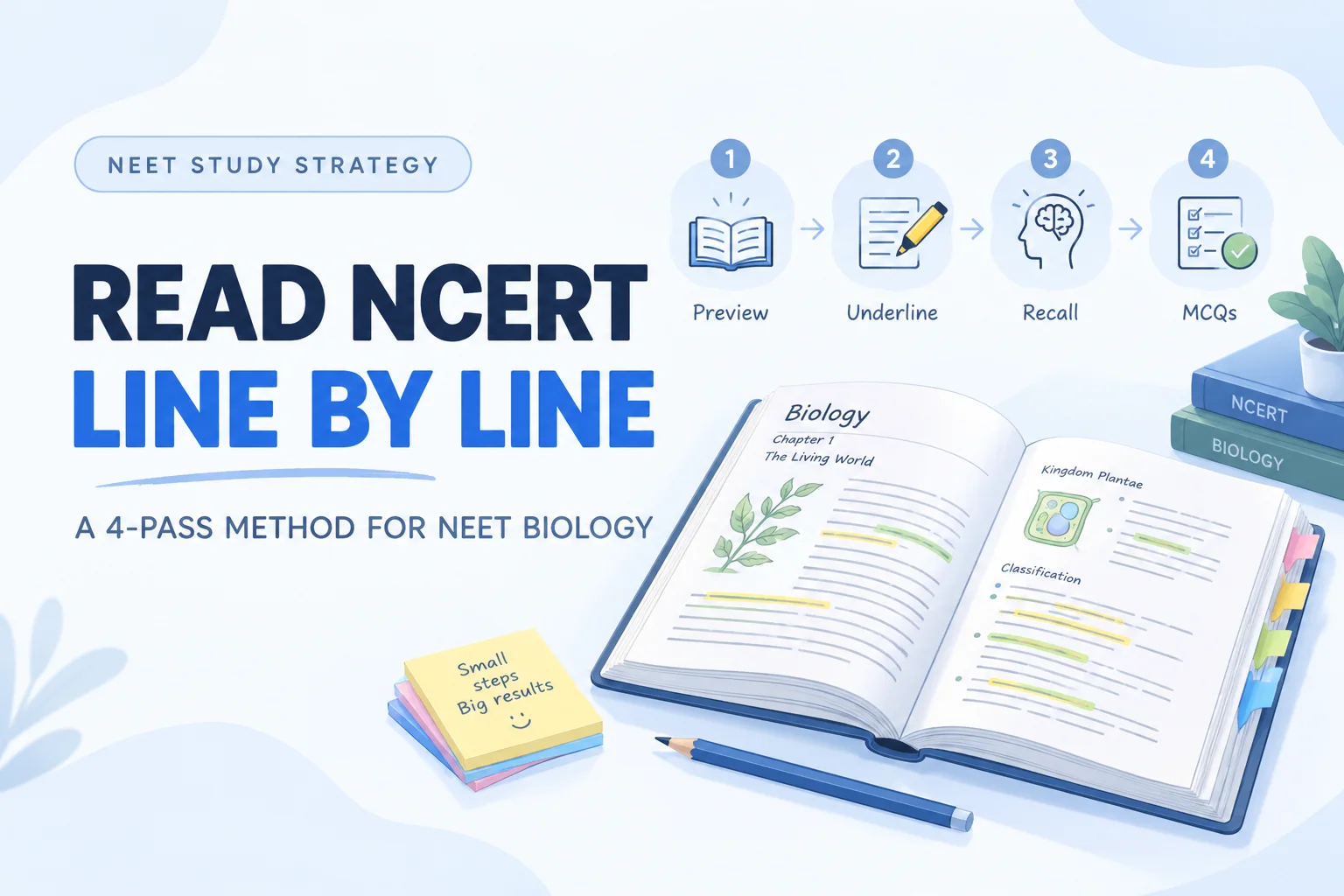
Why "Read NCERT Line by Line" Actually Means Something Specific
Every NEET topper interview includes some version of "just read NCERT line by line," and it's genuinely true — NEET draws a large share of its questions, especially in Biology, directly from NCERT's exact phrasing, footnotes, and diagram labels. But the advice usually stops there, which leaves aspirants either skimming the same chapter five times with no clear improvement, or burning out trying to memorise the entire book word for word like a story.
"Line by line" doesn't mean memorise every sentence verbatim. It means no sentence gets silently skipped as "probably not important" —a because NEET has a long history of picking exactly the line most students gloss over (a parenthetical note, a diagram caption, an exception mentioned once in passing).
The Four-Pass Method
Reading NCERT "properly" doesn't mean one slow, exhausting read-through. It means several shorter, purpose-built passes, each with a different job:
Pass 1 — Structural Read (no notes, no highlighting)
Read the full chapter once, just to see its shape: how many sections, where the diagrams sit, how ideas connect. Don't stop to memorise anything yet. This pass exists purely so your brain has a map before you start filling in detail — studying detail without structure is what makes a chapter feel like disconnected facts.
Pass 2 — Line-by-Line Detail Pass (active, with a pencil)
This is the actual "line by line" pass. Go sentence by sentence. For every sentence, ask: could this exact fact be turned into an MCQ? If yes, underline it. Pay specific attention to:
- Numbers (percentages, counts, measurements — "approximately 20 amino acids," not "several amino acids")
- Exceptions and qualifiers ("except," "unlike," "in most cases but not all")
- Diagram labels and captions, which are tested as directly as body text
- Footnotes and small-print boxes, which NEET has repeatedly drawn questions from despite students assuming they're skippable
Pass 3 — Self-Explain Without the Book
Close the NCERT. Using only the chapter's headings as prompts, explain each section out loud or on paper, from memory, in your own words. Where you get stuck or go vague, that's your actual gap — not where you assumed you were weak, but where retrieval just failed. Go back to the book only for those specific gaps, not the whole chapter again.
Pass 4 — MCQ Stress-Test
Attempt NEET-pattern MCQs from that exact chapter. Wrong answers here tell you one of two things: either the underlying concept wasn't as solid as Pass 3 suggested, or you missed the specific "silently skipped" line now being tested. Both are useful information — route it back into a short, targeted re-read, not a full chapter repeat.
Handling the Lines That Feel Like Filler
Certain NCERT sentences feel like pure padding — background context, a single mention of a scientist's name, a one-line historical note. The instinct is to skip these, and sometimes that's fine. But a quick filter helps decide which "filler" lines are safe to deprioritise and which aren't:
- Safe to skim: Pure historical trivia with no testable fact attached (a scientist's nationality, the year a lab was founded, unless the date itself is a well-known fact pattern).
- Not safe to skim: Any sentence containing a number, a named structure, a process name, or a comparison between two things — these are exactly NCERT's favourite MCQ source material, however minor they look in context.
When unsure, default to not skipping — the cost of over-reading one extra filler line is a few seconds; the cost of skipping a tested line is a lost mark on exam day.
A Realistic Chapter Timeline
For a medium-length NCERT Biology chapter (roughly 10–15 pages):
- Pass 1 (structural read): 15–20 minutes
- Pass 2 (line-by-line detail): 45–60 minutes
- Pass 3 (self-explain): 20–30 minutes, done a day or two later, not immediately after Pass 2
- Pass 4 (MCQ stress-test): 20–30 minutes, plus review of wrong answers
Spread across 2–3 days rather than one long sitting, this totals roughly 2–2.5 hours of focused work per chapter — sustainable across the dozens of chapters in the full syllabus, unlike the "reread until it sticks" approach, which has no natural endpoint and tends to produce diminishing returns after the second pass anyway.
Why Spacing the Passes Matters More Than Most Students Expect
Doing Pass 3 (self-explain) immediately after Pass 2 (detail read) feels efficient, but it tests short-term memory, not the durable kind you need months later on exam day. A gap of a day or two between passes forces genuine retrieval rather than recognition — and retrieval under a small amount of forgetting is what actually strengthens long-term memory. This single change — spacing passes a day apart instead of doing them back-to-back — is one of the highest-leverage adjustments students report after switching to this method.
Frequently Asked Questions
Do I need to memorise NCERT word for word for NEET? No — you need to know every tested fact in the chapter, not the exact sentence structure. Memorising verbatim wastes effort on phrasing that doesn't matter, while line-by-line reading (as described above) ensures no fact, number, or exception gets missed regardless of how it's phrased in the actual question.
How many times should I re-read an NCERT chapter before moving on? Re-reading the same way repeatedly has limited value after the second pass. Instead of rereading, move through the four distinct passes above — each one tests or builds a different kind of understanding, which is what actually drives improvement, not raw repetition of the same reading style.
I read NCERT carefully but still get tricked by NEET questions on footnotes or diagram labels. What am I missing? This is almost always a Pass 2 gap — diagrams, captions, and footnotes get skipped during a "normal" read because they don't look like main body text. Treat every diagram label and footnote as a full sentence during your detail pass, since NEET has repeatedly tested exactly this material.
Should I make notes while reading NCERT, or is that a waste of time compared to just reading? Light underlining or marginal notes during Pass 2 help flag MCQ-worthy lines for faster revision later, but full rewritten notes of the entire chapter are usually not worth the time compared to spending that time on Pass 3 (self-explain) and Pass 4 (MCQ testing), which build retrieval far more effectively than copying text out.
Is this method only for Biology, or does it work for Chemistry NCERT too? The same four-pass structure works well for NCERT Chemistry, especially Inorganic Chemistry and the theory portions of Physical Chemistry, which share Biology's pattern of direct, fact-based NEET questions. Numerical-heavy sections benefit from the same detail pass for formulas and conditions, but need additional dedicated problem-solving practice on top.
Want chapter-wise NCERT-based MCQ sets that mirror exactly this four-pass method? Edurack's practice banks are built directly from NCERT line items — including the footnotes and diagram labels most question banks skip.