Lac Operon Mechanism & Regulation of Gene Expression for NEET
The Lac operon trips up students because it's taught as one mechanism when it's really two overlapping switches. Here's both switches, separated clearly, with the exact NEET traps.
Edurack
October 10, 2026
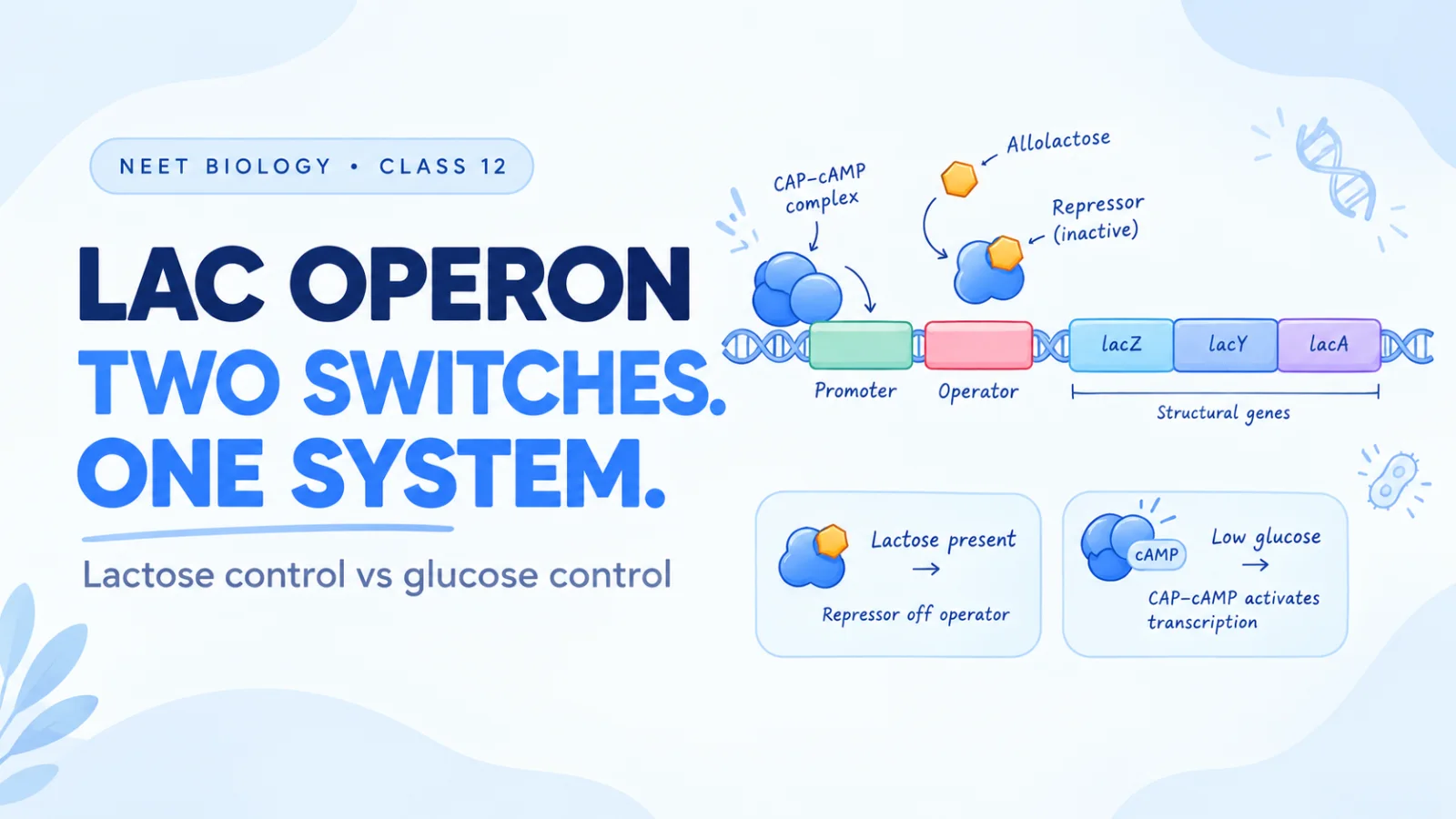
Why the Lac Operon Confuses Students: It's Actually Two Switches, Not One
Most students read the Lac operon once, see words like "repressor," "inducer," and "catabolite repression" all in the same paragraph, and walk away with a blurred, half-correct picture. The fix is simple: the Lac operon is controlled by two independent switches that happen to act on the same set of genes.
- Negative control (the repressor switch) — decides whether the operon can be transcribed at all. Governed by the presence or absence of lactose.
- Positive control (the CAP/catabolite repression switch) — decides how strongly the operon is transcribed, even when switch 1 allows it. Governed by the presence or absence of glucose.
Keep these two as separate mental boxes. Nearly every NEET question on this topic is really asking you to track just one of the two switches at a time — confusion happens when students try to reason about both simultaneously without first locking down each one individually.
The Operon's Physical Layout
Before the switches make sense, the parts need to be clear, in order along the DNA:
- *Regulatory gene (i gene): Constitutively transcribed (always being made, independent of the operon's own state). Codes for the Lac repressor protein*.
- *Promoter (p):* Where RNA polymerase binds to begin transcription.
- *Operator (o):* Overlaps the promoter; where the repressor protein binds when active.
- *Structural genes — lacZ, lacY, lacA:* Transcribed together as a single polycistronic mRNA.
- lacZ → β-galactosidase (breaks lactose into glucose + galactose)
- lacY → permease (transports lactose into the cell)
- lacA → transacetylase (function still debated in exact NEET-relevant detail — its enzymatic role in lactose metabolism is less critical to the operon logic than Z and Y)
Switch 1 — Negative Control: The Repressor
When lactose is absent: The i gene produces the repressor protein, which binds tightly to the operator. A repressor sitting on the operator physically blocks RNA polymerase from transcribing the structural genes. Operon is OFF.
When lactose is present: A small amount of lactose is converted to allolactose (the actual inducer molecule — not lactose itself, a detail NEET has tested directly). Allolactose binds to the repressor protein, changing its shape (allosteric change) so it can no longer bind the operator. The operator is now free, RNA polymerase can proceed, and the structural genes are transcribed. Operon is ON.
Switch 2 — Positive Control: Catabolite Repression (Glucose's Role)
Even with lactose present and the repressor off the operator, the operon's transcription rate is still not maximal unless a second condition is met: glucose must be low.
Here's the chain, which is where most students lose the thread:
- When glucose is low, intracellular cAMP levels rise.
- cAMP binds to CAP (Catabolite Activator Protein), also called CRP.
- The cAMP–CAP complex binds to a site near the promoter and helps RNA polymerase bind more efficiently — this is positive regulation, the one clearly positive-control example in the classic Lac operon story.
- Result: transcription proceeds at a high rate.
When glucose is high, cAMP levels fall, CAP can't activate the promoter, and transcription proceeds only at a low, basal rate — even if lactose is present and the repressor is off the DNA. This is catabolite repression: the cell preferentially uses glucose and only ramps up lactose metabolism machinery when glucose runs low.
The Four Combinations — Worked Out Explicitly
| Lactose | Glucose | Repressor status | CAP status | Operon output |
|---|---|---|---|---|
| Absent | Low or High | Bound to operator (ON as repressor) | Irrelevant — operon is blocked regardless | OFF |
| Present | High | Removed from operator | Inactive (low cAMP) | ON, but LOW transcription |
| Present | Low | Removed from operator | Active (high cAMP) | ON, HIGH transcription (maximal) |
| Absent | Low | Bound to operator | Active, but irrelevant | OFF |
NEET questions frequently present one of these four rows as a scenario ("a bacterium is grown in a medium with lactose but abundant glucose — what happens to lacZ expression?") and expect you to apply both switches, not just one. The table above is worth memorising as a unit, not re-deriving from scratch under exam time pressure.
Constitutive Mutants — A Frequently Tested Edge Case
A mutation in the operator sequence (o^c, operator-constitutive) that prevents the repressor from binding, or a mutation in the i gene that produces a non-functional repressor, results in the operon being transcribed constitutively — i.e., continuously, regardless of lactose presence. This is a classic NEET distractor setup: the question describes a mutant strain that makes β-galactosidase even without lactose in the medium, and asks you to identify which part of the operon is mutated.
Frequently Asked Questions
Is lactose itself the inducer of the Lac operon, or is it something else? Allolactose, a metabolic isomer formed from a small amount of lactose inside the cell, is the actual inducer that binds the repressor protein — not lactose directly. This is a specific, frequently tested distinction.
Why does the Lac operon still work at a low rate even without glucose completely absent? The repressor switch (negative control) and the CAP switch (positive control) act independently. Once lactose removes the repressor, baseline transcription is possible regardless of glucose; glucose's presence or absence only affects how strongly CAP boosts that transcription through cAMP levels, not whether transcription happens at all.
What exactly does CAP do, and why is cAMP needed for it to work? CAP (Catabolite Activator Protein) only binds its site near the promoter and helps recruit RNA polymerase when it is first bound by cAMP. Since cAMP levels rise specifically when glucose is scarce, this links the operon's maximal activity to low-glucose conditions — the cell's way of only fully committing to lactose metabolism when glucose, its preferred energy source, isn't available.
What happens if a mutation makes the repressor protein unable to bind allolactose? If the repressor can still bind the operator but can no longer bind allolactose, it stays locked onto the operator permanently — the operon would remain OFF even when lactose is present, because the inducer can no longer trigger the repressor's release.
Are lacZ, lacY, and lacA transcribed as separate mRNAs or one? As one single polycistronic mRNA transcript, which is then translated into three separate proteins (β-galactosidase, permease, and transacetylase respectively). This single-transcript, multi-protein arrangement is characteristic of prokaryotic operons and is itself a testable NEET fact.
Struggling to keep gene-regulation mechanisms straight across similar-sounding NEET topics? Edurack's chapter-wise NCERT practice sets on Molecular Basis of Inheritance are built around exactly these commonly confused distinctions.