Eliminating Digital Distractions During NEET Self-Study
Willpower-based "just don't check your phone" advice fails predictably. A friction-based system that makes distraction harder than focus, built for real NEET study hours.
Edurack
October 10, 2026
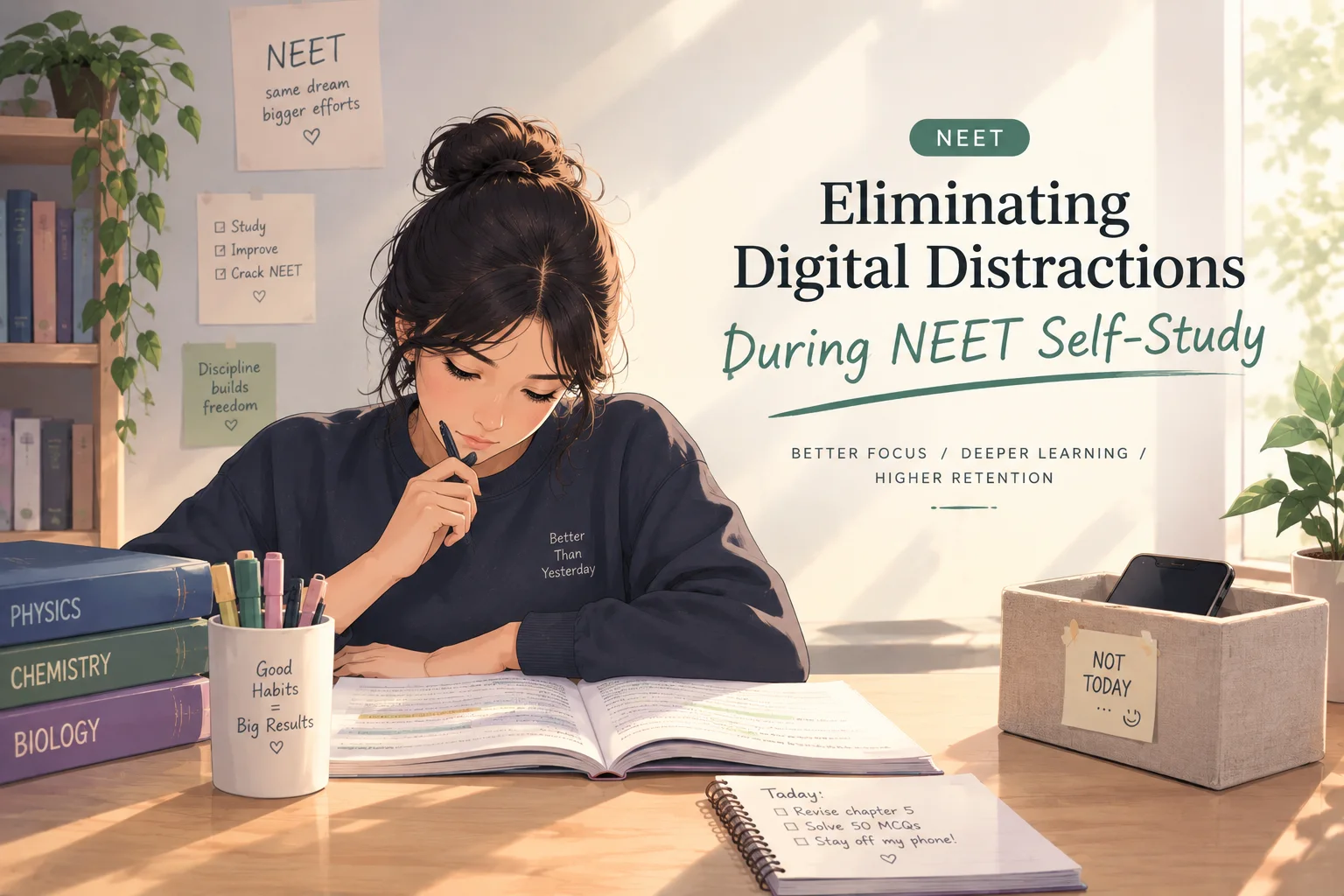
Why "Just Have More Willpower" Fails as Advice
Every NEET aspirant has tried, at some point, to simply resolve not to check their phone during study hours — and most have watched that resolution collapse within days. This isn't a personal failing; willpower is a limited, depletable resource, and modern apps are specifically engineered (notification design, infinite scroll, variable rewards) to overcome exactly the kind of resolve you're relying on. Fighting that design with willpower alone is a fight stacked against you from the start.
The Real Cost of a "Quick Check"
A 30-second notification check doesn't cost 30 seconds. After switching attention away from a task, it takes the brain a meaningful stretch of time — often cited as somewhere in the range of 10–20 minutes — to fully return to the same depth of focus, a phenomenon researchers call "attention residue." A student who checks their phone every 15 minutes during a 2-hour study block may never actually reach deep focus at all during that entire session, despite feeling like they were "mostly studying." This is why distraction feels like it costs little in the moment but devastates total output over a full session.
Physical Separation Beats Any App-Based Fix
App-based screen-time blockers help some students, but they share a critical weakness: the same device that's trying to block you is also the one you can unblock with a few taps, in a moment of exactly the weakened willpower the block was meant to protect against. Physical separation doesn't have this failure mode.
- Put your phone in a different room, not just "face down" on the desk. Face-down-on-desk is routinely demonstrated to reduce focus even when it's never touched, let alone picked up — its mere presence consumes a measurable amount of attention. A different room removes that cost entirely.
- If the phone must stay nearby (as a timer, or for a specific reason), use a basic alarm clock or standalone timer instead, and keep the phone itself out of reach, not just out of sight on the same desk.
- For a study block where you must have the phone for a specific resource (an app-based question bank, say), close every other app first and enable airplane mode or do-not-disturb before opening the one app you actually need — don't rely on willpower to avoid your other apps once unlocked.
Fixing the Environment, Not Just the Phone
Phones aren't the only digital distraction, and an all-or-nothing phone ban can just shift the same pattern onto a laptop or tablet instead. A broader environment pass:
- Browser tabs: Close unrelated tabs before starting a study session, rather than relying on not clicking them. An open tab is a standing invitation; a closed one requires a deliberate re-open, which is enough extra friction to interrupt most idle-distraction impulses.
- Notifications on any device you keep nearby: Turn off non-essential notifications entirely during study blocks, not just "silent mode," which often still shows a visual badge that pulls attention even without a sound.
- Background music/video "for focus": If you genuinely find instrumental or ambient sound helps, fine — but watch for sessions where "studying with a video playing in the background" quietly becomes "half-watching a video with a book open." Be honest with yourself about which one is actually happening most days.
Make Starting Easier Than Checking
The flip side of adding friction to distraction is removing friction from the actual study task, so starting feels like the lower-effort option:
- Keep tomorrow's chapter and materials physically open and ready the night before, so sitting down to study requires zero setup decisions.
- Start every session with a small, easy, already-familiar task (reviewing yesterday's notes, a few recall flashcards) rather than the hardest new material — an easy on-ramp reduces the urge to "just check one thing first" before starting.
The Timed-Block Method (Works Better Than Open-Ended "No Phone" Rules)
An open-ended rule like "no phone during study time" is vague and easy to rationalize around ("just this once, it's important"). A structured block is more concrete and sustainable:
- Pick a block length you can realistically commit to fully (25–50 minutes works for most students — don't start with 3 hours if you've never completed one distraction-free).
- Phone in another room, notifications off, single task decided before you start the timer.
- At the end of the block, take a genuine 5–10 minute break — and yes, checking your phone during this break is fine. The point isn't zero phone use ever; it's protecting specific blocks of deep, uninterrupted focus.
- Gradually extend block length as completing a full distraction-free block stops feeling difficult.
When the Urge to Check Hits Mid-Block
Noticing the urge and not immediately acting on it is itself the skill being trained — it doesn't get easier by avoiding the sensation entirely, only by riding it out repeatedly until it passes without being acted on. A few things that help in the moment:
- Name the pull explicitly ("I want to check messages right now") rather than acting on it automatically without noticing the decision point — simply noticing often weakens its pull.
- Remind yourself the urge will pass within a minute or two whether or not you act on it — most notification-checking urges are short-lived if left unaddressed.
- If the urge is specifically anxiety about missing something important (not boredom-driven), a single scheduled check mid-block, decided in advance rather than reactively, can address the anxiety without fully breaking focus.
Frequently Asked Questions
Do phone-blocking apps actually work, or is physical separation always better? Blocking apps can help as a secondary layer, but they share the weakness that the same device can usually be unlocked in a moment of weakened willpower. Physical separation (a different room, not just face-down nearby) removes that failure mode entirely and tends to produce more reliable results for most students.
How long should my first distraction-free study blocks be if I currently check my phone every few minutes? Start shorter than feels necessary — even 20–25 minutes, fully distraction-free, is a solid starting point if your current pattern involves frequent checking. Extending block length gradually, once a shorter block stops feeling difficult, works better than attempting a long block immediately and failing it repeatedly.
Is it okay to use my phone as a study tool (apps, PDFs, question banks) if it's also my biggest distraction? Yes, but isolate the specific use: close every other app, enable do-not-disturb or airplane mode, and open only the one app you need for that session. Mixing "phone for studying" and "phone for everything else" in the same unrestricted session is what lets distraction creep back in under the cover of legitimate use.
Why do I feel more distracted after a short notification check, even though it only took a few seconds? Switching attention away from a task and back costs more than the time the interruption itself takes — your brain needs a stretch of time to fully re-engage with the same depth of focus it had before the interruption, an effect often called attention residue. This is why frequent brief checks can prevent reaching deep focus for an entire session, even though each individual check feels trivial.
Should background music or videos be avoided entirely while studying? Not necessarily — some students genuinely focus better with instrumental or ambient background sound. The risk is specifically with video content that invites visual attention, which tends to quietly shift from "background" to the actual focus of attention. Being honest about which is happening on a given day is more useful than a blanket rule either way.
Struggling with distraction is almost never really about willpower — it's about environment design. Edurack mentors can help you build a realistic, friction-based study setup around your actual daily environment, not a generic "just focus" pep talk.