Counter-Current Mechanism in Urine Formation (Henle's Loop & Vasa Recta)
The counter-current mechanism is the single most skipped-as-"too confusing" topic in Excretion. Broken into its two separate counter-current systems, it stops being confusing.
Edurack
October 10, 2026
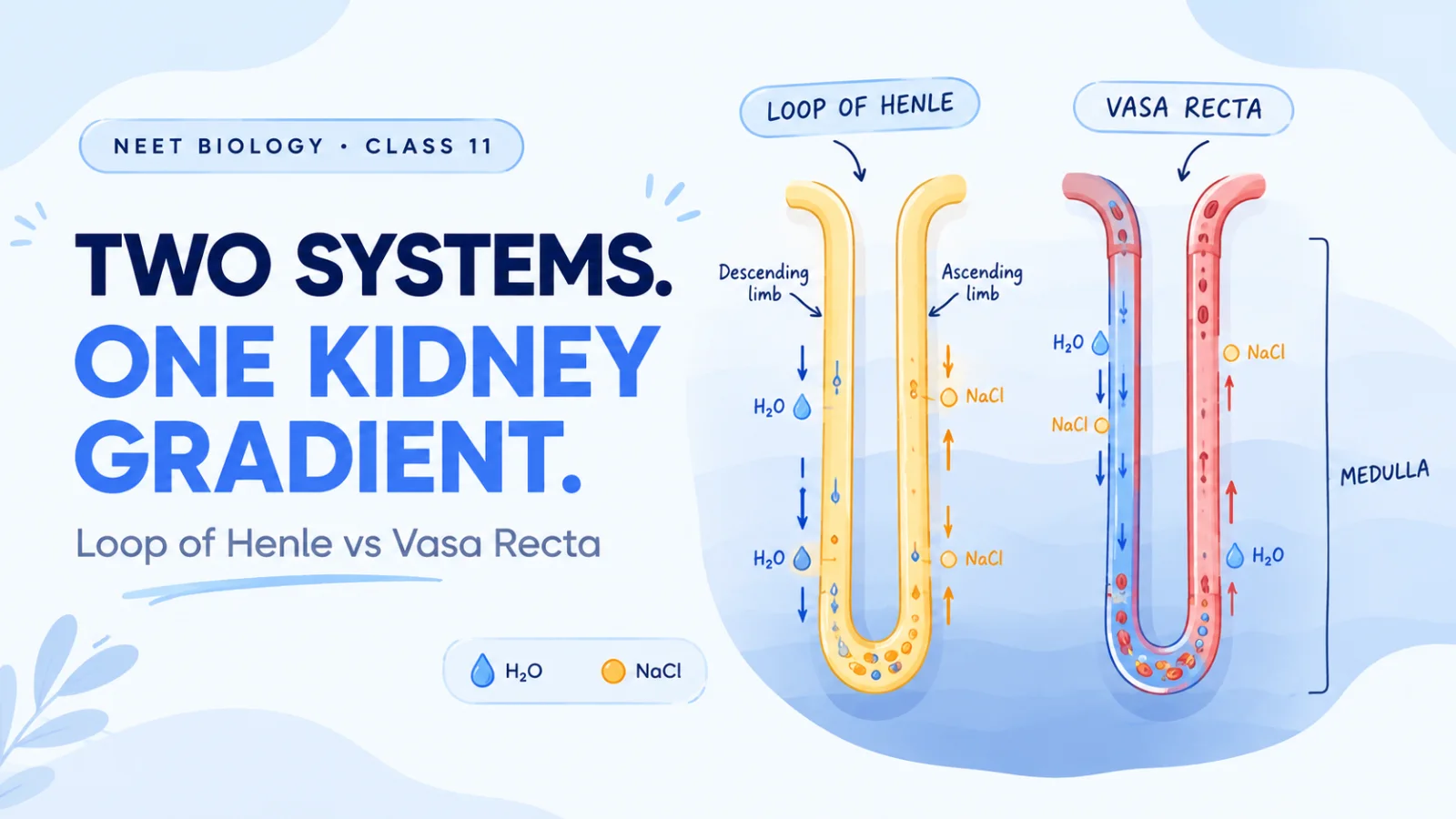
Two Counter-Current Systems, Not One
"Counter-current mechanism" in the nephron is usually taught as a single confusing block, but it's genuinely two separate systems doing two separate jobs, operating in the same region of the kidney:
- The loop of Henle — creates the concentration gradient in the medulla (this is the active, gradient-building system).
- The vasa recta — preserves that gradient instead of washing it away with blood flow (this is the passive, gradient-protecting system).
Learn these as two different mechanisms with two different jobs, and the whole topic stops being one tangled idea.
Why "Counter-Current" at All?
Counter-current simply means two fluids flowing in opposite directions, running parallel and close to each other. In the loop of Henle, filtrate flows down the descending limb and back up the ascending limb — two opposite-direction flows right next to each other. In the vasa recta, blood flows down alongside the descending limb and back up alongside the ascending limb — again, two opposite-direction flows in parallel. This opposite-direction, side-by-side arrangement is what makes gradient-building (or gradient-preservation) possible; a simple one-direction flow couldn't achieve either effect.
System 1 — The Loop of Henle Builds the Gradient
The loop has two limbs with very different, specific permeability properties — this asymmetry is the actual mechanism, and it's the single most commonly tested fact in this topic:
- Descending limb: Permeable to water, impermeable to salt (NaCl). As filtrate moves down into the increasingly salty medulla, water passively moves OUT (following the concentration gradient into the surrounding tissue), and the filtrate becomes progressively more concentrated as it descends.
- Ascending limb: Impermeable to water, but actively and passively permits salt (NaCl) to move OUT into the surrounding medullary tissue. As filtrate moves up, it loses salt but can't lose water, so it becomes progressively more dilute as it ascends.
The net effect: salt deposited into the medullary tissue by the ascending limb keeps the interstitial fluid around the loop progressively saltier as you go deeper toward the papilla — this is the medullary concentration gradient, increasing from the cortex (less salty) down to the inner medulla (most salty).
System 2 — The Vasa Recta Preserves the Gradient
Ordinary blood flow through the medulla would simply wash away the carefully built salt gradient, carrying the salt out of the tissue and back into general circulation — this is exactly what happens in experimental conditions where vasa recta blood flow is disrupted. The vasa recta prevents this through passive exchange along its own hairpin (U-shaped) counter-current path, running parallel to the loop of Henle:
- As blood descends into the medulla (descending vasa recta), it passively gains salt and loses water to the surrounding increasingly salty tissue — the blood equilibrates somewhat with its surroundings as it goes deeper.
- As blood ascends back out (ascending vasa recta), it passively loses that salt back and regains water — because now it's moving from a high-salt region toward a low-salt region, the exchange reverses.
The net result: blood leaving the medulla via the vasa recta carries away only a small net amount of salt, because what it picked up on the way in, it mostly gives back on the way out. This is why the vasa recta is described as preserving, not creating, the gradient — it's a passive recycling system, with no active transport of its own, unlike the ascending limb of Henle's loop.
How ADH Uses This Gradient (Why It All Matters)
The medullary gradient built by the loop of Henle and preserved by the vasa recta is what makes the collecting duct's water reabsorption possible. The collecting duct passes through this same increasingly salty medulla on its way to the papilla. Under ADH (vasopressin) action, the collecting duct's walls become permeable to water, and because the surrounding medullary tissue is so concentrated (thanks to the gradient), water is drawn out of the urine passively, concentrating it. Without the gradient already in place, ADH would have no concentration difference to pull water against — the entire concentrating ability of the kidney depends on this gradient existing first.
Frequently Asked Questions
What is the one thing that actually creates the medullary concentration gradient? Active transport of salt (NaCl) out of the ascending limb of the loop of Henle into the surrounding medullary interstitium. This is the only actively pumped step in the whole system — everything else (descending limb water loss, vasa recta exchange) is passive movement following the gradient this active step creates.
Why doesn't blood flowing through the vasa recta wash away the salt gradient? Because the vasa recta runs as a hairpin counter-current loop: blood picks up salt and loses water on the way down into the medulla, then loses that same salt and regains water on the way back up and out. The two legs largely cancel each other's exchange, so only a small net amount of salt is carried away — unlike a straight-through blood vessel, which would steadily wash the gradient out.
Is the descending limb of the loop of Henle permeable to salt or not? No — the descending limb is impermeable to salt (NaCl) and permeable to water only. This is the opposite of the ascending limb (impermeable to water, permits salt movement out), and mixing up which limb does which is one of the most common NEET-level errors on this topic.
How does ADH actually use the medullary gradient to concentrate urine? ADH makes the collecting duct's walls permeable to water as it passes through the salty medulla. Because the surrounding tissue is already highly concentrated (due to the gradient built by the loop of Henle), water moves passively out of the collecting duct into the tissue, concentrating the urine left behind — without that pre-existing gradient, ADH alone couldn't pull water out, since there'd be no concentration difference to drive the movement.
Do both limbs of the loop of Henle use active transport? No — only the ascending limb actively transports salt out (via ion pumps). The descending limb's water loss is entirely passive, driven by the salt gradient the ascending limb (and the surrounding vasa recta system) has already established in the medullary tissue.
Excretion is one of the NCERT chapters where a single mechanism diagram (like this one) is worth more than pages of text. Edurack's Biology mentors walk through diagram-based mechanisms like this live, so the gradient actually clicks instead of just being memorised.