Conduction of Nerve Impulse (Depolarization, Repolarization & Na⁺/K⁺ Pump)
Nerve impulse conduction is a sequence of five clearly ordered events. Memorise the order once, correctly, and every NEET question on this topic becomes a lookup, not a guess.
Edurack
October 10, 2026
Treat It as One Ordered Sequence, Not Five Separate Facts
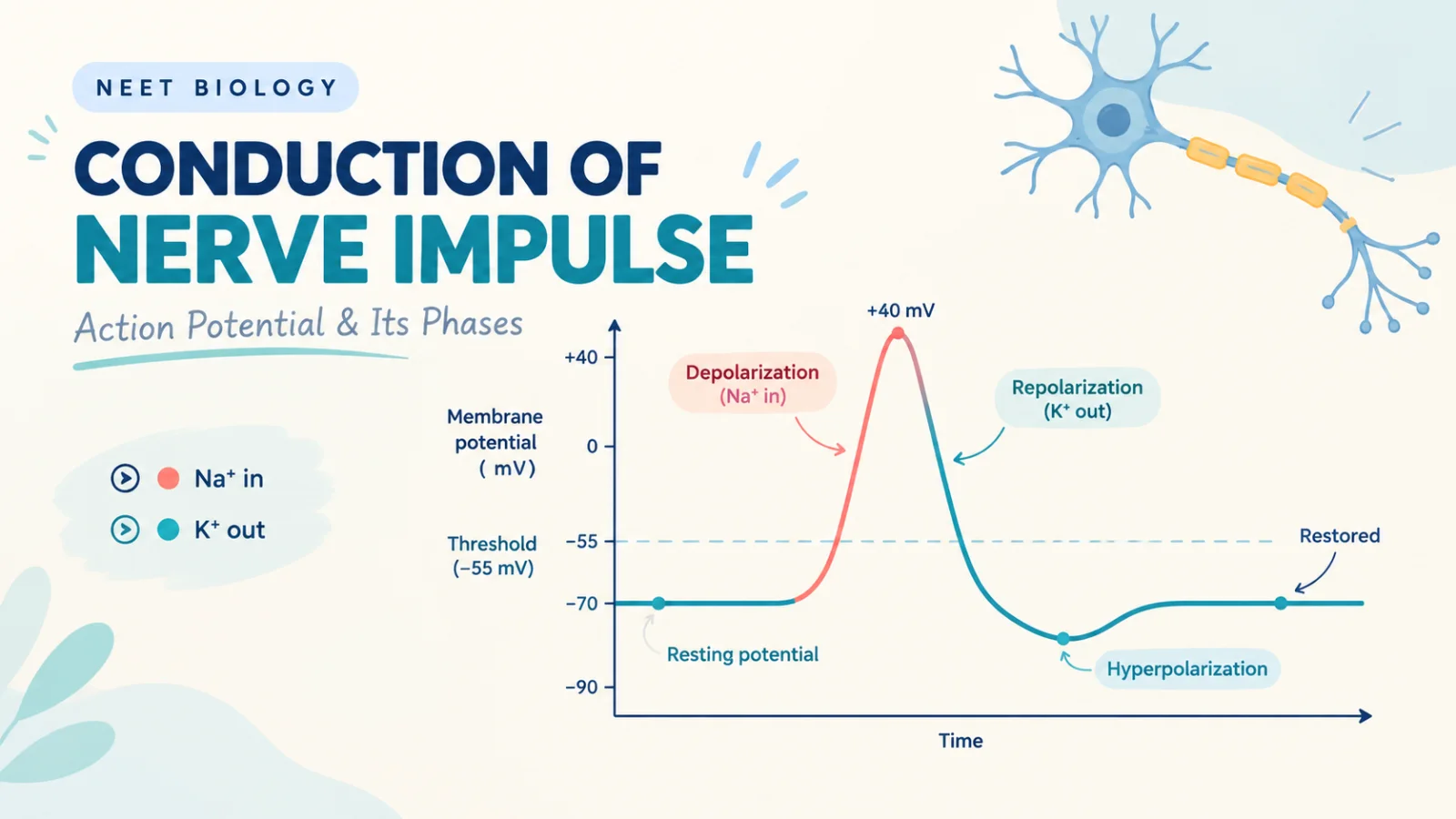
Nerve impulse conduction gets memorised badly when each phase (resting potential, depolarization, repolarization, hyperpolarization, pump restoration) is learned as an isolated fact. It's actually one continuous, strictly ordered sequence — each phase causes the next. Once you know the order and why each step triggers the next one, you stop needing to memorise it as a list and start being able to derive it.

Phase 1 — Resting Potential (The Baseline)
At rest, the neuron's inside is roughly −70 mV relative to the outside — the membrane is polarized. This resting state is actively maintained by the Na⁺/K⁺ ATPase pump, which pumps 3 Na⁺ out for every 2 K⁺ in, using ATP. This unequal exchange (3 out, 2 in) itself contributes to the negative internal charge, on top of the concentration gradients it maintains. At rest, the membrane is also more permeable to K⁺ than Na⁺ through leak channels, which further sets the resting potential near K⁺'s equilibrium point rather than exactly at zero.
Phase 2 — Depolarization (The Stimulus Arrives)
When a stimulus reaches threshold (around −55 mV, not the full resting potential), voltage-gated Na⁺ channels open rapidly. Na⁺ rushes INTO the cell, down its concentration gradient (it was kept high outside by the pump). This sudden inward positive charge flips the membrane potential from negative to positive — reaching roughly +40 mV at the peak. This reversal, from negative inside to positive inside, is what "depolarization" literally means — the polarity is being lost, then reversed.
Phase 3 — Repolarization (The Return Toward Negative)
At the peak, two things happen almost simultaneously: voltage-gated Na⁺ channels close (inactivate), stopping further Na⁺ entry, and voltage-gated K⁺ channels open, allowing K⁺ to rush OUT of the cell down its concentration gradient. This outward flow of positive charge brings the membrane potential back down toward negative — this falling phase is repolarization.
Phase 4 — Hyperpolarization (Briefly Overshooting)
The voltage-gated K⁺ channels are relatively slow to close, so K⁺ continues leaving slightly longer than needed to reach exactly −70 mV — the membrane potential briefly dips below resting potential (more negative than −70 mV) before settling back. This brief overshoot is hyperpolarization (sometimes called the after-hyperpolarization or undershoot).
Phase 5 — Restoration by the Na⁺/K⁺ Pump
The voltage-gated channel activity (phases 2–4) only redistributes ions across the membrane locally in a way that changes voltage — it doesn't, on its own, restore the original concentration gradients (Na⁺ is now higher inside than before, K⁺ slightly lower). The Na⁺/K⁺ ATPase pump runs continuously to actively restore these concentration gradients (pumping the entered Na⁺ back out, bringing K⁺ back in), re-establishing the conditions needed for the resting potential to be fully maintained and the neuron ready to fire again.
The Five Phases, Summarised as One Table
| Phase | Membrane potential | What's happening | Which channels/pumps are active |
|---|---|---|---|
| Resting | ~ −70 mV | Polarized baseline maintained | Na⁺/K⁺ pump (3 out, 2 in); K⁺ leak channels |
| Depolarization | −55 mV → +40 mV | Na⁺ rushes in | Voltage-gated Na⁺ channels open |
| Repolarization | +40 mV → falling | K⁺ rushes out | Na⁺ channels close; voltage-gated K⁺ channels open |
| Hyperpolarization | briefly below −70 mV | Slight K⁺ overshoot | K⁺ channels still closing |
| Restoration | back to −70 mV | Ion gradients rebuilt | Na⁺/K⁺ pump active again |
Saltatory Conduction — Why Myelinated Axons Are Faster
In myelinated neurons, the myelin sheath insulates the axon except at the nodes of Ranvier, where voltage-gated channels are concentrated. The action potential appears to "jump" from node to node (saltatory conduction) rather than regenerating continuously along every point of the membrane, which is what happens in unmyelinated axons. This jumping is why myelinated axons conduct impulses significantly faster than unmyelinated ones of the same diameter — fewer points along the axon need to undergo the full channel-opening sequence described above.
Frequently Asked Questions
What's the difference between threshold potential and peak potential in an action potential? Threshold (around −55 mV) is the specific voltage a stimulus must reach to trigger voltage-gated Na⁺ channels to open, starting depolarization. Peak potential (around +40 mV) is the maximum voltage reached once that depolarization is fully underway. They're two different points on the same curve, often confused because both are described using "mV" values close in the sequence.
Does the Na⁺/K⁺ pump cause depolarization and repolarization directly? No — depolarization and repolarization are caused by voltage-gated Na⁺ and K⁺ channels opening and closing, which allow ions to move passively down existing concentration gradients. The Na⁺/K⁺ pump's role is to actively (using ATP) restore those concentration gradients afterward, so the neuron is ready to fire again — it does not directly drive the fast voltage changes seen in a single action potential.
Why does hyperpolarization happen if the goal is to return to resting potential? Voltage-gated K⁺ channels close somewhat slowly compared to how quickly they opened, so K⁺ keeps leaving the cell slightly longer than needed to land exactly back at −70 mV, causing a brief dip below resting potential before the membrane settles. It's a side effect of channel closing kinetics, not a separate deliberate mechanism.
Why do myelinated neurons conduct impulses faster than unmyelinated ones? Myelin insulates most of the axon, forcing voltage-gated channel activity to occur only at the nodes of Ranvier. The impulse effectively jumps from node to node (saltatory conduction) instead of regenerating at every point along the membrane, which is a much faster process than continuous conduction along an unmyelinated axon.
What exact ratio does the Na⁺/K⁺ pump move ions in, and why does it matter for the resting potential? The pump moves 3 Na⁺ ions out of the cell for every 2 K⁺ ions it moves in, using one ATP per cycle. Because more positive charge leaves than enters in each cycle, the pump itself contributes directly to making the inside of the cell more negative, in addition to maintaining the concentration gradients that the voltage-gated channels later rely on.
Diagram-based mechanisms like this one are far easier to retain when you can trace the graph yourself under timed conditions. Edurack's Neural Control and Coordination practice sets include labelled-diagram and graph-based MCQs exactly in this format.