Chemiosmotic Hypothesis: ATP Synthesis in Photosynthesis & Respiration
The same chemiosmotic logic powers ATP synthesis in both the mitochondria and the chloroplast. Separate the two locations clearly and the "hypothesis" stops being confusing.
Edurack
October 10, 2026
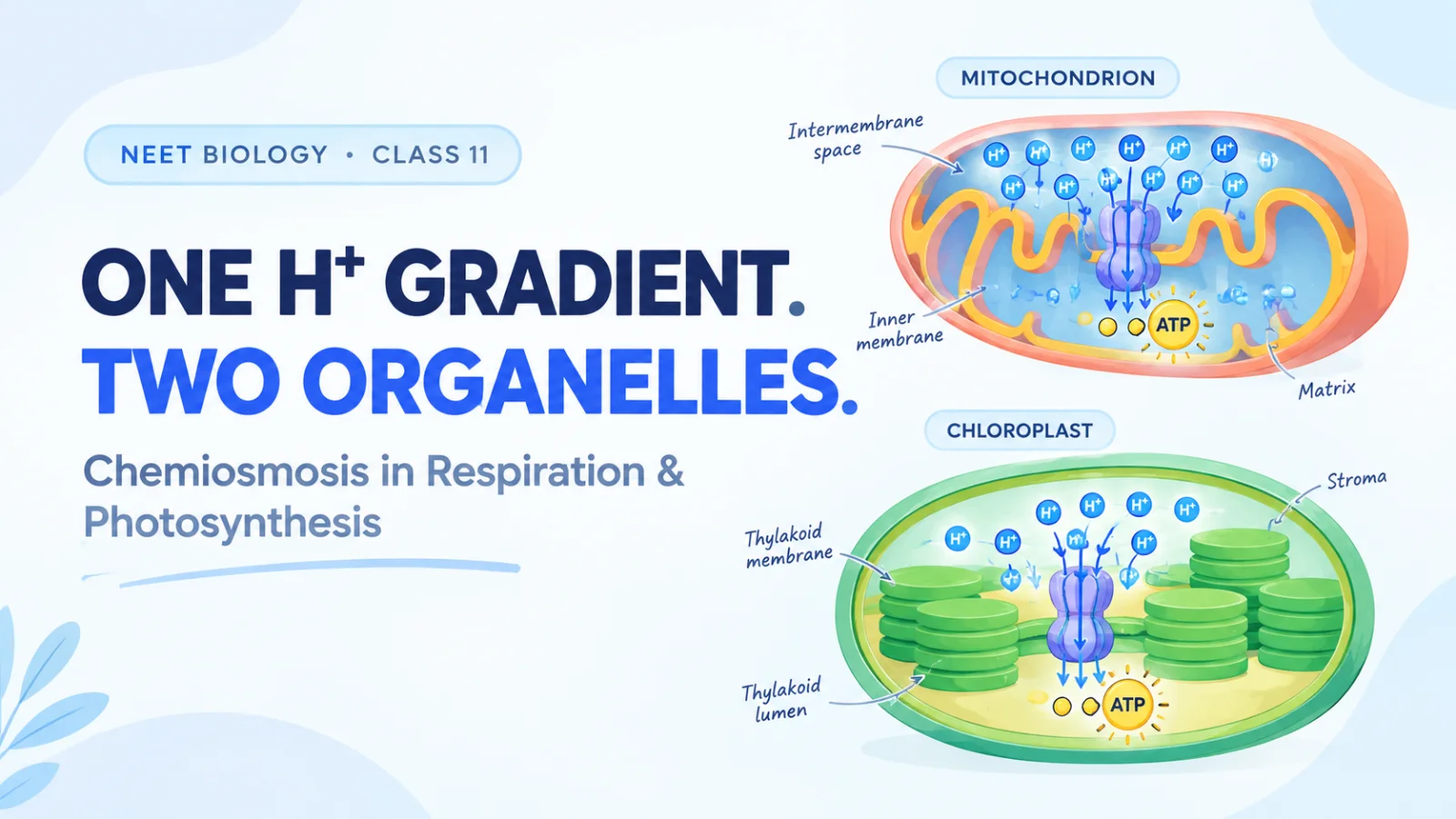
One Hypothesis, Applied in Two Different Organelles
Students usually meet the chemiosmotic hypothesis twice in the syllabus — once for cellular respiration (mitochondria) and once for photosynthesis (chloroplast) — and because the two lessons are taught weeks apart, the underlying mechanism never gets recognised as the same idea applied twice. Once you see them side by side, both become far easier to hold in memory.
The Three-Step Logic (Applies in Both Organelles)
- Electron transport pumps protons across a membrane, creating a high H⁺ concentration on one side and a low concentration on the other — this is the proton gradient, also called the electrochemical gradient or proton motive force.
- Protons can only cross back through a specific channel: ATP synthase (also called F₀–F₁ particle / CF₀–CF₁ in chloroplasts). The membrane itself is impermeable to H⁺ otherwise.
- As protons flow through ATP synthase down their concentration gradient, the enzyme's rotation drives the synthesis of ATP from ADP + Pi. This coupling of proton flow to ATP synthesis is the "chemiosmotic" part of the name — chemical (ATP synthesis) coupled to osmotic (ion gradient) movement.
Location 1 — Mitochondria (Cellular Respiration)
- Where the gradient forms: Across the inner mitochondrial membrane, with protons pumped from the matrix into the intermembrane space.
- What pumps the protons: Complexes I, III, and IV of the electron transport chain, as electrons pass from NADH/FADH₂ down to the final acceptor, oxygen.
- Final electron acceptor: Oxygen, reduced to water —
- Where ATP synthase sits: Also on the inner mitochondrial membrane, with its head (F₁) projecting into the matrix.
- Direction of proton flow through ATP synthase: Intermembrane space → matrix (high to low concentration — protons flow back toward where they started).
Location 2 — Chloroplast (Photosynthesis, Light Reactions)
- Where the gradient forms: Across the thylakoid membrane, with protons accumulating inside the thylakoid lumen.
- What pumps the protons: The electron transport chain between Photosystem II and Photosystem I (notably at the cytochrome complex), plus the splitting of water itself inside the lumen, which directly releases H⁺ into the thylakoid space —
- Where ATP synthase sits: On the thylakoid membrane, with its head (CF₁) projecting outward into the stroma.
- Direction of proton flow through ATP synthase: Thylakoid lumen → stroma (high to low concentration — same logic, opposite physical orientation compared to mitochondria).
Side-by-Side Comparison Table
| Feature | Mitochondria (Respiration) | Chloroplast (Photosynthesis) |
|---|---|---|
| Membrane used | Inner mitochondrial membrane | Thylakoid membrane |
| High H⁺ side | Intermembrane space | Thylakoid lumen |
| Low H⁺ side (ATP synthase side) | Matrix | Stroma |
| Electron source | NADH, FADH₂ (from Krebs cycle etc.) | Water (via PS II) and excited electrons from PS I/PS II |
| Final electron acceptor | Oxygen → water | NADP⁺ → NADPH |
| Proton pumping source(s) | Electron transport chain only | Electron transport chain + water splitting |
| ATP synthase orientation | Head (F₁) faces matrix | Head (CF₁) faces stroma |
| Net ATP-synthesizing flow direction | Intermembrane space → matrix | Lumen → stroma |
Why ATP Synthase Needs the Gradient, Not Just "Energy"
A common wrong answer treats ATP synthase as if it simply uses "chemical energy from electrons" directly. It doesn't — it's a mechanical, rotational enzyme driven purely by the concentration difference forcing protons through it. If you artificially equalised H⁺ concentration on both sides of the membrane (which is exactly what certain uncoupling agents do), ATP synthesis would stop even though electron transport could continue — proof that the gradient itself, not the electrons directly, is what ATP synthase depends on.
Frequently Asked Questions
Is the chemiosmotic hypothesis the same mechanism in both mitochondria and chloroplasts, or are they different? The underlying logic is identical — a proton gradient built by electron transport, discharged through ATP synthase to produce ATP. What differs is the membrane involved, the direction of proton flow relative to the organelle's compartments, and what ultimately builds the gradient (electron transport only, versus electron transport plus water-splitting in chloroplasts).
Where exactly does water get split during photosynthesis, and why does it matter for the proton gradient? Water splitting (photolysis) happens on the lumen side of the thylakoid membrane, associated with Photosystem II. It matters because the protons released go directly into the thylakoid lumen, adding to the gradient independently of the electron transport chain's own proton pumping — a detail that's easy to miss if you only think of the ETC as the gradient's source.
Which direction does ATP synthase let protons flow in — toward higher or lower concentration? Always toward lower concentration — that's what makes ATP synthesis "downhill" and therefore spontaneous. In mitochondria this is intermembrane space to matrix; in chloroplasts, thylakoid lumen to stroma. The enzyme cannot pump protons uphill; it only harvests energy from their natural downhill flow.
What's the difference between how cyanide and an uncoupling agent each stop ATP synthesis? Cyanide blocks the electron transport chain directly (at Complex IV), which prevents the proton gradient from forming in the first place — no gradient, no ATP synthesis, even though ATP synthase itself is undamaged. An uncoupling agent instead makes the membrane leak protons across it directly, destroying the gradient even while electron transport keeps running — a different point of failure with the same final result.
Does chemiosmosis explain ATP production in glycolysis too? No — glycolysis produces ATP through substrate-level phosphorylation (direct enzyme-catalysed phosphate transfer), not through a membrane-based proton gradient. Chemiosmosis specifically explains the ATP generated during oxidative phosphorylation (mitochondria) and photophosphorylation (chloroplast light reactions).
Need worked NEET numericals that test chemiosmosis alongside electron transport and photophosphorylation in the same question? Edurack's Biology practice sets group these commonly-confused mechanisms together on purpose, so mix-ups surface in practice, not on exam day.